On Pentecost 1944 C. S. Lewis delivered a message he titled "Transposition." He provides an apologetic against claims that the heavenlies are merely a human conception, since they are described by purely natural things. "If we have really been visited by a revelation from beyond Nature, is it not very strange that an Apocalypse can furnish heaven with nothing more than seelctions from terrestrial experience (crowns, thrones, and music), that devotion can find no language but that of human lovers, and that the rite whereby Christians enact a mystical union should turn out to be only the old, familiar act of eating and drinking?" (The Weight of Glory: And Other Addresses [San Francisco: Harper, 1980], 94).
In his defense of the use of natural imagery in the Scriptures, he first details how our varied emotions (the "higher medium") may be "transposed" into physical sensations of, say, tears or trembling (the "lower medium"). The tears are not the joy or grief itself; to be absolutely identified by weeping itself is to say grief and joy are one and the same. At the same time, however, these emotions are never experienced or tangible to us apart from the sensations into which they're "transposed." In like fashion, pictures aren't merely symbolic of the material world as transposed onto paper or paint. They are not simply signs or symbols that only correlate only by convention, as spoken and written words do.
Pictures are part of the visible world themselves and represent it only be being part of it. Their visibility has the same source. The suns and lamps in pictures seem to shine only because real suns or lamps shine on them; that is, they seem to shine a great deal because they really shine a little in reflecting their archetypes. . . . It is a sign, but also something more than a sign, and only a sign because it is also more than a sign, because in it the thing signified [in this example, light] is really in a certain mode present. If I had to name the relation I should call it not symbolical but sacramental. (p. 102)
I know this is getting long, but bear with me. His coup-de-grace is pure genius, lifting us into wonder at the possibilities of stark, joy-bringing realities of heaven--realities which for now are only known to us by crowns, thrones, music, and the like.
Let us construct a fable. Let us picture a woman thrown into a dungeon. There she bears and rears a son. He grows up seeing nothing but the dungeon walls, the straw on the floor, and a little patch of the sky seen through the grating, which is too high up to show anything except sky. This unfortunate woman was an artist, and when they imprisoned her she managed to bring with her a drawing pad and a box of pencils. As she never loses the hope of deliverance, she is constantly teaching her son about that outer world which he has never seen. She does it largely by drawing him pictures. With her pencil she attempts to show him what fields, rivers, mountains, cities, and waves on a beach are like. He is a dutiful boy and he does his best to believe her when she tells him that that outer world is far more interesting and glorious than anything in the dungeon. At times he succeeds. On the whole he gets on tolerably well until, one day, he says something that gives his mother pause. For a minute or two they are at cross-purposes. Finally it dawns on her that he has, all these years, lived under a misconception. "But," she gasps, "you didn't think that the real world was full of lines drawn in lead pencil?" "What?" says the boy. "No pencil marks there?" And instantly his whole notion of the outer world becomes a blank. For the lines, by which alone he was imagining it, have now been denied of it. He has no idea of that which will exclude and dispense with the lines, that of which the lines were merely a transposition--the waving treetops, the light dancing on the weir, the coloured three-dimensional realities which are not enclosed in lines but define their own shapes at every moment with a delicacy and multiplicity which no drawing could ever achieve. The child will get the idea that the real world is somehow less visible than his mother's pictures. In reality it lacks lines because it is incomparably more visible.
So with us. "We know not what we shall be" [1 John 3:2]; but we may be sure we shall be more, not less, than we were on earth. Our natural experiences (sensory, emotional, imaginative) are only like the drawing, like pencilled lines on flat paper. If they vanish in the risen life, they will vanish only as pencil lines vanish from the real landscape, not as candle flame that is put out but as a candle flame which becomes invisible because someone has pulled up the blind, thrown open the shutters, and let in the blaze of the risen sun.
You can put it whichever way you please. You can say that by Transposition our humanity, senses and all, can be made the vehicle of beatitude. Or you can say that the heavenly bounties by Transposition are embodied during this life in our temporal experience. But the second way is the better. It is the present life which is the diminution, the symbol, the etiolated, the (as it were) "vegetarian" substitute. If flesh and blood cannot inherit the Kingdom [1 Corinthians 15:50], that is not because they are too solid, too gross, too distinct, too "illustrious with being." They are too flimsy, too transitory, too phantasmal. (pp. 109-11)
Wednesday, August 30, 2006


Tuesday, August 29, 2006
For eyes to see
Do you think, perhaps, that heaven really is here right now? I mean, we seem to think of heaven as some sort of upper sphere of the cosmos, separated from the terra firma like layers on a cake. This is not without warrant; Revelation 21:3 says that "I saw the holy city, new Jerusalem, coming down out of heaven from God." But doesn't it seem rather Manichean or Gnostic of us to think that the spiritual perfection where God dwells is completely distinct from the material earth?* And could it be that when the Bible speaks of the skies as the heavens, perhaps it's not merely symbolic?
We know that "now we see in a mirror dimly, but then face to face. Now I know in part; then I shall know fully, even as I have been fully known" (1 Cor. 13:12). Saint Paul prays that the Father of glory "may give you a spirit of wisdom and of revelation in the knowledge of him, having the eyes of your heart enlightened" (Eph. 1:17 -8). That is to say, there's a whole lot we cannot yet see or sense.
Our eyes can only pick up a narrow range of the total spectrum of electromagnetic radiation. Far from being able to see infrared, ultraviolet, microwaves, X rays, and the like, we base our realities on what we can see with the paltry assortment of rods and cones in our eyes. When the eyes of our hearts are regnerated, when our sin-plagued, mortal bodies are swallowed up by life (Rom. 8:18-25; 2 Cor. 5:1-5), we'll see so much more--all the deep, shimmering realities that yet lie hidden to our senses.
We also can't see gases, but that doesn't mean they don't exist. And when we can "see" them, it's only when the sky acts as a prism to refract certain wavelengths of the sun's light to us. How the skies appear depends on the angle and intensity of the sunlight reaching it. Illuminated by the very luminescence of God himself (Isa. 60:19-20; Rev. 22:5), will we see that the gases that fill the "heavens" are those same ones that we inhale every moment of our lives and that God turned out to be with us all along?
Now I don't mean to get all sappy or to throw out the Bible. But I sometimes wonder, what more is there? (Seriously, I need to get around to posting some quotes from C. S. Lewis' essay "Transposition".)
______________________________
*The philosophies of Manichaeism and Gnosticism arose out of the erroneous belief that matter was inherently corrupt and evil, as opposed to the good and pure immaterial spirit.
We know that "now we see in a mirror dimly, but then face to face. Now I know in part; then I shall know fully, even as I have been fully known" (1 Cor. 13:12). Saint Paul prays that the Father of glory "may give you a spirit of wisdom and of revelation in the knowledge of him, having the eyes of your heart enlightened" (Eph. 1:17 -8). That is to say, there's a whole lot we cannot yet see or sense.
Our eyes can only pick up a narrow range of the total spectrum of electromagnetic radiation. Far from being able to see infrared, ultraviolet, microwaves, X rays, and the like, we base our realities on what we can see with the paltry assortment of rods and cones in our eyes. When the eyes of our hearts are regnerated, when our sin-plagued, mortal bodies are swallowed up by life (Rom. 8:18-25; 2 Cor. 5:1-5), we'll see so much more--all the deep, shimmering realities that yet lie hidden to our senses.
We also can't see gases, but that doesn't mean they don't exist. And when we can "see" them, it's only when the sky acts as a prism to refract certain wavelengths of the sun's light to us. How the skies appear depends on the angle and intensity of the sunlight reaching it. Illuminated by the very luminescence of God himself (Isa. 60:19-20; Rev. 22:5), will we see that the gases that fill the "heavens" are those same ones that we inhale every moment of our lives and that God turned out to be with us all along?
Now I don't mean to get all sappy or to throw out the Bible. But I sometimes wonder, what more is there? (Seriously, I need to get around to posting some quotes from C. S. Lewis' essay "Transposition".)
______________________________
*The philosophies of Manichaeism and Gnosticism arose out of the erroneous belief that matter was inherently corrupt and evil, as opposed to the good and pure immaterial spirit.
Saturday, August 26, 2006
More thoughts on the Sacraments
"Now to him who is able to establish you by my gospel and the proclamation of Jesus Christ, according to the revelation of the mystery hidden for long ages past, but now revealed and made known through the prophetic writings by the command of the eternal God, so that all nations might believe and obey him--to the only wise God be glory forever through Jesus Christ. Amen." (Romans 16:25-7)
When I read through this passage at the tail end of Romans this morning, I recognized that this passage is speaking of the gospel proclaimed and "made known through the prophetic writings." But then I thought of another proclamation: the Lord's Supper. In 1 Corinthians 11:26 Paul says that "whenever you eat this bread and drink this cup, you proclaim the Lord's death until he comes." If you connect the dots, the Supper is also a proclamation of the gospel that would serve to effectively "strengthen and preserve [us] in the one true faith unto life everlasting," using the words of the Lutheran liturgy. After all, it is a sign of the atoning death of Christ, a "visible gospel" tangible to our senses in the bread and wine. It says, "As truly as this bread and wine are real and give you life by being in you, so too do you have within you life by union to the crucified and risen Lord."
But it's not just the Lord's death that is proclaimed; it's also his resurrection and the consummation of the kingdom and our redemption. Note that little phrase "until he comes." Jesus talks of the meal as something to be shared again upon its fulfillment in the kingdom of God (Luke 22:14-18). Whenever we share this meal, we are (or ought to be) aware and expectant of the resurrection that followed Jesus' tomb and, by virtue of our union to him and participation in him through this meal, our own resurrection as well. Maybe this is why Catholics sing the mysterion before the Eucharist: "Christ has died, Christ is risen, Christ will come again"--an eager expectation of the coming wedding feast of the Lamb.
Finally--and here's where stuff gets way weird and theologically deep--we baptize children as a sign and seal of "our ingrafting into Christ, and partaking of the benefits of the covenant of grace" (Westminster Shorter Catechism, question 94), right? Baptism incorporates us into the body of Christ, the church. And because Christ died for all people and gives us new birth by grace, not by physical, intellectual, or spiritual maturity, we baptize children. "And truly, Christ has shed his blood no less for washing little children of believers than he did for adults" (Belgic Confession, article 34). "Infants as well as adults are in God's covenant and are his people. They, no less than adults, are promised the forgiveness of sin through Christ's blood and the Holy Spirit who produces faith" (Heidelberg Catechism, Lord's Day 27).
So here's my question: ought we also allow children to share in the Supper? After all, if baptism seals or guarantees what it represents: "partaking of the benefits of the covenant of grace," and such benefits include the gospel-confirming, faith-strengthening Supper, ought we not deny children this very benefit? Yes, Scripture says we are to "recognize" or "discern" the body of the Lord in the Supper (1 Cor. 11:29). But I'm not sure this has as much to do with consubstantiation as with the visible fellowship of the church in the Supper: "Because there is one loaf, we, who are many, are one body, for we all partake of one loaf" (1 Cor. 10:17). Would a little girl who loves Jesus and knows that Jesus loves her see everyone else communing at the Table and wonder, Why am I not allowed to take part? Didn't her baptism make her part of the body, the one loaf of which others partake?
When I read through this passage at the tail end of Romans this morning, I recognized that this passage is speaking of the gospel proclaimed and "made known through the prophetic writings." But then I thought of another proclamation: the Lord's Supper. In 1 Corinthians 11:26 Paul says that "whenever you eat this bread and drink this cup, you proclaim the Lord's death until he comes." If you connect the dots, the Supper is also a proclamation of the gospel that would serve to effectively "strengthen and preserve [us] in the one true faith unto life everlasting," using the words of the Lutheran liturgy. After all, it is a sign of the atoning death of Christ, a "visible gospel" tangible to our senses in the bread and wine. It says, "As truly as this bread and wine are real and give you life by being in you, so too do you have within you life by union to the crucified and risen Lord."
But it's not just the Lord's death that is proclaimed; it's also his resurrection and the consummation of the kingdom and our redemption. Note that little phrase "until he comes." Jesus talks of the meal as something to be shared again upon its fulfillment in the kingdom of God (Luke 22:14-18). Whenever we share this meal, we are (or ought to be) aware and expectant of the resurrection that followed Jesus' tomb and, by virtue of our union to him and participation in him through this meal, our own resurrection as well. Maybe this is why Catholics sing the mysterion before the Eucharist: "Christ has died, Christ is risen, Christ will come again"--an eager expectation of the coming wedding feast of the Lamb.
Finally--and here's where stuff gets way weird and theologically deep--we baptize children as a sign and seal of "our ingrafting into Christ, and partaking of the benefits of the covenant of grace" (Westminster Shorter Catechism, question 94), right? Baptism incorporates us into the body of Christ, the church. And because Christ died for all people and gives us new birth by grace, not by physical, intellectual, or spiritual maturity, we baptize children. "And truly, Christ has shed his blood no less for washing little children of believers than he did for adults" (Belgic Confession, article 34). "Infants as well as adults are in God's covenant and are his people. They, no less than adults, are promised the forgiveness of sin through Christ's blood and the Holy Spirit who produces faith" (Heidelberg Catechism, Lord's Day 27).
So here's my question: ought we also allow children to share in the Supper? After all, if baptism seals or guarantees what it represents: "partaking of the benefits of the covenant of grace," and such benefits include the gospel-confirming, faith-strengthening Supper, ought we not deny children this very benefit? Yes, Scripture says we are to "recognize" or "discern" the body of the Lord in the Supper (1 Cor. 11:29). But I'm not sure this has as much to do with consubstantiation as with the visible fellowship of the church in the Supper: "Because there is one loaf, we, who are many, are one body, for we all partake of one loaf" (1 Cor. 10:17). Would a little girl who loves Jesus and knows that Jesus loves her see everyone else communing at the Table and wonder, Why am I not allowed to take part? Didn't her baptism make her part of the body, the one loaf of which others partake?
Thursday, August 24, 2006
Why Evangelicals Can't Write
In an entry on the Reformed Credenda/Agenda online magazine (http://credenda.org) titled “Why Evangelicals Can’t Write,” [1] writer Peter Leithart laments the lack of literary genius from Western Protestants. The reason he cites: the disappearance of real sacramental theology from Protestantism. He brings up the 1529 Colloquy of Marburg, where Lutherans and Zwinglians (from whom the Reformed and Anabaptist understandings of Baptism and the Supper stemmed) split over—of all things—the “real presence” of Christ in the Communion elements.
For many post-Marburg Protestants, literal truth is over here, while symbols drift off in another direction. At best, they live in adjoining rooms; at worst, in widely separated neighborhoods, and they definitely inhabit different academic departments.
Here is a thesis, which I offer in a gleeful fit of reductionism: Modern Protestants can't write because we have no sacramental theology. Protestants will learn to write when we have reckoned with the tragic results of
In contrast to this Christian affirmation of the cosmos, [Roman Catholic author Flannery] O'Connor saw Manichean impulses behind the modern denigration of material reality, and believed this made fiction writing almost impossible: "The Manicheans separated spirit and matter. To them all material things were evil. They sought pure spirit and tried to approach the infinite directly without any mediation of matter. This is also pretty much the modern spirit, and for the sensibility infected with it, fiction is hard if not impossible to write because fiction is so much an incarnational art." …
Symbols separated from reality and reduced, as they are in much Protestant theology, to "mere signs," cannot do anything, whether in reality or in fiction. They exist as sheer ornament, or, at best, as pointers to some something in some real realm of reality that can do something. But if this is so, then the moment of grace, whether in fiction or reality, never enters this world, into the realm of what-is. Without a sacramental theology, and specifically a theology of sacramental action, Protestant writers cannot do justice to this world or show that this world is the theater of God's redeeming action. …
The renewal of literature, like the renewal of the world, begins in worship. The renewal of literature, like the renewal of the world, begins from the pulpit, to be sure. But the pulpit will renew literature only when it is nestled where it should be nestled, between the font and the table.
Raised in an ecumenical Catholic and Lutheran family and now drifting to and from Reformed understandings, I’ve been met with myriad understandings of the Sacraments (and I mean the only two instituted by our Lord, Baptism and the Supper): known respectively as transubstantiation, consubstantiation, and, for lack of a better word, signification. And to think: as the Western (Catholic) Church separated from the Eastern (Orthodox) over the matter of from whom in the Godhead the Holy Spirit proceeds (i.e., whether he proceeds from both the Father and Son, or from only the Father through the Son), so did the Lutherans and Zwinglians part ways over exactly how it is we receive grace and fellowship with the risen Christ in a cake of bread and a cup of wine.
But
I think this is affirmed on a number of levels: (1) The third person of the Trinity is denoted by the Hebrew word ruach and the Greek pneuma. "Both terms mean, specificially, moved and moving air; they mean breath or wind, probably also storm" [3].
(2) God chooses first not to reveal himself in the Old Testament as some sort of esoteric body of knowledge or a Divine Consciousness or something like that, but he comes as a pillar of fire, a cloud of water vapor. His shekinah glory actually shines like the sun; it’s no mere illustration. The psalmist speaks of God’s voice as thunder (Psalms 18, 29). It’s not that God only used these things as inspired imagery; God actually came to people in these ways, as he met godly men in a burning bush or in a storm atop Sinai or in a gentle blowing (or as in the KJV's beautiful rendering, a "still small voice").
(3) God is revealed fully and satisfactorily in becoming the enfleshed Word dwelling among us (John 1:1-3, 14, 18), living a fully human life in a body that breathed, slept, and bled. Jesus said, “If you really knew me, you would know my Father as well. From now on, you do know him and have seen him.” Perplexed, his disciple Philip asks him to show them the Father. What was Jesus' reply? “Don’t you know me, Philip, even after I have been among you a long time? Anyone who has seen me has seen the Father” (John 14:7-9).
(4) That we are all held accountable to God’s self-revelation is true, but through what medium? Spirit? Knowledge? Nay—matter. “What may be known about God is plain to them, because God has made it plain to them. For since the creation of the world God’s invisible qualities—his eternal power and divine nature—have been clearly seen, being understood from what has been made, so that men are without excuse” (Romans 1:19-20, emphasis mine).
(5) God’s main chosen vehicle of revelation is not in some sort of euphoric vision, but in plain ol’ words on a page: scripture. As Scripture is read aloud in human words, God even takes on a human voice. (As an aside, this is part of why I believe biblical “tongues” are intelligible but foreign languages that can be interpreted for others’ benefit, as at Pentecost, not some sort of Spiritual gibberish a la Billy Madison.)
(6) Even the “higher emotions” of life—and surely those of life with God—be they joy, love, grief, relief, etc., are never ours apart from some sort of physical, bodily component. Neurotransmitters like adrenalin and dopamine are released; electric impulses trigger our sympathetic or parasympathetic nervous systems; our blood pressure climbs or ebbs. We perspire or go dizzy. [4]
I don’t know yet where I precisely stand concerning the sacraments (though I’ve been tiptoeing from Calvinistic Reformed [as opposed to Zwinglian] toward the Lutheran understanding), but it’s undeniable that God can be known apart from mediation through matter. To ask God that we come to him apart from his written and spoken Word, apart from human contact, apart from sunrise and vale, font and table, is to seek God not in truth nor on his own terms, but it is to seek the spirit of the world, avoiding the humble, avoiding the cross. Such will be only an exercise in futility; he does not promise to meet us otherwise. Now if only God would reveal himself through baseball!
[1] http://credenda.org/issues/18-2liturgia.php; accessed 23 August 2006.
[2] Ref. Eugene H. Peterson, Christ Plays in Ten Thousand Places (
[3] Karl Barth, Evangelical Theology: An Introduction (Grand Rapids, Mich.: Eerdmans, 1963), 53.
[4] See C. S. Lewis’s amazing essay Transposition. (Then again, aren’t all his essays amazing?) Relevant excerpts shall likely be forthcoming on this blog.
Wednesday, August 23, 2006
A cruciform city plan
In Monty Python and the Holy Grail, Sir Gallahad the Chaste stumbles upon Castle Anthrax and sees above it a vision of the holy grail, the cup of Our Lord's last supper. Upon entering its gates, one of the nuns living there sorrowfully exclaims, "Oh, bad, bad Zoot! She must've set alight to our grail-shaped beacon again." As funny as the movie is, it's not far from the truth that the light of the church, the "city upon a hill", must illumine the Cup of Christ: the new and eternal covenant in his blood.
"No one has ever seen God, but God the One and Only, who is at the Father's side, has made him known." (John 1:18)
"To be sure, he [Christ] was crucified in weakness, yet he lives by God's power. Likewise, we are weak in him, yet by God's power we will live with him to serve you." (2 Cor. 13:4)
I've begun studying "Second" Corinthians (actually Paul's fourth letter to Corinth) out of the desire that God will graciously guide my roommates and I this year into true knowledge of him and that we'd serve him rightly in making known the message of reconciliation. Two related quotes have recently stood out to me, embracing how truly we must embrace a "cruciform" existence if we are to actually communicate the gospel in truth, not as false peddlers.
The first is from British Anglican pastor-scholar N. T. Wright's book The Challenge of Jesus (London: SPCK, 2000), as found on my buddy Ryan's Web site.
"When we speak about 'following Christ,' it is the crucified Messiah we are talking about. His death was simply not the messy bit that enables our sins to be forgiven but that can then be forgotten. The cross is the surest, truest and deepest window on the very heart and character of the living and loving God; the more we learn about the cross in all its historical and theological dimensions, the more we discover about the One in whose image we are made and hence about our own vocation to be the cross-bearing people, the people in whose lives and service the living God is made known.
"And when therefore we speak of shaping our world, we do not--we dare not--simply treat the cross as the thing that saves us 'personally,' but which can be left behind when we get on with the job. The task of shaping our world is best understood as the redemptive task of bringing the achievement of the cross to bear upon the world, and in that task the methods, as well as the message, must be cross-shaped through and through" (pp. 94-5).
Over sixty years earlier, German Lutheran pastor Dietrich Bonhoeffer saw equally strongly the need for the body of Christ on Earth to display not glory alone in letting our light shine before men, but the glory of the cross and "the light of the Resurrection":
"Men are not to see the disciples but their good works, says Jesus. And these works are nothing other than those which the Lord Jesus himself has created in them by calling them to be the light of the world under the shadow of his cross. The good works are poverty, peregrination, meekness, peaceableness, and finally persecution and rejection. All these good works are a bearing of the cross of Jesus Christ. The cross is the strange light which alone illuminates these good works of the disciples. . . . It is by seeing the cross and the community beneath it that men come to believe in God. But that is the light of the Resurrection" (The Cost of Discipleship, trans. R. H. Muller, rev. ed. [New York: Macmillan, 1959], 133-4).
Dear Lamb of God, may we come to know the very heart of our Father through your sufferings and death, and in this, so know his love for the world more deeply, compelling us to die to ourselves to bring life to the others in our spheres. Amen.
"No one has ever seen God, but God the One and Only, who is at the Father's side, has made him known." (John 1:18)
"To be sure, he [Christ] was crucified in weakness, yet he lives by God's power. Likewise, we are weak in him, yet by God's power we will live with him to serve you." (2 Cor. 13:4)
I've begun studying "Second" Corinthians (actually Paul's fourth letter to Corinth) out of the desire that God will graciously guide my roommates and I this year into true knowledge of him and that we'd serve him rightly in making known the message of reconciliation. Two related quotes have recently stood out to me, embracing how truly we must embrace a "cruciform" existence if we are to actually communicate the gospel in truth, not as false peddlers.
The first is from British Anglican pastor-scholar N. T. Wright's book The Challenge of Jesus (London: SPCK, 2000), as found on my buddy Ryan's Web site.
"When we speak about 'following Christ,' it is the crucified Messiah we are talking about. His death was simply not the messy bit that enables our sins to be forgiven but that can then be forgotten. The cross is the surest, truest and deepest window on the very heart and character of the living and loving God; the more we learn about the cross in all its historical and theological dimensions, the more we discover about the One in whose image we are made and hence about our own vocation to be the cross-bearing people, the people in whose lives and service the living God is made known.
"And when therefore we speak of shaping our world, we do not--we dare not--simply treat the cross as the thing that saves us 'personally,' but which can be left behind when we get on with the job. The task of shaping our world is best understood as the redemptive task of bringing the achievement of the cross to bear upon the world, and in that task the methods, as well as the message, must be cross-shaped through and through" (pp. 94-5).
Over sixty years earlier, German Lutheran pastor Dietrich Bonhoeffer saw equally strongly the need for the body of Christ on Earth to display not glory alone in letting our light shine before men, but the glory of the cross and "the light of the Resurrection":
"Men are not to see the disciples but their good works, says Jesus. And these works are nothing other than those which the Lord Jesus himself has created in them by calling them to be the light of the world under the shadow of his cross. The good works are poverty, peregrination, meekness, peaceableness, and finally persecution and rejection. All these good works are a bearing of the cross of Jesus Christ. The cross is the strange light which alone illuminates these good works of the disciples. . . . It is by seeing the cross and the community beneath it that men come to believe in God. But that is the light of the Resurrection" (The Cost of Discipleship, trans. R. H. Muller, rev. ed. [New York: Macmillan, 1959], 133-4).
Dear Lamb of God, may we come to know the very heart of our Father through your sufferings and death, and in this, so know his love for the world more deeply, compelling us to die to ourselves to bring life to the others in our spheres. Amen.
Saturday, July 29, 2006
Guilty until (or even if) proven innocent?
This is what sucks about the United States media culture: pure sensationalism. I thought we threw out yellow journalism with the 19th century. No one gave a crap about bike racing (probably the world's most grueling sport) until Americans actually won the Tour de France--most recently Floyd Landis. Gotta have the Big Story. And now the media has already crucified Landis for mere allegations that he is using illegal hormone doping.

Let's set the facts straight: First, the testing. During the TdF, the riders who win the day's stage as well as the overall leader are subject to blood and urine tests within half an hour of the finish of each day's race. This means Landis would've been tested after stages 11, 12, 15-17, 19, 20. Four other competitors selected at random are tested each day as well.
Okay, so Landis gets his blood and urine tested seven times. Six of the seven times, nothing abnormal shows up on the first test or "A" test. Although cycling's governing body, the Union Cycliste International (UCI), does not require positive A tests to be confirmed by a second "B" test, standard laboratory protocol would assume this is necessary to offset any potential testing errors. (Does this say something already about the UCI?)
What Landis' post-stage 17 A test revealed was an "elevated" ratio of testosterone to epitestosterone. Normal people have a T:E ratio of between 1:1 and 2:1. Above 4:1 is considered abnormal, although some people do naturally have ratios in this range. A naturally occurring hormone (a biological "messenger"), testosterone stimulates muscle growth following strenuous efforts. Normally, an athlete would have to use testosterone supplements over a long period of time during training, with recovery afterwards, to reap the benefits. A quick shot of it following stage 16 would've been largely pointless and provided no tangible results one day later. The only evidence to the contrary is that Landis looked downright pissed off at the people crowding around him when he got off his bike after stage 17--a case of 'roid rage, perhaps? And even if, as some erroneously claim, that Landis was drinking tons of water during stage 17 to dilute his blood, doing so only decreases absolute concentrations, not relative concentrations (as concerning the T:E ratio).
The UCI is partners in crime with the World Anti-Doping Administration (WADA). Now it's true that various forms of performance-enhancing doping were rampant within professional cycling and cross-country skiing, and I applaud the UCI's crackdown on it since the "Festina scandal" in 1998. But the UCI has gone so far off the deep end that they've demolished athlete's careers on the basis of mere speculation (case in point: the team Astana riders who were prevented from starting this year's Tour, even though they never conducted any blood tests and were later acquitted). Even at the slighest whisper of fraud, the UCI slaps racing bans of up to four years. This has unduly tarnished cycling's reputation, causing many sponsors to pull out. For example, the Spanish Comunidad Valenciana team has lost its sponsorship post-Tour, and now the struggling athletes are left jobless. This happens all the time.
I find it interesting that TdF runner-up Oscar Pereiro, upon being told he would become the champion of Landis is stripped of his title, said that he doesn't want the title--a mere "academic" championship, he said. With all he has going for him, Pereiro doesn't even trust the UCI's testing!
If tests can prove unquestionably that Landis cheated, then by all means he ought to face the consequences. But the UCI, WADA, and--most of all--the American media need to give athletes the benefit of the doubt and live by the "innocent until proven guilty beyond reasonable doubt" rule. After all, isn't due process part of the Bill of Rights by which we live or die?

Let's set the facts straight: First, the testing. During the TdF, the riders who win the day's stage as well as the overall leader are subject to blood and urine tests within half an hour of the finish of each day's race. This means Landis would've been tested after stages 11, 12, 15-17, 19, 20. Four other competitors selected at random are tested each day as well.
Okay, so Landis gets his blood and urine tested seven times. Six of the seven times, nothing abnormal shows up on the first test or "A" test. Although cycling's governing body, the Union Cycliste International (UCI), does not require positive A tests to be confirmed by a second "B" test, standard laboratory protocol would assume this is necessary to offset any potential testing errors. (Does this say something already about the UCI?)
What Landis' post-stage 17 A test revealed was an "elevated" ratio of testosterone to epitestosterone. Normal people have a T:E ratio of between 1:1 and 2:1. Above 4:1 is considered abnormal, although some people do naturally have ratios in this range. A naturally occurring hormone (a biological "messenger"), testosterone stimulates muscle growth following strenuous efforts. Normally, an athlete would have to use testosterone supplements over a long period of time during training, with recovery afterwards, to reap the benefits. A quick shot of it following stage 16 would've been largely pointless and provided no tangible results one day later. The only evidence to the contrary is that Landis looked downright pissed off at the people crowding around him when he got off his bike after stage 17--a case of 'roid rage, perhaps? And even if, as some erroneously claim, that Landis was drinking tons of water during stage 17 to dilute his blood, doing so only decreases absolute concentrations, not relative concentrations (as concerning the T:E ratio).
The UCI is partners in crime with the World Anti-Doping Administration (WADA). Now it's true that various forms of performance-enhancing doping were rampant within professional cycling and cross-country skiing, and I applaud the UCI's crackdown on it since the "Festina scandal" in 1998. But the UCI has gone so far off the deep end that they've demolished athlete's careers on the basis of mere speculation (case in point: the team Astana riders who were prevented from starting this year's Tour, even though they never conducted any blood tests and were later acquitted). Even at the slighest whisper of fraud, the UCI slaps racing bans of up to four years. This has unduly tarnished cycling's reputation, causing many sponsors to pull out. For example, the Spanish Comunidad Valenciana team has lost its sponsorship post-Tour, and now the struggling athletes are left jobless. This happens all the time.
I find it interesting that TdF runner-up Oscar Pereiro, upon being told he would become the champion of Landis is stripped of his title, said that he doesn't want the title--a mere "academic" championship, he said. With all he has going for him, Pereiro doesn't even trust the UCI's testing!
If tests can prove unquestionably that Landis cheated, then by all means he ought to face the consequences. But the UCI, WADA, and--most of all--the American media need to give athletes the benefit of the doubt and live by the "innocent until proven guilty beyond reasonable doubt" rule. After all, isn't due process part of the Bill of Rights by which we live or die?
Monday, July 24, 2006
Beloved Before Time is entering the political fray!
As if there weren't enough politically-minded weblogs already, I have now decided to enter the game. (Well, it may only be one post.) But the real impact comes not in my crappy blog, but in last night's unformal commencement of . . .
As a collective of seven keen-minded twenty-somethings, we are FED UP! (We figure being called the "Fed Up" Party wouldn't give us as much cred'.) We hereby propose two initial changes:
Repeal/reduce property taxes. Joe and Janet Yankee have lived in their modest two-story home for forty-one years, having finished mortgage payments eleven years ago. According to their deed and the bank, their home is paid off and is theirs. But should they miss a few property tax payments, the government is now the proud owner of the Yankee homestead. Wait a sec, didnt' I already finish paying for my house? Apparently no one can actually own anything in America. I mean, the reason I can't pay my property taxes is because Social Security ran out! Granted, it is a good thing to have the mortgage and property tax allowances on ye olde 1040, but something's amiss here. We are somewhat agreed upon seeking the offsetting revenue in luxury taxes or an increase in income tax. (Don't get me started on eminent domain.)
Establish runoff balloting. No, this does not mean that we steal all the ballots, run off with them, and cast all the votes in our favor. Runoff balloting has been promoted by those sometimes-genius folk in the Green Party as a way to give a third (or other) party greater clout. Although varying formats have been proposed, here's the gist: Voters are allowed to cast votes for not only one, but two or more candidates (perhaps rank-ordering them), and the winner is declared on the basis of greatest overall approval by the voting public.
Given the artifically and unnecessarily polarized platforms of the current incarnations of the Democratic and Republican Parties, let's say 50% of the public votes Democratic but, loathing the Republicans, votes for the Green Party candidate as a second choice. The other 50% votes Republican and hates the Democrats, so they also vote Green with their second choice. The result: the Green Party gains the highest overall approval, landing its candidate in the Oval Office. The Asses and Elephants can no longer target select voter groups like the Religious Wrong, but must consider what would gain the widest approval by all voter groups.
Let's face it: the Democrats and the Republicans are both off their respective rockers right now: no honest person considering all sides of any given issue can be as bigoted and polarized as either party. While I sit around vainly wishing for Lieberman-McCain duel in '08, I know that's not going to happen (heaven forbid that progressive moderates would actually be selected by their parties!). Is anyone else FED Up?
THE FED PARTY!
As a collective of seven keen-minded twenty-somethings, we are FED UP! (We figure being called the "Fed Up" Party wouldn't give us as much cred'.) We hereby propose two initial changes:
Repeal/reduce property taxes. Joe and Janet Yankee have lived in their modest two-story home for forty-one years, having finished mortgage payments eleven years ago. According to their deed and the bank, their home is paid off and is theirs. But should they miss a few property tax payments, the government is now the proud owner of the Yankee homestead. Wait a sec, didnt' I already finish paying for my house? Apparently no one can actually own anything in America. I mean, the reason I can't pay my property taxes is because Social Security ran out! Granted, it is a good thing to have the mortgage and property tax allowances on ye olde 1040, but something's amiss here. We are somewhat agreed upon seeking the offsetting revenue in luxury taxes or an increase in income tax. (Don't get me started on eminent domain.)
Establish runoff balloting. No, this does not mean that we steal all the ballots, run off with them, and cast all the votes in our favor. Runoff balloting has been promoted by those sometimes-genius folk in the Green Party as a way to give a third (or other) party greater clout. Although varying formats have been proposed, here's the gist: Voters are allowed to cast votes for not only one, but two or more candidates (perhaps rank-ordering them), and the winner is declared on the basis of greatest overall approval by the voting public.
Given the artifically and unnecessarily polarized platforms of the current incarnations of the Democratic and Republican Parties, let's say 50% of the public votes Democratic but, loathing the Republicans, votes for the Green Party candidate as a second choice. The other 50% votes Republican and hates the Democrats, so they also vote Green with their second choice. The result: the Green Party gains the highest overall approval, landing its candidate in the Oval Office. The Asses and Elephants can no longer target select voter groups like the Religious Wrong, but must consider what would gain the widest approval by all voter groups.
Let's face it: the Democrats and the Republicans are both off their respective rockers right now: no honest person considering all sides of any given issue can be as bigoted and polarized as either party. While I sit around vainly wishing for Lieberman-McCain duel in '08, I know that's not going to happen (heaven forbid that progressive moderates would actually be selected by their parties!). Is anyone else FED Up?
Sunday, July 23, 2006
Congrats, Floyd!
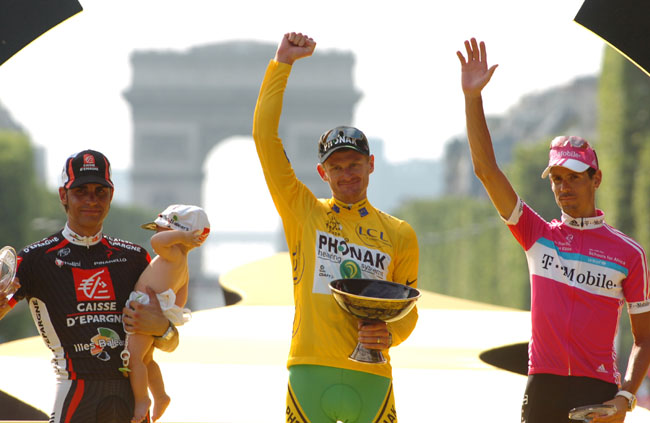
The champions of the closest TdF in years, from left to right:
2nd place, Oscar Pereiro (Caisse d'Epargne), Spain
1st place, Floyd Landis (Phonak), USA
3rd place, Andreas Klöden (T-Mobile), Germany
Thanks for the thrills.
Friday, July 21, 2006
Forget Gatorade
By now everyone in the cycling world (and all you futbol bandwagon wannabees had better pay attention: the Tour de France is the world's largest spectator sport, not the World Cup) knows how Floyd Landis roared back into contention on stage 17. According to Patrick O'Grady of VeloNews he "chased down an 11-man breakaway, killed and ate them, built a new bicycle out of their bones, and roared away in a pillar of fire to win the stage to Morzine and jump back to within 30 seconds of the yellow jersey."
Apparently the secret to Floyd Landis' success on stage 17 of the Tour de France was due to . . . beer. I can hear the cyclists of the world applauding. Maybe this is why Belgium churns out both amazing ales and grizzled cyclists. After actually pedaling so slowly that he rode backwards on the final climb of stage 16 (well, almost: he lost a minute per kilometer), Landis was asked, "How do you deal with this from a mental standpoint?"
 "I don't know. Drink some beer? That's what I'm thinking about now."
Landis drank tons of water on his epic ride. Aside from the temps in the 90s, was there any other reason? "Maybe it was the beer I had last night," he admitted. I can see the made-for-TV movies now: "The making of a true American hero: Raised in an oppressive Mennonite family and forbidden to wear shorts, Landis broke free of his restraints, moved to California, became a pro mountain bike racer, and even shaved his legs. Now, like a bubbly head of foam, he has risen to the top of the cycling world, owing it all to beer."
On one last note (sorry), maybe the Germans have had it right all along (no surprise there). The inspiration for many of today's citrus-tweaked wheat ales, the German Radlermass, or"cyclist mug", is a carbohydrate-rich mix of beer and lemonade, ready to replenish the weary rider.
Apparently the secret to Floyd Landis' success on stage 17 of the Tour de France was due to . . . beer. I can hear the cyclists of the world applauding. Maybe this is why Belgium churns out both amazing ales and grizzled cyclists. After actually pedaling so slowly that he rode backwards on the final climb of stage 16 (well, almost: he lost a minute per kilometer), Landis was asked, "How do you deal with this from a mental standpoint?"
 "I don't know. Drink some beer? That's what I'm thinking about now."
Landis drank tons of water on his epic ride. Aside from the temps in the 90s, was there any other reason? "Maybe it was the beer I had last night," he admitted. I can see the made-for-TV movies now: "The making of a true American hero: Raised in an oppressive Mennonite family and forbidden to wear shorts, Landis broke free of his restraints, moved to California, became a pro mountain bike racer, and even shaved his legs. Now, like a bubbly head of foam, he has risen to the top of the cycling world, owing it all to beer."
On one last note (sorry), maybe the Germans have had it right all along (no surprise there). The inspiration for many of today's citrus-tweaked wheat ales, the German Radlermass, or"cyclist mug", is a carbohydrate-rich mix of beer and lemonade, ready to replenish the weary rider.
Thursday, July 20, 2006
Tour de Floyd
In the immortal words of LL Cool J, "Don't call it a comeback!"--it's more like resurrection! After riding a strong but conservative Tour de France so far and holding the maillot jaune, the yellow jersey designating the overall leader, American Floyd Landis (Phonak) simply blew up on the final climb of stage 16 yesterday, losing nine minutes on the day to his nearest rival, Carlos Sastre (CSC). This dropped him to 11th place, 8:08 arears of Oscar Pereiro (Caisse d'Epargne). "Now it's Landis whose name is scratched off the contenders' list," writes VeloNews.com. "His dreams of winning this Tour de France [are] completely shattered."
But today was a new day. Long-time cycling commentators Phil Liggett and Paul Sherwen call it the greatest single day of bike racing they've seen in 35 years as professionals. Let's face it: the Tour was boring with Lance; with a team stacked like the 1927 Yankees, there was no question who would win; the only question was: by how much? And Landis provided the excitement today in the most wide-open Tour in a decade.

Starting 50 km into the first of the day's four major climbs in the Alps, a Categorie 1 (5 being the least difficult, 1 the most difficult), Landis and his Phonak boys cranked up the tempo, splitting the pack. Landis then took off on his own, bridging to the eleven-man breakaway group and catching them on the second mountain, a Categorie 2. Continuing to hammer away, he dropped all but a few on the day's third mountain pass, another Categorie 1.
On the the fourth and final major climb, the viscious Hors-Categorie (so difficult it is beyond categorization) Col de Joux-Plane, where legends are made and hopes are dashed, Landis rode away for good, coming over the top 5:08 ahead of Sastre. Landis then gained another 30 seconds on the dangerous, winding descent to the finish, giving him his first-ever Tour de France stage win and catapulting him from a hopeless eleventh to third place overall, only 30 seconds behind Pereiro, who holds the maillot jaune.
Saturday's 57km time trial (a solo race against the clock) should decide it all. Landis, having finished second in the first time trial, is the odds-on favorite to win. Can the scrappy Pennsylvanian do it?
But today was a new day. Long-time cycling commentators Phil Liggett and Paul Sherwen call it the greatest single day of bike racing they've seen in 35 years as professionals. Let's face it: the Tour was boring with Lance; with a team stacked like the 1927 Yankees, there was no question who would win; the only question was: by how much? And Landis provided the excitement today in the most wide-open Tour in a decade.

Starting 50 km into the first of the day's four major climbs in the Alps, a Categorie 1 (5 being the least difficult, 1 the most difficult), Landis and his Phonak boys cranked up the tempo, splitting the pack. Landis then took off on his own, bridging to the eleven-man breakaway group and catching them on the second mountain, a Categorie 2. Continuing to hammer away, he dropped all but a few on the day's third mountain pass, another Categorie 1.
On the the fourth and final major climb, the viscious Hors-Categorie (so difficult it is beyond categorization) Col de Joux-Plane, where legends are made and hopes are dashed, Landis rode away for good, coming over the top 5:08 ahead of Sastre. Landis then gained another 30 seconds on the dangerous, winding descent to the finish, giving him his first-ever Tour de France stage win and catapulting him from a hopeless eleventh to third place overall, only 30 seconds behind Pereiro, who holds the maillot jaune.
Saturday's 57km time trial (a solo race against the clock) should decide it all. Landis, having finished second in the first time trial, is the odds-on favorite to win. Can the scrappy Pennsylvanian do it?
Thursday, July 6, 2006
Fear, trembling, and discerning God's will
Okay, so you probably know that I'm one heck of a crazy person: I'm in the midst of raising $31K (again) to continue bringing the amazing news of God's grace in Jesus Christ to students in the Near East. And, as you can expect, most of my time is spent floundering in doubt: Will the money come in? Why can't I get a hold of anybody? Am I really supposed to be going back there again instead of looking for a teaching job? Do I actually even care about the gospel myself, let alone reaching others with it, blah, blah, blah. But the other night I read something that is keeping my feet on the ground and some sense in my head:
Christian discipleship is a process of paying more and more attention to God's righteousness [his unswerving fidelity in relationship] and less and less attention to our own; finding the meaning of our lives not by probing our moods and motives and morals but by believing in God's will and purposes; making a map of the faithfulness of God, not charting the rise and fall of our affections.*
I began to wonder: How much of my doubt and waffling is on account of looking to my subjective emotions and perceptions about my supposed "calling" to go back overseas rather than looking to those sureties grounded in God's unassailable plan for the world's peoples? I know for an overwhelming fact that unless God revokes his covenant with Abraham (Genesis 12:2-3; Galatians 3:6-9) and scorns the blood of his own beloved Son (Revelation 5:9-10)--thus bringing his own self-condemnation (Genesis 15:7-10, 17)--he will act to bring the nations to Christ. And this will not occur without preachers of the gospel (Romans 10:14-17).
Now this is not to say that my role is assured on account of this. But Jesus himself gave the imperative to pray for harvesters (Matthew 9:37-38), so every prayer to that end is as if Christ himself were petitioning the Lord of the harvest. Surely his prayers are not met in vain! While I can't make a definite claim either way, it seems to me that our odds for success are far better when we trust in God's firm purposes to guide our lives, instead of relying on "gut feeling" or "probing our moods and motives and morals." So I keep on keepin' on.
______________________________________
*Eugene H. Peterson, A Long Obedience in the Same Direction, 2nd ed. (Downers Grove, Ill.: InterVarsity, 2000), 133.
Christian discipleship is a process of paying more and more attention to God's righteousness [his unswerving fidelity in relationship] and less and less attention to our own; finding the meaning of our lives not by probing our moods and motives and morals but by believing in God's will and purposes; making a map of the faithfulness of God, not charting the rise and fall of our affections.*
I began to wonder: How much of my doubt and waffling is on account of looking to my subjective emotions and perceptions about my supposed "calling" to go back overseas rather than looking to those sureties grounded in God's unassailable plan for the world's peoples? I know for an overwhelming fact that unless God revokes his covenant with Abraham (Genesis 12:2-3; Galatians 3:6-9) and scorns the blood of his own beloved Son (Revelation 5:9-10)--thus bringing his own self-condemnation (Genesis 15:7-10, 17)--he will act to bring the nations to Christ. And this will not occur without preachers of the gospel (Romans 10:14-17).
Now this is not to say that my role is assured on account of this. But Jesus himself gave the imperative to pray for harvesters (Matthew 9:37-38), so every prayer to that end is as if Christ himself were petitioning the Lord of the harvest. Surely his prayers are not met in vain! While I can't make a definite claim either way, it seems to me that our odds for success are far better when we trust in God's firm purposes to guide our lives, instead of relying on "gut feeling" or "probing our moods and motives and morals." So I keep on keepin' on.
______________________________________
*Eugene H. Peterson, A Long Obedience in the Same Direction, 2nd ed. (Downers Grove, Ill.: InterVarsity, 2000), 133.
Thursday, June 29, 2006
Thy kingdom come! - part two
A few weeks ago I posted regarding the distinction between the church and the basileia tou theou, the kingdom of God. Before moving on, I'd like to clarify one thing: In saying that "Earth is not the kingdom, either; it is the place where the dominion of Christ is worked out," I do not intend to say that the kingdom doesn't have the aspect of being a realm or a place to be occupied. It certainly is, as indicated by Jesus' teachings that we can enter it as if passing through a needle's eye (Mark 10:25), and that he will drink wine with his disciples again there (Mark 14:25). But the primary teaching in the Gospels is that it is the reign of God present in Christ.
In two previous posts here (1) and here (2), I questioned some Christians' justification of physical violence in executing justice and bringing peace to this earth, namely, the plot of some members of the Confessing Church to assassinate Hitler and bring an end to WWII and the Holocaust. After all, Jesus said that "all who take up the sword shall perish by the sword" (Matt. 27:52). How different is this from theocracy or jihad? Theology here has ramifications spreading into all realms of ethics, including the ever-hot debates over laws governing abortion, euthanasia, capital punishment, homosexual marriage, and the like.
This has prompted me to read up a little on the prevailing theology behind many leaders of the Confessing Church: Luther's "two kingdoms" doctrine, an extension of his theology concerning the proper aims and uses of the Law and of the Gospel. (You can read an excellent summary here.) Just as the Word of both law and gospel were horribly mingled in the medieval Western Church, so the church and state were also improperly intertwined and mixed in one another's business.
In essence, Luther says that God's government (reign) is carried out in two different ways, the earthly (secular) and the spiritual. This allows the church to be properly distinguished from the state but not separate from it, just as Christian saints live in the good world God created but are no longer of this world (John 17:15-19). (1) On the "left hand" God governs and preserves the entire world through Law. Just as God's law serves to both convict and guide the consciences of all people (cf. Rom. 2:15), so does God maintain order and the things which cultivate life for all people through the use of law (both civic and natural) and reason. Here God works for the preservation of structures that make life possible, such as marriage and family, commerce, work, property, etc. For this reason Paul and Peter admonish obedience to the government as long as they have freedom to worship God (Rom. 13:1-7; 1 Pet. 2:13-14; cf. Luke 20:25).
(2) On the "right hand" God executes his spiritual reign through the church in the preaching of the gospel and the administration of the sacraments. There is no higher authority here than Scripture, and the main concern is to make and strengthen disciples of Jesus Christ. Clergy are not to be lawmakers, and dukes don't work to preach the gospel. Both jobs have specific purposes, and mixing the two gets ugly. You can be a Christian and honor God in your secular vocation, and Christians can advise lawmakers, but they're distinct.
Inevitably Christians twisted and misinterpreted this doctrine, leaving many to blame Luther for the rise of the Third Reich and its atrocities. (I hate to tell them, but Luther was dead for 400 years at that point.) But now I see that at least according to this doctrine, Bonhoeffer actually did properly embody it, leading him to seek to end the war by means of killing Hitler. He and others, while under the spiritual reign of God, didn't seek revenge for their own arrest or abuses. And under that same reign, the love of Christ compelled them to seek the good of others ahead of themselves. But how was this to be done? Hitler didn't respond to his nor Martin Niemoeller's preaching of either law or the gospel. Thus out of love for the common good and the preservation of life for Jew and German alike, they decided to operate under the earthly kingdom's sword and "be a sinner, and sin boldly" while trusting even more strongly in the forgiveness in Christ.
[*Perhaps this also clarifies my post concerning the interface between biblical ethics and legislation.]
In two previous posts here (1) and here (2), I questioned some Christians' justification of physical violence in executing justice and bringing peace to this earth, namely, the plot of some members of the Confessing Church to assassinate Hitler and bring an end to WWII and the Holocaust. After all, Jesus said that "all who take up the sword shall perish by the sword" (Matt. 27:52). How different is this from theocracy or jihad? Theology here has ramifications spreading into all realms of ethics, including the ever-hot debates over laws governing abortion, euthanasia, capital punishment, homosexual marriage, and the like.
This has prompted me to read up a little on the prevailing theology behind many leaders of the Confessing Church: Luther's "two kingdoms" doctrine, an extension of his theology concerning the proper aims and uses of the Law and of the Gospel. (You can read an excellent summary here.) Just as the Word of both law and gospel were horribly mingled in the medieval Western Church, so the church and state were also improperly intertwined and mixed in one another's business.
In essence, Luther says that God's government (reign) is carried out in two different ways, the earthly (secular) and the spiritual. This allows the church to be properly distinguished from the state but not separate from it, just as Christian saints live in the good world God created but are no longer of this world (John 17:15-19). (1) On the "left hand" God governs and preserves the entire world through Law. Just as God's law serves to both convict and guide the consciences of all people (cf. Rom. 2:15), so does God maintain order and the things which cultivate life for all people through the use of law (both civic and natural) and reason. Here God works for the preservation of structures that make life possible, such as marriage and family, commerce, work, property, etc. For this reason Paul and Peter admonish obedience to the government as long as they have freedom to worship God (Rom. 13:1-7; 1 Pet. 2:13-14; cf. Luke 20:25).
(2) On the "right hand" God executes his spiritual reign through the church in the preaching of the gospel and the administration of the sacraments. There is no higher authority here than Scripture, and the main concern is to make and strengthen disciples of Jesus Christ. Clergy are not to be lawmakers, and dukes don't work to preach the gospel. Both jobs have specific purposes, and mixing the two gets ugly. You can be a Christian and honor God in your secular vocation, and Christians can advise lawmakers, but they're distinct.
Inevitably Christians twisted and misinterpreted this doctrine, leaving many to blame Luther for the rise of the Third Reich and its atrocities. (I hate to tell them, but Luther was dead for 400 years at that point.) But now I see that at least according to this doctrine, Bonhoeffer actually did properly embody it, leading him to seek to end the war by means of killing Hitler. He and others, while under the spiritual reign of God, didn't seek revenge for their own arrest or abuses. And under that same reign, the love of Christ compelled them to seek the good of others ahead of themselves. But how was this to be done? Hitler didn't respond to his nor Martin Niemoeller's preaching of either law or the gospel. Thus out of love for the common good and the preservation of life for Jew and German alike, they decided to operate under the earthly kingdom's sword and "be a sinner, and sin boldly" while trusting even more strongly in the forgiveness in Christ.
[*Perhaps this also clarifies my post concerning the interface between biblical ethics and legislation.]
Thursday, June 22, 2006
Check 'em out
Okay, I'm not normally one to give props to others' weblogs, but I consider two recent posts worth passing on to like the three of you who read my blog:
First, Be Strong in the Grace wrote recently about the beauty of our calling as priests to console others by sharing the news that they're forgiven in Christ (commonly referred to as absolution or the office of the keys).
I used to balk in church when we, as a congregation, would confess our sins, followed by absolution from the pastor. I thought, This is crap. How can any pastor say whether or not anyone is forgiven? But now I'm beginning to see not only the "scripturality" of it*, but also the need for it.
Second, Rob at Love & Blunder's post "Theology for the dying and dead" begins in a way that sort of haunts me:
I sometimes wonder what it would be like to have a child of my own. What would it be like to hold her (or him)? Could I sleep at night if she weren't right next to me? Would I be selfish and try to wrestle "my time" away from her, or would I live this new death-to-myself that is required in lovingly raising a child? If she dies, will I be able to say along with Martin Luther (at the death of his father in 1530), "Never have I hated death so much"?
I mean, so often have I (and other Christians) thought of death as but a gateway into the glory hereafter, thanks to our union with the resurrected Christ. (Props to the Orthodox Church for placing this reality at the fore of their theology.) But in reality, we Christians ought to vehemently hate death in every form and weep in every place it rears its ugly head. It was never part of God's good plan for the world! (This is coming from the conscience of yours truly, a five-point Calvinist who believes that God, in some unfathomable way, foresees and foreordains every calamity and death.) We ought to look at death and fall into despair--only then to look with an even stronger hope in the Lord.
______________________________
* "I will give you the keys of the kingdom of heaven, and whatever you bind on earth shall be bound in heaven, and whatever you loose on earth shall be loosed in heaven" (Matthew 16:18); "If you forgive the sins of anyone, they are forgiven; if you withhold forgiveness from anyone, it is withheld" (John 20:23); "You yourselves are . . . to be a holy priesthood . . . . You are . . . a royal priesthood" (1 Peter 2:5, 9). Also see Luther's Small Catechism, under "Confession", and the Heidelberg Catechism, Lord's day 31.
First, Be Strong in the Grace wrote recently about the beauty of our calling as priests to console others by sharing the news that they're forgiven in Christ (commonly referred to as absolution or the office of the keys).
Luther writes in the Large Catechism:
"Christ himself has entrusted absolution to his Christian church and commanded us to absolve one another from sins. So if there is a heart that feels its sin and desires consolation, it has here a sure refuge when it hears in God's Word that through a fellow human being, God absolves a person from sin." Read more . . .
I used to balk in church when we, as a congregation, would confess our sins, followed by absolution from the pastor. I thought, This is crap. How can any pastor say whether or not anyone is forgiven? But now I'm beginning to see not only the "scripturality" of it*, but also the need for it.
Second, Rob at Love & Blunder's post "Theology for the dying and dead" begins in a way that sort of haunts me:
Death has been on my mind for more than a year. I can trace its shadow back to a strange origin: The birth of my daughter.
I think about it every night, as we put her to bed. We help Olivia into her pajamas, watch her brush her teeth, read "Goodnight Moon" together, and say a prayer. The lights go out. The rocking chair creaks, Olivia sighs in her sleep, and my own mortality grips me. And holding her there in the darkness, I'm filled with a holy ache. The close of the evening is one tiny goodbye in a lifelong string of goodbyes.
I can't help but whisper Jesus' name. I hold my daughter tight, and I cling to the Gospel all the tighter. Read more . . .
I sometimes wonder what it would be like to have a child of my own. What would it be like to hold her (or him)? Could I sleep at night if she weren't right next to me? Would I be selfish and try to wrestle "my time" away from her, or would I live this new death-to-myself that is required in lovingly raising a child? If she dies, will I be able to say along with Martin Luther (at the death of his father in 1530), "Never have I hated death so much"?
I mean, so often have I (and other Christians) thought of death as but a gateway into the glory hereafter, thanks to our union with the resurrected Christ. (Props to the Orthodox Church for placing this reality at the fore of their theology.) But in reality, we Christians ought to vehemently hate death in every form and weep in every place it rears its ugly head. It was never part of God's good plan for the world! (This is coming from the conscience of yours truly, a five-point Calvinist who believes that God, in some unfathomable way, foresees and foreordains every calamity and death.) We ought to look at death and fall into despair--only then to look with an even stronger hope in the Lord.
______________________________
* "I will give you the keys of the kingdom of heaven, and whatever you bind on earth shall be bound in heaven, and whatever you loose on earth shall be loosed in heaven" (Matthew 16:18); "If you forgive the sins of anyone, they are forgiven; if you withhold forgiveness from anyone, it is withheld" (John 20:23); "You yourselves are . . . to be a holy priesthood . . . . You are . . . a royal priesthood" (1 Peter 2:5, 9). Also see Luther's Small Catechism, under "Confession", and the Heidelberg Catechism, Lord's day 31.
Friday, June 16, 2006
Thy kingdom come!
Have you ever heard anyone say, "We need to be part of building God's kingdom?" Maybe you've said it yourself; I know I have. And with the Emergent focus on missional living and being God's "kingdom agents"--a very good and honorable thing, I might add--I think it's important to recognize the distinction between the church and the kingdom of God. Here's a brief walk through Jesus' "kingdom parables" in Matthew 13, showing why I believe that, while inseparable in some sense, the church is not to be identified or equated with the kingdom of God.
Parable of the sower (13:1-23). The "word [message] of the kingdom" is something sown into people's hearts (v. 19). Thus we see the kingdom as something external to the people, which produces fruit within those who receive the news of it.
Parable of the tares (13:24-30, 36-43). The kingdom is compared to the man who sowed the wheat seeds. Likewise the enemy sowed the weeds (v. 25). Jesus' direct comparison of the kingdom and the sower in v. 24 ("The kingdom of heaven may be compared to a man who came and sowed good seed in his field") shows that the kingdom is something separate from the wheat, who are the "sons of the kingdom" (v. 38). These sons, the communion of saints, are those given new birth by the word of the kingdom (v. 19; 1 Pet. 1:23-25). They are those who are brought to creation from or on account of the kingdom, and who live a life concordant with their new nature and relationship to the Sower. To make the church synonymous with the kingdom is to make your unbelieving neighbor synonymous with Satan.
Parables of the mustard seed and the leaven (13:31-33). While the distinct aim of these parables is to show the growing, spreading nature of the presently incipient kingdom, as opposed to Jewish expectations that the messianic kingdom would come in one fell swoop, the kingdom-church distinction can be seen again. First off, the mustard seed becomes the tree in which birds perch. It is what creates a home for the birds. The birds are not a tree! And in the second parable, the yeast is a force that spreads through the dough and effects change within it. Thus the kingdom cannot be equated with the world, either.
Parable of the dragnet (13:47-50). This parable perhaps most strongly delineates the distinction. Here the kingdom is likened to a fisherman's dragnet that catches fish in its wake, collecting them for the day of judgment. Rather than equating the kingdom with the church, we see here the principle testified throughout these parables: the kingdom of God is really the eschatological reign or rule of God, the force of which creates the church and exerts influence in the world. The word for kingdom, basileia, really is better translated by "dominion" (cf. Dan. 7:13-14) or "kingship" (John 18:36, RSV).
So as we are a church body gathered to pray, "Thy kingdom come, thy will be done, on earth as it is in heaven," I think it's helpful to recognize a few things. First, we are not the kingdom. And Earth is not the kingdom, either; it's the place where the dominion of Christ is worked out. Nowhere does the Bible promise an earthly utopia or theocracy prior to the Second Advent and the great regeneration of all things (Matt. 19:28; 2 Pet. 3:13). (My apologies to any premillenialists and social gospel advocates reading this.) But we are to pray with the desire that the risen and ascended Christ will extend his scepter to free people from death and captivity to sin and the devil.
Second, we don't "go out there and build the kingdom." That's solely the work of Christ as he continues his ministry in the Holy Spirit (John 14:12). Rather, we are "kingdom participants" and witnesses of the King. But there is something we can and must do, for we are entrusted with the keys to the kingdom: The saving effects of Jesus' resurrection-dominion only come in people's lives through the means of grace, that is, the Word and the Sacraments. As the "message of the kingdom" (Matt. 13:19; 24:14) is sown, people are brought to faith and strengthened in it. Apart from the preached gospel, the kingdom is powerless, and no one enters. "He who has ears, let him hear."
(For a little more on the kingdom and mission, please check out what Mark Driscoll has to say. I'm starting to find him as one of the most well-thought and scripturally sound voices in the Emergent movement.)
Parable of the sower (13:1-23). The "word [message] of the kingdom" is something sown into people's hearts (v. 19). Thus we see the kingdom as something external to the people, which produces fruit within those who receive the news of it.
Parable of the tares (13:24-30, 36-43). The kingdom is compared to the man who sowed the wheat seeds. Likewise the enemy sowed the weeds (v. 25). Jesus' direct comparison of the kingdom and the sower in v. 24 ("The kingdom of heaven may be compared to a man who came and sowed good seed in his field") shows that the kingdom is something separate from the wheat, who are the "sons of the kingdom" (v. 38). These sons, the communion of saints, are those given new birth by the word of the kingdom (v. 19; 1 Pet. 1:23-25). They are those who are brought to creation from or on account of the kingdom, and who live a life concordant with their new nature and relationship to the Sower. To make the church synonymous with the kingdom is to make your unbelieving neighbor synonymous with Satan.
Parables of the mustard seed and the leaven (13:31-33). While the distinct aim of these parables is to show the growing, spreading nature of the presently incipient kingdom, as opposed to Jewish expectations that the messianic kingdom would come in one fell swoop, the kingdom-church distinction can be seen again. First off, the mustard seed becomes the tree in which birds perch. It is what creates a home for the birds. The birds are not a tree! And in the second parable, the yeast is a force that spreads through the dough and effects change within it. Thus the kingdom cannot be equated with the world, either.
Parable of the dragnet (13:47-50). This parable perhaps most strongly delineates the distinction. Here the kingdom is likened to a fisherman's dragnet that catches fish in its wake, collecting them for the day of judgment. Rather than equating the kingdom with the church, we see here the principle testified throughout these parables: the kingdom of God is really the eschatological reign or rule of God, the force of which creates the church and exerts influence in the world. The word for kingdom, basileia, really is better translated by "dominion" (cf. Dan. 7:13-14) or "kingship" (John 18:36, RSV).
So as we are a church body gathered to pray, "Thy kingdom come, thy will be done, on earth as it is in heaven," I think it's helpful to recognize a few things. First, we are not the kingdom. And Earth is not the kingdom, either; it's the place where the dominion of Christ is worked out. Nowhere does the Bible promise an earthly utopia or theocracy prior to the Second Advent and the great regeneration of all things (Matt. 19:28; 2 Pet. 3:13). (My apologies to any premillenialists and social gospel advocates reading this.) But we are to pray with the desire that the risen and ascended Christ will extend his scepter to free people from death and captivity to sin and the devil.
Second, we don't "go out there and build the kingdom." That's solely the work of Christ as he continues his ministry in the Holy Spirit (John 14:12). Rather, we are "kingdom participants" and witnesses of the King. But there is something we can and must do, for we are entrusted with the keys to the kingdom: The saving effects of Jesus' resurrection-dominion only come in people's lives through the means of grace, that is, the Word and the Sacraments. As the "message of the kingdom" (Matt. 13:19; 24:14) is sown, people are brought to faith and strengthened in it. Apart from the preached gospel, the kingdom is powerless, and no one enters. "He who has ears, let him hear."
(For a little more on the kingdom and mission, please check out what Mark Driscoll has to say. I'm starting to find him as one of the most well-thought and scripturally sound voices in the Emergent movement.)
Friday, June 9, 2006
New music recommendation
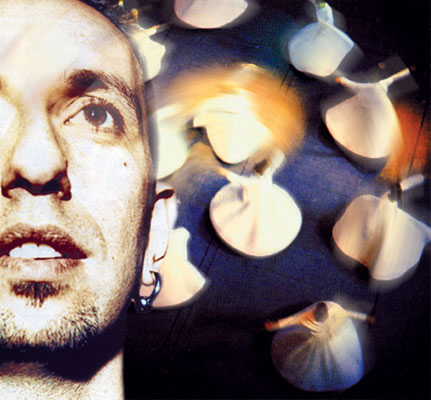
A la my friends Chris and Jim, it's time for a Thursday music recommendation (delayed until Friday). Well, not exactly. But I can't help but extol why I like the music of Mercan Dede so much, especially on my final day in Turkey until September.
Performing under the name Mercan Dede--his first name coming from a Turkish fiction novel character and his second name meaning "grandpa"--this Turkish-born, Quebec-dwelling DJ really captures what I feel is the modern spirit of Istanbul. His craft is a sort of Sufi electronica, blending computerized beats and modern elements with the traditional music and instruments of the whirling dervishes, such as the ney, a type of flute.
Why does he capture Istanbul so well? First off, he does Sufi music, i.e., it's Islamic. When Constantinople feel to Fatih Sultan Mehmet II and the Selcuks in 1453, the city quickly became "the city of a thousand mosques." Nowadays there are still many conservative Muslims here, and the ezan (call to prayer) can be heard sounding from minarets several times daily. But owing largely to Kemal Ataturk's secular reforms and nudges by the European Union's offers of membership, the devotion to Islam here is but a shadow of the past. But its influence cannot be escaped by even the most blind of persons.
Second, it's Sufi music. Sure, most of the Muslims in Turkey belong to the Sunni sect, but I think Sufism, once banned by Ataturk, may be on the rise. Spirituality is important to a lot of people, and Sufism offers connection with the divine within the elements of this world. You can see this in some of the more recent Turkish art. Dede's music is for dervishes, whose prayer-spinning attempts to experience the divine by connection between the heavens and the earth (hence their diagonally-outstretched arms).
Third, Mercan Dede reflects the modernization of the city while retaining its distinctively Turkish roots. I mean, it's electronica. Dede has had giant spikes for hair. But the traditional flavors will not leave; this is no mere progress-by-sounding-like-europop. This is something I really like about the megalopolis in which I live: many of new restaurants, night clubs, and art galleries exhibit progress into the future while echoing the past. (Case in point: the renovation of the Beyoğlu district.)
You can check out more, including several MP3 music files, at www.mercandede.com.
Wednesday, June 7, 2006
What do our votes say?
A few weeks back, my roommates and I had what became a rather extended discussion about why we would vote one way or the other on the issue of banning same-sex marriages. And with President Bush wasting taxpayers' money and congressmen's time trying futilly to add a Constitutional amendment banning same-sex marriages, I can't help think about it (along with how negligent the current administration is).
If you're a biblically-minded Christian or anyone else who believes homosexual marriages to be wrong, what would you do when faced with a vote that would either ban or permit same-sex marriage? For me--and hopefully for anyone with any true sensitivity and engaged in deep though--it's hardly a simple decision. My question is, What does my vote say or do?
I believe that same-sex marriage is not as harmless as many people like to claim. Anything contrary to God's revealed will for our wholeness is damaging and therefore wrong. (Uh-oh, I feel a discussion about theocracy coming on . . . ) And I cannot imagine what will happen to children, adopted or otherwise, reared in a same-sex household. So do I vote against it out of the desire to actually prevent potentially harmful situations from arising?
What happens if, even though I'm morally opposed to it, I vote to permit it, and it becomes/stays legal? Does legally allowing something imply that it's okay? I wonder, has a shift in popular opinion concerning abortion occurred since--or, more importantly but more difficult to determine, been caused by--the Roe v. Wade decision? Is there any inherent pedagogical and moral influence of laws? After all, St. Paul does say that he wouldn't have known that coveting is wrong if it weren't for the law (Romans 7:7).
Or what about the effects of my vote as far as what it says? If same-sex marriage is banned, does that simply serve to perpetuate the well-deserved stereotype that America's Christians, upon whom much of the blame will inevitably fall, hate gays? Will this only serve to further estrange the LBGTA* community from the Church--or, worse yet, from Jesus? I certainly don't want to set up any unwarranted and unnecessary hindrances to the gospel. Conversely, though, God does not need me to defend his honor or make compromises, as if I could embarrass him or screw up the execution of his eternal redemptive purposes. I mean, no amount of hate-mongering or "intolerance" by the Church has ever kept anyone from Christ. Rather, "the light has come into the world, and people loved the darkness rather than the light because their deeds were evil. For everyone who does wicked things hates the light and does not come to the light, lest his deeds should be exposed" (John 3:19-20). It's the prideful fear of exposure and the love of sin that keep anyone from repentance and faith in Christ.
Anyway, it's a lot to chew on. I could go on for a long time. But, really, what's a vote worth on this issue? How are we to choose?
__________________________________
* LBGTA stands for Lesbian, Bisexual, Gay, Transgender, and Ally (those supporting LBGT rights)
If you're a biblically-minded Christian or anyone else who believes homosexual marriages to be wrong, what would you do when faced with a vote that would either ban or permit same-sex marriage? For me--and hopefully for anyone with any true sensitivity and engaged in deep though--it's hardly a simple decision. My question is, What does my vote say or do?
I believe that same-sex marriage is not as harmless as many people like to claim. Anything contrary to God's revealed will for our wholeness is damaging and therefore wrong. (Uh-oh, I feel a discussion about theocracy coming on . . . ) And I cannot imagine what will happen to children, adopted or otherwise, reared in a same-sex household. So do I vote against it out of the desire to actually prevent potentially harmful situations from arising?
What happens if, even though I'm morally opposed to it, I vote to permit it, and it becomes/stays legal? Does legally allowing something imply that it's okay? I wonder, has a shift in popular opinion concerning abortion occurred since--or, more importantly but more difficult to determine, been caused by--the Roe v. Wade decision? Is there any inherent pedagogical and moral influence of laws? After all, St. Paul does say that he wouldn't have known that coveting is wrong if it weren't for the law (Romans 7:7).
Or what about the effects of my vote as far as what it says? If same-sex marriage is banned, does that simply serve to perpetuate the well-deserved stereotype that America's Christians, upon whom much of the blame will inevitably fall, hate gays? Will this only serve to further estrange the LBGTA* community from the Church--or, worse yet, from Jesus? I certainly don't want to set up any unwarranted and unnecessary hindrances to the gospel. Conversely, though, God does not need me to defend his honor or make compromises, as if I could embarrass him or screw up the execution of his eternal redemptive purposes. I mean, no amount of hate-mongering or "intolerance" by the Church has ever kept anyone from Christ. Rather, "the light has come into the world, and people loved the darkness rather than the light because their deeds were evil. For everyone who does wicked things hates the light and does not come to the light, lest his deeds should be exposed" (John 3:19-20). It's the prideful fear of exposure and the love of sin that keep anyone from repentance and faith in Christ.
Anyway, it's a lot to chew on. I could go on for a long time. But, really, what's a vote worth on this issue? How are we to choose?
__________________________________
* LBGTA stands for Lesbian, Bisexual, Gay, Transgender, and Ally (those supporting LBGT rights)
Saturday, May 27, 2006
To watch or not to watch?

Ooh, a Da Vinci Code-related post! Now's my chance to jump on the bandwagon and boost my ratings.
On my friend Ryan's recommendation, I was listening to a talk by Pastor Joel Biermann this morning. The thrust of his message was that our character is molded by our surroundings. One thing he suggested is that we really need not read Dan Brown's The Da Vinci Code or see the movie, because it's not really a salutary influence upon our minds and beliefs. In addition, our money would only help to support these types of entertainment. But I, for one, have read the book and watched the film (which, I say, was a confusing and rather poorly-rendered adaptation of the book).
Part of me really wants to agree with Biermann: During the film, my friend Sam, who hadn't read the book, said that the film's bloody scenes and sexual innuendo "quenched her spirit." And I think that we are accountable for the entertainment choices we choose, as to whether or not they are actually beneficial. "All things are lawful, but not all things are profitable. All things are lawful, but not all things edify" (1 Cor. 10:23). Is watching The Da Vinci Code a worthwhile use of two hours and $8?
But with everyone and his mom in both America and Turkey having read this book, I honestly would've felt like an ignorant fool if I didn't read it. I wanted to know exactly what was being purported about the historical Jesus and the Church, not merely what some website or apologetic book tells me. In the same way, I want people to read the Bible for themselves, not simpy to pass judgment based upon secondary sources or hearsay. I do likewise and read the Qur'an. (And I might add that doing so has only further solidified my belief that it is not divine in origin.)
In a similar way, though I've never been one for basing sermons off of popular films (no more Braveheart or Lord of the Rings, please!), Paul himself models that we are to be knowledgeable about popular, secular things. He frequently quotes Greek poets (Acts 17:28; 1 Cor. 15:33; Tit. 1:12). [Disclaimer: Don't even think you can justify watching any and every film, no matter how grotesque or indulgent, just so you can be a "more knowledgeable evangelist." Films like Eyes Wide Shut do not count!] So should those of us who are Christians concerned about effectively communicating the gospel of the rescuing Christ to others bear with entertainment like The Da Vinci Code or The Last Temptation of Christ even when they are hardly edifying to one's faith?
And while you're online, please check out www.jesusanddavinci.com.
Saturday, May 13, 2006
Do clothes really make the man?
I know it's just a dumb cliche, but this question actually has been floating through my head a bit these days. Here in Turkey--a land renowned for its mustache-wearing machismo--tight clothing for men is en vogue. Of course, that's sort of true about much of Europe, but there's no escaping the leg-squeezing jeans and narrow-cut, open-chested shirts sported here. Sometimes I even see men's capris.
Being involved in a Latin dancing club (cha cha, salsa, rhumba, and the like) here at Istanbul Technical University, I've entered into a world where men actually move their hips and wear tight black pants and shoes with heels. It seems like a lot of students here are really into Latin dancing, despite being something we in America would probably shun. Last night I was at the Bosphorus University Dance Festival with some friends, and as I watched some of the performances, I couldn't help but think how much some of the wardrobe and moves were reminiscent of figure skating. In my high school there was a guy who figure skated, and despite the athletic skill and strength demanded by it, he got mocked constantly and called "gay" or "fag".
So this makes me wonder if there really exists a true expression of manhood within any given culture. On the one hand, I easily recognize now that real men are not defined by being "wild at heart" (sorry, John Eldredge), for in Latin cultures, the men do dance and are thinly built and wear heels. But the Bible does beg the question, for propriety in church worship is based upon the distinction that there are to be visible differences in male and female fashion (see 1 Corinthians 11:3-16, where the main concern is that women cover their heads to respect their husbands and show that they're married, sort of like wearing a wedding ring nowadays):
"Does not even nature itself teach you that if a man has long hair, it is a dishonor to him, but if a woman has long hair, it is a glory to her? " (1 Corinthians 11:14-15b)
Now, it must be understood that there is nothing wrong or ungodly about long hair for males itself; Samson and other Nazirites had long hair and were men commended by God. Absalom had long hair, too. Paul is not making absolute distinctions about hairstyles (or any other fashion, for that matter). But he does seem to be saying that the natural order of things indicates that there ought to be visible distinctions between men and women. But what those distinctions are is left up to the prevailing cultural trends. Would a man living in America right now be wrong to wear capris or to figure skate? Is it wrong for both men and women to have same-length hair (be it short or long)?
Being involved in a Latin dancing club (cha cha, salsa, rhumba, and the like) here at Istanbul Technical University, I've entered into a world where men actually move their hips and wear tight black pants and shoes with heels. It seems like a lot of students here are really into Latin dancing, despite being something we in America would probably shun. Last night I was at the Bosphorus University Dance Festival with some friends, and as I watched some of the performances, I couldn't help but think how much some of the wardrobe and moves were reminiscent of figure skating. In my high school there was a guy who figure skated, and despite the athletic skill and strength demanded by it, he got mocked constantly and called "gay" or "fag".
So this makes me wonder if there really exists a true expression of manhood within any given culture. On the one hand, I easily recognize now that real men are not defined by being "wild at heart" (sorry, John Eldredge), for in Latin cultures, the men do dance and are thinly built and wear heels. But the Bible does beg the question, for propriety in church worship is based upon the distinction that there are to be visible differences in male and female fashion (see 1 Corinthians 11:3-16, where the main concern is that women cover their heads to respect their husbands and show that they're married, sort of like wearing a wedding ring nowadays):
"Does not even nature itself teach you that if a man has long hair, it is a dishonor to him, but if a woman has long hair, it is a glory to her? " (1 Corinthians 11:14-15b)
Now, it must be understood that there is nothing wrong or ungodly about long hair for males itself; Samson and other Nazirites had long hair and were men commended by God. Absalom had long hair, too. Paul is not making absolute distinctions about hairstyles (or any other fashion, for that matter). But he does seem to be saying that the natural order of things indicates that there ought to be visible distinctions between men and women. But what those distinctions are is left up to the prevailing cultural trends. Would a man living in America right now be wrong to wear capris or to figure skate? Is it wrong for both men and women to have same-length hair (be it short or long)?
Thursday, May 4, 2006
April fools' was a month ago . . .
. . . which is precisely why I was a bit surprised when I read on CNN.com yesterday that a recent survey shows that most American youth do not know where either Louisiana or Iraq are on a map. In fourth or fifth grade I had to memorize the map of every country in the world and know every world capital. I'm not kidding. And I did it, now allowing my team to dominate the recent Union Church of Istanbul "International Quiz Night".
Having lived in Turkey for night eight months now, I'm growing appalled at just how ignorant America is of the rest of the world--and also how much of an impact America has on the world. Students here begin learning English in middle school, and in order to begin their formal university studies, they must pass the hazırlık, a difficult English proficiency exam. And their awareness of world history, events, and politics seems to me much higher than that of most American students. And when I'm with my German friends, I'm even more blown away. Almost every German now speaks English well, if not other languages in addition to that. I constantly feel challenged and even ashamed that I know only a bit of German and Turkish, and my effort in studying them is scarcely what I'd consider stout.
With the relatively low taxation of American citizens and our near-isolation on the North American continent, foreign language education has been tossed by the wayside as budgets get trimmed. (Thank you so much, George W. Bush and NCLB.) Now I know that 90% of our students will never leave the continent, but with the increasing number of immigrants entering the U.S. and with growing globalization, we cannot expect everyone else to learn English and conform to us while we lazily sit back upon our laurels as some self-deemed great nation and savior of the world. (And does anyone even realize that the Gulf War was largely started because of the conflicts between people who misunderstand one another's worldviews, i.e., America is founded upon a Platonic law/guilt-based worldview, and Iraq upon a shame-based one?)
I really want to see a greater priority placed upon learning about other cultures and languages, as well as the fine arts, in our schools. I know it's going to take time, and there's no quick "band-aid" approach. Language learning needs to start young. But it's something worth fighting for, especially for those who wish to see America remain a strong and effective presence in the world. How can we boast in ourselves when we don't understand and evaluate all cultures, when we can't even communicate in order to learn? Our ways are far from perfect or well-thought-out. Industrialization can lead to dehumanization on dangerous assembly lines. Our concepts of dating lead to the highest divorce rate in the world. And people in other nations are left to shake their heads, cringe, or curse. They're not perfect, either, but we just need to get on the ball.
Having lived in Turkey for night eight months now, I'm growing appalled at just how ignorant America is of the rest of the world--and also how much of an impact America has on the world. Students here begin learning English in middle school, and in order to begin their formal university studies, they must pass the hazırlık, a difficult English proficiency exam. And their awareness of world history, events, and politics seems to me much higher than that of most American students. And when I'm with my German friends, I'm even more blown away. Almost every German now speaks English well, if not other languages in addition to that. I constantly feel challenged and even ashamed that I know only a bit of German and Turkish, and my effort in studying them is scarcely what I'd consider stout.
With the relatively low taxation of American citizens and our near-isolation on the North American continent, foreign language education has been tossed by the wayside as budgets get trimmed. (Thank you so much, George W. Bush and NCLB.) Now I know that 90% of our students will never leave the continent, but with the increasing number of immigrants entering the U.S. and with growing globalization, we cannot expect everyone else to learn English and conform to us while we lazily sit back upon our laurels as some self-deemed great nation and savior of the world. (And does anyone even realize that the Gulf War was largely started because of the conflicts between people who misunderstand one another's worldviews, i.e., America is founded upon a Platonic law/guilt-based worldview, and Iraq upon a shame-based one?)
I really want to see a greater priority placed upon learning about other cultures and languages, as well as the fine arts, in our schools. I know it's going to take time, and there's no quick "band-aid" approach. Language learning needs to start young. But it's something worth fighting for, especially for those who wish to see America remain a strong and effective presence in the world. How can we boast in ourselves when we don't understand and evaluate all cultures, when we can't even communicate in order to learn? Our ways are far from perfect or well-thought-out. Industrialization can lead to dehumanization on dangerous assembly lines. Our concepts of dating lead to the highest divorce rate in the world. And people in other nations are left to shake their heads, cringe, or curse. They're not perfect, either, but we just need to get on the ball.
Tuesday, May 2, 2006
Ich liebe Deutschland!
 Every three months I have to leave the country to renew my visa, and I was blessed to find an inexpensive plane ticket to the great city of Berlin to visit my friend Dorothee. The five days I spent there were sort of bittersweet: I remembered how much I like Germany and its culture, which made it sort of difficult to leave and go back to Turkey. It was cool, too, that though I could scarcely remember a word of German, a lot of it started coming back to my mind while I was there. I'm starting to wonder--and even wish--that I might have a future living in Germany. And please do not scold me for not eating the traditional foods that I love: Knödl, Sauerbraten, Rouladen, or Spätzle. I was on a budget and hanging out with three near-vegetarians! Sadly, I didn't even get to enjoy a Masskrug (one-liter mug of beer) at all, either. Bummer.
"Whoever wants the world to remain as she is, does not want her to remain."
On Saturday we went to the concentration camp at Sachsenhausen. The 45-degree, windy, and rainy weather was appropriate. Though I had once before been to the camp at Buchenwald, it was still rather surreal to think that the grounds upon which we walked were not long ago a place of unspeakable atrocities: beatings, starvation, arbitrary murders, forced 25-mile treks for the sake of testing army boots, days spent standing in subzero temperatures with but a thin shirt on, and being hung from a pole so that the shoulders are dislocated.
But the scary thing that struck me was that these crimes weren't devised or carried out by monsters or animals. They were done by humans just like you and me. "The heart is deceitful above all things and desperately sick; who can understand it?" (Jer. 17:9). It's easy to pass these things off and comment, "Who could ever do such a thing?" Yet was it any different with the vile death of our Lord Jesus? Whose sin was it that forced him to endure the lashes and being shamefully stripped and hung upon a tree? The desires that lied within the hearts of the National Socialists are yet in ours. We want to pass the blame. We put up defense mechanisms to defer complicity and make ourselves feel better about ourselves. We want to find meaning and value in ourselves and who we are--for some it's nation and race, for others it's intellect or beauty or academic/job recognition--rather than in being servants of God Most High. We wish to say along with Nietzsche, "God is dead," and we run from the light into the darkness.*
Sunday night was Walpurgisnacht, known as the night when witches are free to rome the earth
 and gather at the Harz mountains in Germany to convene with the devil. It's one of the main holidays in Scandinavia and central Europe (and mentioned twice in Johann von Goethe's remarkable Faust). In addition to being a night of pranks similar to Halloween, it's also marked by shadowy happenings of occult practices and sexual revelry. Mostly, people gather to drink in a sort of bohemian, festival-type atmosphere, but in years past things have turned violent, with fights, fires, and rioting. We joined some other Christians from Berlin at one of the parks where this night was being celebrated, to pray for the safety of people and police and for the breaking of evil spiritual forces at work that night. The four hours we spent in the park were a rather tense time, but it was amazing to see how God and his angels worked for peace. The newspapers reported that this was the most peaceful Walpurgisnacht in Berlin to date.
Back in the fall, my friends (more like family) Lee and Joella discovered Gemeinde Neues Leben (New Life Fellowship) tucked inside a much larger, old church building in Berlin. Ever since they told me of this tiny but faithful community, I've been praying for them. What a blessing it was to actually be there and visit the church! The pastor was nearly in tears that I was there and that I had been praying for them. And in fact, with Doro and my presence, that made five visitors--exactly what they'd been praying for all week! I was asked to share about my life and work in Istanbul, and then several people gathered to pray for Doro, for me, and for our team.
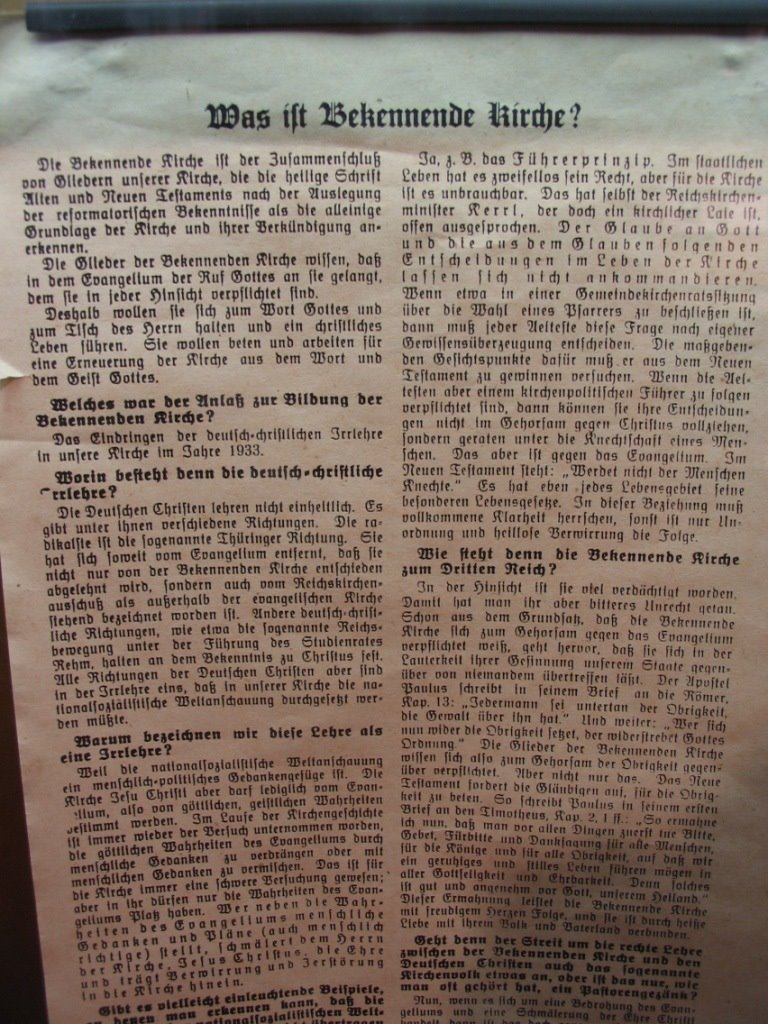
"What is the Confessing Church?" - Nazi pamphlet
Berlin is not only World Cup-crazy; it is also the city with the largest Turkish population outside of Turkey itself. Germany is home to some four million Turks, and when I was in Berlin's Wedding and Kreuzberg districts, their presence was notably felt. Please take a moment to ask of God that his people in Berlin would have both desire and discernment in reaching out to their neighbors._______________________
*Consequently, I think we need more books like Golding's Lord of the Flies, O'Connor's A Good Man is Hard to Find, and Wilde's The Picture of Dorian Gray. So few books are willing to deal strictly with either the reality of Satan or the evil within our own hearts that can only be cured by Jesus Christ.
Friday, April 21, 2006
On hiatus
I once read somewhere in a comment about weblogs, that with the advent of the Internet, podcasts, and their kin, everyone can be heard. But does everyone have the right to be heard?
Not everyone in the world needs to know my thoughts. And how many biblical proverbs warn about blabbing or speaking too quickly rather than choosing one's words wisely? A good portion of the time I post stuff on here as soon as it comes to my mind, rather than actually thinking it through and praying about it and working it out in my life. That's stupid. So unless I've got something actually informative about my life to say or something that would actually edify you while you read it, I think Beloved Before Time is going to go on hiatus. It's not dead; merely it's going to sleep a lot more. Check back, please. There will be fresh stuff here from time to time. But I actually want your time spent reading this--if there is anyone who reads this anymore--to be constructive, a service to you.
In the meantime, you've got three wonderful options:
1. If you simply want to keep up with the more frequent goings-on of my life, please read my other blog at www.xanga.com/ragamuffin1981.
2. If you want to use your time much more constructively, please purchase a copy of Operation World and spend ten minutes praying for a nation of the world, especially Turkey.
3. If you're still interested in the thoughts in my head regarding theology and its implications in our daily lives, grab some books by Dietrich Bonhoeffer, Eugene Peterson, Richard Phillips, John Piper, Martin Luther, A. W. Tozer, or the Puritans. Or you can check out the links to the right side of this page.
Thanks to all who read this.
Not everyone in the world needs to know my thoughts. And how many biblical proverbs warn about blabbing or speaking too quickly rather than choosing one's words wisely? A good portion of the time I post stuff on here as soon as it comes to my mind, rather than actually thinking it through and praying about it and working it out in my life. That's stupid. So unless I've got something actually informative about my life to say or something that would actually edify you while you read it, I think Beloved Before Time is going to go on hiatus. It's not dead; merely it's going to sleep a lot more. Check back, please. There will be fresh stuff here from time to time. But I actually want your time spent reading this--if there is anyone who reads this anymore--to be constructive, a service to you.
In the meantime, you've got three wonderful options:
1. If you simply want to keep up with the more frequent goings-on of my life, please read my other blog at www.xanga.com/ragamuffin1981.
2. If you want to use your time much more constructively, please purchase a copy of Operation World and spend ten minutes praying for a nation of the world, especially Turkey.
3. If you're still interested in the thoughts in my head regarding theology and its implications in our daily lives, grab some books by Dietrich Bonhoeffer, Eugene Peterson, Richard Phillips, John Piper, Martin Luther, A. W. Tozer, or the Puritans. Or you can check out the links to the right side of this page.
Thanks to all who read this.
Saturday, April 15, 2006
Consumerism, part deux
On the cusp of Resurrection Sunday, the words of Paul have come to my mind: "If we have hoped in Christ in this life only, we are of all men most to be pitied" (1 Cor. 15:19). What the heck? Doesn't this totally contradict Blaise Pascal's famous wager: Even if in the end Christianity proves to be false and there is no afterlife, believers will have been no worse for the wear? Paul writes this in the midst of being shipwrecked, beaten with rods, flogged, hungry, and naked (2 Cor. 11:24-29). He says, in effect, "If there is no resurecction and true heavenly reward for my faith that leads me to do these crazy things, then woe is me!"
This verse stands as a severe indictment of American consumer Christianity. People got fed to lions for the sake of the gospel, while today churches are chosen on the basis of how comfortable the seating is or whether or not hip coffee beverages are available in the lobby (heaven forbid I use the word "narthex"!). And why do we see $35,000 environment-killing SUV's littering church parking lots--or, worse yet, in pastor's garages?
Commenting on the impotency of the Church to act as reform agents in his book The Prophetic Imagination, Walter Brueggemann writes, "The contemporary American church is so largely enculturated to the American ethos of consumerism that it has little power to believe or act. . . . The intenral cause of such enculturation is our loss of identity through the abandonment of the faith tradition. Our consumer culture is organized against history. There is a depreciation of memory and a ridicule of hope, which means everything must be held in the now, either an urgent now or an eternal now." *
Israel was constantly called to "remember" how Yahweh had delivered them from Egypt and brought them safely into a land of milk of honey, how men could earnestly say, "The LORD is my Shepherd, I shall not want. [He has] anointed my head with oil; my cup overflows" (Ps. 23). Move forward in history and we can see Golgotha and men who said, "He who did not spare His own Son, but delivered Him over for us all, how will He not also with Him freely give us all things?" (Rom. 8:32). They had memory of God's faithful provision and steadfast love in the past, liberating them from the craving for lesser things and freeing them to embrace the great God of covenant. And they knew and believed in that day when their Lord walked out of his tomb, radiant and overflowingly alive. This hope freed them to love earnestly and sacrifically, because they clung to the fact that in union with Christ they would "depart out of this world to the Father" and that they "had come from God and [were] going back to God" (John 13:1, 3; cf. Col. 1:4-5; Heb. 10:32-34).
Memory and hope. It's no wonder we're forced to live for the now when the Resurrection of Jesus Christ is far from us. We all want joy and fulfillment. But we recognize, deep down, that our lives aren't entirely in our hands. With no hope in Someone greater than us, the Almighty Father full of goodness and power, everything becomes a vain grasping for the little things we can get and control in the moment.
Now I don't want anyone to think I've even really begun to get this figured out and worked into my own life. I still put my hope and desire in visible things and in people, rather than in God. "Though you have not seen Him you love Him" (1 Pet. 1:8). Um, yeah. . . But I know this is a problem, and we all have constant need to be whipped back into order by the Cross of Christ, through which we are reconciled and brought into the care of our Abba and Shepherd, and which tells us that this world has been judged and is passing away, but we have a new life that isn't confined to this world.
__________________________________
*Walter Brueggemann, The Prophetic Imagination (Minneapolis: Augsburg Fortress, 2001), 1.
This verse stands as a severe indictment of American consumer Christianity. People got fed to lions for the sake of the gospel, while today churches are chosen on the basis of how comfortable the seating is or whether or not hip coffee beverages are available in the lobby (heaven forbid I use the word "narthex"!). And why do we see $35,000 environment-killing SUV's littering church parking lots--or, worse yet, in pastor's garages?
Commenting on the impotency of the Church to act as reform agents in his book The Prophetic Imagination, Walter Brueggemann writes, "The contemporary American church is so largely enculturated to the American ethos of consumerism that it has little power to believe or act. . . . The intenral cause of such enculturation is our loss of identity through the abandonment of the faith tradition. Our consumer culture is organized against history. There is a depreciation of memory and a ridicule of hope, which means everything must be held in the now, either an urgent now or an eternal now." *
Israel was constantly called to "remember" how Yahweh had delivered them from Egypt and brought them safely into a land of milk of honey, how men could earnestly say, "The LORD is my Shepherd, I shall not want. [He has] anointed my head with oil; my cup overflows" (Ps. 23). Move forward in history and we can see Golgotha and men who said, "He who did not spare His own Son, but delivered Him over for us all, how will He not also with Him freely give us all things?" (Rom. 8:32). They had memory of God's faithful provision and steadfast love in the past, liberating them from the craving for lesser things and freeing them to embrace the great God of covenant. And they knew and believed in that day when their Lord walked out of his tomb, radiant and overflowingly alive. This hope freed them to love earnestly and sacrifically, because they clung to the fact that in union with Christ they would "depart out of this world to the Father" and that they "had come from God and [were] going back to God" (John 13:1, 3; cf. Col. 1:4-5; Heb. 10:32-34).
Memory and hope. It's no wonder we're forced to live for the now when the Resurrection of Jesus Christ is far from us. We all want joy and fulfillment. But we recognize, deep down, that our lives aren't entirely in our hands. With no hope in Someone greater than us, the Almighty Father full of goodness and power, everything becomes a vain grasping for the little things we can get and control in the moment.
Now I don't want anyone to think I've even really begun to get this figured out and worked into my own life. I still put my hope and desire in visible things and in people, rather than in God. "Though you have not seen Him you love Him" (1 Pet. 1:8). Um, yeah. . . But I know this is a problem, and we all have constant need to be whipped back into order by the Cross of Christ, through which we are reconciled and brought into the care of our Abba and Shepherd, and which tells us that this world has been judged and is passing away, but we have a new life that isn't confined to this world.
__________________________________
*Walter Brueggemann, The Prophetic Imagination (Minneapolis: Augsburg Fortress, 2001), 1.
Sunday, April 9, 2006
"Justin case you didn't notice, Detroit is hot"
That was the headline on MLB.com today.
3-1. 14-3. 10-6. 5-2. 7-0. No, folks, those aren't last night's winning lottery numbers. Those are the scores from the Tigers' first five games, leaving Detroit as the only undefeated team in the American League. How are they doing it?
First off, we've had solid pitching throughout the rotation, leaving little need for relief, let alone closer Todd Jones. Even at the bottom of our rotation, Justin Verlander fanned seven yesterday (hence the headline at MLB.com).
Then there's this just plain freakish first baseman by the name of Chris Shelton. Last year he showed flashes of talent, but he hit five dingers in his first four games (with two multiple-homer games). With his 3-for-4 outing yesterday, accompanied by a triple to right field, he's batting over .700!
Then came Thursday's 10-6 victory over Texas. Not one ... not two ... not three ... but SEVEN. That's how many balls the Tigers swatted over the fence. Fierce. Could this be the year to "restore the roar?" Perhaps not, but don't count 'em out yet. (The only thing that worries me is that the only other remaining undefeated team in the Majors is Milwaukee, who's just as notorious as Detroit for posting abysmal win-loss records.)
Detroit is the best sports city in the nation: The Tigers have the best record in the MLB (5-0). The Pistons are the best in the NBA (61-15). And the Red Wings are tops in the NHL (54-15). When was the last time something like that happened? Dee-troit what?!
3-1. 14-3. 10-6. 5-2. 7-0. No, folks, those aren't last night's winning lottery numbers. Those are the scores from the Tigers' first five games, leaving Detroit as the only undefeated team in the American League. How are they doing it?
First off, we've had solid pitching throughout the rotation, leaving little need for relief, let alone closer Todd Jones. Even at the bottom of our rotation, Justin Verlander fanned seven yesterday (hence the headline at MLB.com).
Then there's this just plain freakish first baseman by the name of Chris Shelton. Last year he showed flashes of talent, but he hit five dingers in his first four games (with two multiple-homer games). With his 3-for-4 outing yesterday, accompanied by a triple to right field, he's batting over .700!
Then came Thursday's 10-6 victory over Texas. Not one ... not two ... not three ... but SEVEN. That's how many balls the Tigers swatted over the fence. Fierce. Could this be the year to "restore the roar?" Perhaps not, but don't count 'em out yet. (The only thing that worries me is that the only other remaining undefeated team in the Majors is Milwaukee, who's just as notorious as Detroit for posting abysmal win-loss records.)
Detroit is the best sports city in the nation: The Tigers have the best record in the MLB (5-0). The Pistons are the best in the NBA (61-15). And the Red Wings are tops in the NHL (54-15). When was the last time something like that happened? Dee-troit what?!
Wednesday, April 5, 2006
Oh, heal our wounds!
Yesterday an number of recent thoughs congealed in my mind concerning consumerism in America. Maybe it's because I saw that Joel Olsteen's bestseller Your Best Life Now is now available in Turkey.* Perhaps it sprouted from reading the book of Malachi or the ever-prophetic Eugene Peterson and Walter Brueggemann (but please, read them with discernment). Or it could've been explaining to Turks why America has such alarming divorce rates. And lastly, it was not without considering how I've managed to not buy anything for myself all year, save for a few CD's.
"This is another thing you do: you cover the altar of the LORD with tears, with weeping and with groaning, because He no longer regards the offering or accepts it with favor from your hand. Yet you say, 'For what reason?' Because the LORD has been a witness between you and the wife of your youth, against whom you have dealt treacherously, though she is your companion and your wife by covenant." (Malachi 2:13-14)
"What is the source of quarrels and conflicts among you? Is not the source your pleasures that wage war against your members? You lust and do not have; so you commit murder. You are envious and cannot obtain; so you fight and quarrel." (James 4:1-2)
The afflictions of the American consumerist mentality are rampant. (1) How many people merely "go to church" or go "church shopping", seeking a place chiefly for how entertaining, novel, or motivating it is? The Bible says rather that we are "members" of a church "body", and we ought to consider in choosing a church where we can best serve others.
(2) A friend of mine here in Turkey asked what is meant by the saying, "What do you do for a living?" He thought it meant, what do you eat, do for recreation, or how do you choose to spend time with others. He became perplexed when I told him it means "What is your job?" We're sucked into working excessive hours just to afford things--be it clothing, cars, housing, or music--that we think will bring pleasure or fulfillment to our lives. And then we work so much that we can't actually enjoy the things for which we've labored. We're idiots. You see, in America, we sort of live to work, but here people work to live.
(3) The worst and most subtle is seen in Malachi's indictment of the people. When a friendship or marriage is on the rocks or when it has ceased to become pleasurable or exciting any longer, how quickly do we call it quits and move on! Friendship, dating, marriage, and sex are viewed for what we get out of it. When the newness wears off or we actually find ourselves in a position where we must make sacrifices for the sake of reconciliation and faithfulness, we moan, "She's just not doing it for me anymore" and seek out a new partner. Planned obsolesence was never meant to be applied to humans beings! (Nor economic systems, for that matter. My two pairs of shoes, three pairs of pants, and 1997 Honda Civic work just fine, thanks.)
But to call consumerism a disease would be mistaken. Rather, it's a mere symptom. It's the inevitable outcome of the real disease: failure to know and cherish the greatness of God. Without the "surpassing value of knowing Christ Jesus my Lord," we cannot bear to "suffer the loss of all things" nor will we learn "to be content in whatever circumstances" (Philippians 3:8; 4:11). Instead, we seek to find fulfilling pleasure in the finite, transient things of this world. Grasping for physical comfort and gratification in banality are the only things left for us. The cure for my homeland is not moralizing nor economic pitfall; it's the gospel: The eternal and infinite Almighty became flesh, dwelled among us, and died and rose again to bring us to himself, that we might know and enjoy him. So until God, in his mercy, takes away our blindness and stupor and reveals the light of his truth to us, there is no hope. Kyrie eleison! Let's hope America doesn't crumble and eradicate itself before too long.
_________________________________
* I haven't read the book, but if his televised messages at his Texas mega-mega-multiplex-church are any indication, this guy is the quintessential modern self-fulfillment guru, a modern Gnostic of the highest regard. He spoke for over an hour without condemning sin or mentioning the cross or Jesus Christ.
"This is another thing you do: you cover the altar of the LORD with tears, with weeping and with groaning, because He no longer regards the offering or accepts it with favor from your hand. Yet you say, 'For what reason?' Because the LORD has been a witness between you and the wife of your youth, against whom you have dealt treacherously, though she is your companion and your wife by covenant." (Malachi 2:13-14)
"What is the source of quarrels and conflicts among you? Is not the source your pleasures that wage war against your members? You lust and do not have; so you commit murder. You are envious and cannot obtain; so you fight and quarrel." (James 4:1-2)
The afflictions of the American consumerist mentality are rampant. (1) How many people merely "go to church" or go "church shopping", seeking a place chiefly for how entertaining, novel, or motivating it is? The Bible says rather that we are "members" of a church "body", and we ought to consider in choosing a church where we can best serve others.
(2) A friend of mine here in Turkey asked what is meant by the saying, "What do you do for a living?" He thought it meant, what do you eat, do for recreation, or how do you choose to spend time with others. He became perplexed when I told him it means "What is your job?" We're sucked into working excessive hours just to afford things--be it clothing, cars, housing, or music--that we think will bring pleasure or fulfillment to our lives. And then we work so much that we can't actually enjoy the things for which we've labored. We're idiots. You see, in America, we sort of live to work, but here people work to live.
(3) The worst and most subtle is seen in Malachi's indictment of the people. When a friendship or marriage is on the rocks or when it has ceased to become pleasurable or exciting any longer, how quickly do we call it quits and move on! Friendship, dating, marriage, and sex are viewed for what we get out of it. When the newness wears off or we actually find ourselves in a position where we must make sacrifices for the sake of reconciliation and faithfulness, we moan, "She's just not doing it for me anymore" and seek out a new partner. Planned obsolesence was never meant to be applied to humans beings! (Nor economic systems, for that matter. My two pairs of shoes, three pairs of pants, and 1997 Honda Civic work just fine, thanks.)
But to call consumerism a disease would be mistaken. Rather, it's a mere symptom. It's the inevitable outcome of the real disease: failure to know and cherish the greatness of God. Without the "surpassing value of knowing Christ Jesus my Lord," we cannot bear to "suffer the loss of all things" nor will we learn "to be content in whatever circumstances" (Philippians 3:8; 4:11). Instead, we seek to find fulfilling pleasure in the finite, transient things of this world. Grasping for physical comfort and gratification in banality are the only things left for us. The cure for my homeland is not moralizing nor economic pitfall; it's the gospel: The eternal and infinite Almighty became flesh, dwelled among us, and died and rose again to bring us to himself, that we might know and enjoy him. So until God, in his mercy, takes away our blindness and stupor and reveals the light of his truth to us, there is no hope. Kyrie eleison! Let's hope America doesn't crumble and eradicate itself before too long.
_________________________________
* I haven't read the book, but if his televised messages at his Texas mega-mega-multiplex-church are any indication, this guy is the quintessential modern self-fulfillment guru, a modern Gnostic of the highest regard. He spoke for over an hour without condemning sin or mentioning the cross or Jesus Christ.
I'm going back to the classroom ...
... but not quite yet. Yeah, that's right. It's looking as if I'm going to spend another year here in Turkey with our organization. I keep finding myself talking and thinking as if I'm going to be back, lobbying for where to live next year, thinking about how I'd like to go about things differently. Plus, my closest Turkish friend, "Henry", I think is going to become one of God's redeemed. ("Although, if you're Reformed, he already became one long ago," said my teammate Ted, chuckling.) We hang out a lot, have fun, and often talk about Jesus, Christianity, and this ridiculous thing called grace.
It's been difficult for me to go through a lot of conversations with students that seem to go nowhere at all or take surprising turns for the worse. For example, last week Paul and I began talking with a student sitting next to us in the warm spring sunshine. He immediately asked if we were Christians and had questions about the Christian source of goodness. We talked about how it results from knowing God and his love, and how we can only begin to be "good" when the blood of Jesus purifies us from our sins and his Spirit makes us new in heart. He really seemed engaged, only to say while leaving for class, "Well, if we are to meet again, it will be destiny." Then he just got up and left.
But I'm learning that the "progress of the gospel" (Php. 1:12) doesn't only consist in seeing people actually repent and believe in Jesus Christ as their Savior. To Paul, this also consisted in others' knowledge that we are in our present circumstances for the sake of Christ, and when Christians testify boldly (Php. 1:13-14). Both of these come from the work of the gospel in the lives of believers.
Also, I see Turkey as a place where God is seeking to refine and renew me and bring me toward greater maturity (Col. 1:28; Jas. 1:2-4). I find this nearly impossible to believe, because the Holy Spirit has revealed more of my fallenness to me this year than ever before. But God has not forsaken me! And at a worship time at a local international fellowship this past weekend, I was reminded anew of his great fatherly love for his children and how much he desires to pour out the riches of his grace to heal and perfect us.
With Opening Day a few days ago--and I must say, the Tigers did a mighty fine job handling the Royals--it also sort of hit me that the things I love, baseball and, more importantly, cycling, are presently gone. It's weird to see how much I've traded those things to be here. My lack of available exercise here is going to make it difficult to "get back in the saddle" when I return home, and I can just plain forget about racing for several years. I loved the racing scene and effort and rigor of training. At least I've got VeloNews.
I do think a lot about going back to teaching, and I'm presently confident that I'll do so. Biology--especially ecology and environmental science--is just so cool! Plus I just sort of shake my head at comments like, "Isn't it weird how batteries are lighter after the stuff gets used up?" *(I actually heard this a few weeks ago.) But as this opportunity to spend another year in the Near East is open, I don't think I should miss it.
________________________________________
*No matter actually leaves a battery. It's totally sealed. What happens is that negatively-charged particles called electrons are transferred from one substance inside the battery (often a solid such as zinc) to another substance (usually a liquid such as sulfiric acid). This creates the flow of free electrons we know as electricity. Normally, the two substances are kept separate, but when you connect the two ends of a battery with some sort of conductor like metal, electrons can flow. Eventually, all of the free electrons from the zinc will be released and accumulate on the negative end of the battery, and the reaction stops. Then the battery is "dead".
It's been difficult for me to go through a lot of conversations with students that seem to go nowhere at all or take surprising turns for the worse. For example, last week Paul and I began talking with a student sitting next to us in the warm spring sunshine. He immediately asked if we were Christians and had questions about the Christian source of goodness. We talked about how it results from knowing God and his love, and how we can only begin to be "good" when the blood of Jesus purifies us from our sins and his Spirit makes us new in heart. He really seemed engaged, only to say while leaving for class, "Well, if we are to meet again, it will be destiny." Then he just got up and left.
But I'm learning that the "progress of the gospel" (Php. 1:12) doesn't only consist in seeing people actually repent and believe in Jesus Christ as their Savior. To Paul, this also consisted in others' knowledge that we are in our present circumstances for the sake of Christ, and when Christians testify boldly (Php. 1:13-14). Both of these come from the work of the gospel in the lives of believers.
Also, I see Turkey as a place where God is seeking to refine and renew me and bring me toward greater maturity (Col. 1:28; Jas. 1:2-4). I find this nearly impossible to believe, because the Holy Spirit has revealed more of my fallenness to me this year than ever before. But God has not forsaken me! And at a worship time at a local international fellowship this past weekend, I was reminded anew of his great fatherly love for his children and how much he desires to pour out the riches of his grace to heal and perfect us.
With Opening Day a few days ago--and I must say, the Tigers did a mighty fine job handling the Royals--it also sort of hit me that the things I love, baseball and, more importantly, cycling, are presently gone. It's weird to see how much I've traded those things to be here. My lack of available exercise here is going to make it difficult to "get back in the saddle" when I return home, and I can just plain forget about racing for several years. I loved the racing scene and effort and rigor of training. At least I've got VeloNews.
I do think a lot about going back to teaching, and I'm presently confident that I'll do so. Biology--especially ecology and environmental science--is just so cool! Plus I just sort of shake my head at comments like, "Isn't it weird how batteries are lighter after the stuff gets used up?" *(I actually heard this a few weeks ago.) But as this opportunity to spend another year in the Near East is open, I don't think I should miss it.
________________________________________
*No matter actually leaves a battery. It's totally sealed. What happens is that negatively-charged particles called electrons are transferred from one substance inside the battery (often a solid such as zinc) to another substance (usually a liquid such as sulfiric acid). This creates the flow of free electrons we know as electricity. Normally, the two substances are kept separate, but when you connect the two ends of a battery with some sort of conductor like metal, electrons can flow. Eventually, all of the free electrons from the zinc will be released and accumulate on the negative end of the battery, and the reaction stops. Then the battery is "dead".
Subscribe to:
Posts (Atom)