Just imagine Mick Jagger belting out, "I ain't got no (dah-dah-dah) satisfaction!"
Today at church (WEPC again) the pastor taught about Hebrews 6:13-20 and the absolute confidence we can have in God's promises. The absolutely sovereign King of the universe, whose will shall never be thwarted, has not only given us his word of promise that was first pledged to Abraham, but he has backed it up by a self-maledictory oath, "two unchangeable things, in which it is impossible for God to lie" (see Genesis 15). But what it is that he has promised, and what we personally hope for, may be two different things.
As the weeks of school progress--my fifth week commences tomorrow--I've found myself each week seemingly further inundated with take-home planning and grading that eats into my weekend. It was my original desire to get as much done on Saturdays as I could, so that Sundays could truly be a Sabbath rest, a day off given solely to worship corporate and private, reading, and the recreational pursuits I enjoy, such as nature walking, running, and photography. But now I find myself with about three more hours of work yet today. Blech. This is something I really need to work on; Saturdays offer so much to enjoy, namely, cookouts and MSU football.
I have been able to do a lot of enjoyable things with my weekends this fall, don't get me wrong. But there's something that just feels lacking about the whole notion of a weekend and a Sabbath. Each week I eagerly await the two days when I get to relax a bit and not have to deal with failing teenagers who, no matter how much structure and coaching I provide, DO NOT EVER DO THEIR HOMEWORK! Every Sunday evening, the shadow looms of another week of poor student progress, of the difficulties of planning good lessons that include fore-thoughtful classroom management and diverse instructional strategies, and of the sixty-odd hours of work I bang out each week. I never feel wholly rested, never fully eager to tackle what challenges the next day will bring.
But maybe that's how it's supposed to be. Maybe we're not supposed to be satisfied even with the beautiful rest of the Sabbath and the joys of corporate worship of the risen Lord in church. The writer of the epistle to the Hebrews urged his audience (Jewish converts in Rome?) to remember that the present Sabbath-rest was not the fulfillment, was not the Best that God had to offer. It wasn't about entering the Promised Land of Canaan. It wasn't about their freedom from creative labor one day out of seven. There was rather a greater "Sabbath rest" for the people of God to look ahead to (Hebrews 4:1-13). And this rest is still ours for the taking, offered by grace, received by faith alone, and secured by the sure and steadfast Anchor, Jesus Christ our forerunner (6:19-20).
The fulfillment of our final rest is still in the future. God does not promise to us complete joy, satisfaction, and rest in these present days of our lives. Perhaps that longing for more fun, more refreshing sleep (perhaps I should get a real bed and stop sleeping on an air mattress), and more satisfaction with my life and labor is not a deficiency, but rather the echo God has put in our hearts of the true Hope to come in the fullness of God's kingdom. And this Hope that will come for all who are not satisfied with what this life offers but instead "desire a better country, that is, a heavenly one" (11:14).
Sunday, September 30, 2007


Thursday, September 20, 2007
Ignoring Gutenberg

I just today became aware of an amazing Bible project called the Saint John's Bible, a project that began in 1998. Using the NRSV as its text (with Apocrypha), its goal is to visually translate the Scriptures into a present Word that is beautiful to the eyes as well as the ears. Each calligrapher or artisan painstakingly sets to his craft on the canvas of some 1,150 stretched calfskin vellum pages. "The entire process flies in the face of modernity's worship of speed and efficiency," writes Jennifer Trafton of Christianity Today. "This is no longer the Middle Ages. We have the printing press. We have computers. What does the handwritten word have that the mass-printed word doesn't? The Saint John's team hopes more Americans will ask that question."
I really appreciate the seemingly profligate expenditure of time and money to create this Bible a la the medieval scribal traditions of Roman Catholic monasteries. It's an extravagant waste. Perhaps we in the Evangelical world so value getting God's Word into everyone's hands and getting it worked into every detail of our lives that we've lost some of its reverence. In many Catholic and Orthodox worship services, canticles of praise accompany the entrance of God's Word into the sanctuary. Even Jewish and Islamic calligraphers pore over making their scriptures beautiful. Ought not we do the same?
 With our super-crammed schedules--or at least schedules that are poorly prioritized and organized--we modern Americans are so quick to demand everything right now. The ubiquity of television dinners and fast food, high-speed Internet access, and cell phones with mobile e-mail make us think that a life lived faster and more simply is a life better lived. Patience is so passe. This is probably why poetry, a literary form exalted in other regions of the world, is all but dead and left in the gutter in the U.S. It's not practical. It takes a long time to read and appreciate. And who thinks in words like that? Surely poets need to get a life and a real job.
Even in my daily life I find hurry and instant gratification to be at the fore of my goals. I daily fuss and ponder over whether or not my students are growing and if I'm cut out to be a teacher. I am incredibly frustrated with the lack of reading and thinking skills displayed by many of my tenth- and eleventh-grade students. As if sixteen years of lack of parental involvement can be overcome in the three weeks I've taught so far! I find myself placing demands on myself and my students that are simply unrealistic. We've got another eight-plus months together; we've got a lot of time. I need a lot of time.

Our life is but a breath, it's true, if we choose to neglect the living God and squander our time. It will be wasted in fruitless vanity. But for those of us who want to live a Godward life, we find the word "patience" splattered all over the pages of the Bible (or perhaps finely inscribed upon the pages of the Saint John's Bible). Co-opting Nietzsche's words, the ever-colorful Eugene Peterson calls our life "a long obedience in the same direction." And God himself says the same. He calls us in one place "oaks of righteousness, the planting of the LORD, that he may display his beauty" (Isaiah 61:3). Oaks are ancient trees, only maturing over many decades into the stalwarts we swung from and climbed upon in the days of our youth. In like fashion, we are elsewhere called God's "workmanship" (Greek poiema, from which we get the word poem), lives marked out for love and crafted for worship since before the ages began and only now called into being (Ephesians 2:10; cf. 1:4; 2 Timothy 1:9). The Ancient of Days is himself just fine with patient waiting. Perhaps poetry isn't so dumb after all.
Sunday, September 16, 2007
Both near and far
Two blog posts in one day: that's what happens when I have a Sunday free and lots on my mind.
Yesterday was the first unofficial day of fall here in the Commonwealth. When I left to go running in the morning, the air had a new kind of coolness that I hadn't felt in a long time. (In fact, all I felt was stifling heat and humidity for weeks on end.) Underneath gray skies, as water droplets left from the overnight rain dripped onto me, I was actually a bit chilly for a few minutes. There's hope for this state yet.
You see, I love the fall season. It's hands-down the best. Sure, summer has baseball, long days, and green fields rich in corn and sugar beets--at least in Michigan. But fall has the cool, crisp air that invigorates my spirit. Pumpkins. Wheat fields gold for the harvest. The brilliant radiance of leaves losing their chlorophyll. The World Series. College football. Fall's got it all--and it's right on time.
But though I may be near to the best time of the year, I feel farther than ever from Istanbul, and I miss it a lot. In the words of my friend Leanne, "I miss Turkey so much my soul hurts!" Over the past week or two I have been constantly flipping through my photos from that now-distant land, listening to Turkish music, translating recipes and the Gospel of Mark into English, and adding Turkish touches to my meals (chickpeas, yogurt, olives).
 Galata Tower and the Golden Horn at dusk
My crushing longing to be back there might simply be because, in two years' time there, life became familiar, doable. Sure, every day brought new excitements and challenges. But trying to stay afloat in this new world of high school teaching is wearisome. I feel right now like all I want to do is get back over there and find a job, any kind of job, and share the truth of Jesus with the multitudes who don't know him. I looked at my world-map shower curtain last night and thought to myself--or actually I probably said aloud to myself--"Just find a way to get me back, and I'll go! Now!"
But there's a lot of water that needs to pass under my proverbial bridge before that happens. I've only taught two weeks. Even a full school year is hardly enough time to evaluate my enjoyment of and confidence in performing such a job. I need a few years. Plus, my job will allow me to save up a little for any future calling in life, whether that be seminary and some sort of pastoral/teaching ministry or a graduate degree in environmental biology.

Rumeli Hisar and the Bosphorus
It's time to be patient and trust God for what's comes my way today, knowing that he will provide for me and direct my steps (Proverbs 3:5-6).
Yesterday was the first unofficial day of fall here in the Commonwealth. When I left to go running in the morning, the air had a new kind of coolness that I hadn't felt in a long time. (In fact, all I felt was stifling heat and humidity for weeks on end.) Underneath gray skies, as water droplets left from the overnight rain dripped onto me, I was actually a bit chilly for a few minutes. There's hope for this state yet.
You see, I love the fall season. It's hands-down the best. Sure, summer has baseball, long days, and green fields rich in corn and sugar beets--at least in Michigan. But fall has the cool, crisp air that invigorates my spirit. Pumpkins. Wheat fields gold for the harvest. The brilliant radiance of leaves losing their chlorophyll. The World Series. College football. Fall's got it all--and it's right on time.
But though I may be near to the best time of the year, I feel farther than ever from Istanbul, and I miss it a lot. In the words of my friend Leanne, "I miss Turkey so much my soul hurts!" Over the past week or two I have been constantly flipping through my photos from that now-distant land, listening to Turkish music, translating recipes and the Gospel of Mark into English, and adding Turkish touches to my meals (chickpeas, yogurt, olives).
 Galata Tower and the Golden Horn at dusk
My crushing longing to be back there might simply be because, in two years' time there, life became familiar, doable. Sure, every day brought new excitements and challenges. But trying to stay afloat in this new world of high school teaching is wearisome. I feel right now like all I want to do is get back over there and find a job, any kind of job, and share the truth of Jesus with the multitudes who don't know him. I looked at my world-map shower curtain last night and thought to myself--or actually I probably said aloud to myself--"Just find a way to get me back, and I'll go! Now!"
But there's a lot of water that needs to pass under my proverbial bridge before that happens. I've only taught two weeks. Even a full school year is hardly enough time to evaluate my enjoyment of and confidence in performing such a job. I need a few years. Plus, my job will allow me to save up a little for any future calling in life, whether that be seminary and some sort of pastoral/teaching ministry or a graduate degree in environmental biology.

Rumeli Hisar and the Bosphorus
It's time to be patient and trust God for what's comes my way today, knowing that he will provide for me and direct my steps (Proverbs 3:5-6).
Lessons from Turkey, part VI
“You yourselves know how it feels to be aliens” Flag sellers near Taksim Square during a holiday
 The "honey gourd" seller who daily peddled his produce near my apartment
One of the first things I noticed that had changed in me after even my first year in
When it came time to buy groceries, that usually went alright. (Though finding some finer things like nutmeg or cream of Tartar proved exceedingly difficult with my broken Turkish. “Yani, o tarçinin tatı benzen bir bahar istiyorum ama tam tarçin değil. Fıstık gibi bir şeyten dovranılır. Buralarda bulabilir miyim acaba?”) But calling the boiler repairman; asking directions to one of the millions of impenetrably steep, cobbled çıkmaz streets; or figuring out why every pedestrian and driver stopped dead in his or her tracks at precisely the same moment on November 10th—these could be sources of exceeding frustration.
 Flag sellers near Taksim Square during a holiday
All over the books of Exodus and Deuteronomy, the Israelites are given admonitions to treat kindly the foreigners sojourning in their lands. “Do not oppress an alien; you yourselves know how it feels to be aliens, because you were aliens in
 The "honey gourd" seller who daily peddled his produce near my apartment
Here in
And if your paths cross with an immigrant in need, don’t ask for his green card. Just help him in the way Christ now hears and helps you, bearing your every need before the Father.
Monday, September 10, 2007
How precious to me are your thoughts!
On Saturday evening I went to West End Presbyterian Church to see an Indelible Grace concert. (If you're not familiar with them, they take old hymns and set them to newer musical arrangements.) But it was perhaps the opener, Richmond-area native Chris Lucas, whose music left the most memorable moment of the night. His first song was about how nothing ever "occurred" to God. Our omniscient and all-wise Father has never had a moment of ignorance, has never thought in his mind, Gee, I never thought of that before!
After a very taxing week of school--a large number of my biology students are non-native English speakers struggling to read simple sentences, and the rest lack much of anything in the way of motivation--I felt nearly swept away in a torrent of unwarranted, faithless anxieties. How will I make it another 178 school days? How will I help these teens to succeed? How can I get them engaged and interested? And on top of that, being down to a few hundred dollars and not getting paid until the month's end, Will I have enough to pay my hospital bill from last month and still have food and gas this month?
But Chris's song put some life back into my heart; nothing ever "occurred" to God--the God who keeps watch over me and who never slumbers nor sleeps (Psalm 121). That evening I read Psalm 139:17-18, and a passage of it finally clicked that I was always somewhat perplexed by:
How precious to me are your thoughts, O God!
How vast is the sum of them!
If I would count them, they are more than the sand.
I awake, and I am still with you.
Of all the thoughts and worries that race through my mind and upset it, they are worries that are the fruits of but my puny, finite understanding and experience. I worry because I can't see the future. But my Father sees and knows vastly more than I can comprehend or imagine, and it is he who watches over me to guard my steps and supply nourishment for all facets of my faith and life. There is no thought, no situation, no circumstance in my life that escapes the All-Knowing, whose thoughts toward me are as innumerable as the grains of the shore's sand. Even the fact that daily I awake and am still with him ought to give me rest and peace. After all, I spend six or seven hours every night completely void of any activity. During the night I neither provide for myself nor protect myself from illnesses and from Satan's attacks. Yet morning by morning I rise again, not because of my own agency or because my fretting achieved something fruitful, but because the Lord watched over me and kept me alive.
So with Hagar I can call upon Lahai-Roi* and say, "Truly here I have seen him who looks after me" (Genesis 16:13).
_____________________
*"The living one who sees me"
After a very taxing week of school--a large number of my biology students are non-native English speakers struggling to read simple sentences, and the rest lack much of anything in the way of motivation--I felt nearly swept away in a torrent of unwarranted, faithless anxieties. How will I make it another 178 school days? How will I help these teens to succeed? How can I get them engaged and interested? And on top of that, being down to a few hundred dollars and not getting paid until the month's end, Will I have enough to pay my hospital bill from last month and still have food and gas this month?
But Chris's song put some life back into my heart; nothing ever "occurred" to God--the God who keeps watch over me and who never slumbers nor sleeps (Psalm 121). That evening I read Psalm 139:17-18, and a passage of it finally clicked that I was always somewhat perplexed by:
How precious to me are your thoughts, O God!
How vast is the sum of them!
If I would count them, they are more than the sand.
I awake, and I am still with you.
Of all the thoughts and worries that race through my mind and upset it, they are worries that are the fruits of but my puny, finite understanding and experience. I worry because I can't see the future. But my Father sees and knows vastly more than I can comprehend or imagine, and it is he who watches over me to guard my steps and supply nourishment for all facets of my faith and life. There is no thought, no situation, no circumstance in my life that escapes the All-Knowing, whose thoughts toward me are as innumerable as the grains of the shore's sand. Even the fact that daily I awake and am still with him ought to give me rest and peace. After all, I spend six or seven hours every night completely void of any activity. During the night I neither provide for myself nor protect myself from illnesses and from Satan's attacks. Yet morning by morning I rise again, not because of my own agency or because my fretting achieved something fruitful, but because the Lord watched over me and kept me alive.
So with Hagar I can call upon Lahai-Roi* and say, "Truly here I have seen him who looks after me" (Genesis 16:13).
_____________________
*"The living one who sees me"
Wednesday, September 5, 2007
The first day(s) of school
Yesterday was the first day of school. My life as a science teacher has officially begun.
Because we're on block scheduling, I met only with my third, fifth, and seventh blocks yesterday. Most of what I had to do was explain my expectations, grading, rules and consequences, classroom procedures, and the like. In chemistry, we also began some laboratory safety stuff. It's a real shock for me to be in classrooms where the majority of my students are not white, yet it didn't really feel that weird. I noticed it, for sure, but I mostly thought, These are teens--normal teens.
By the time I left the school at 6:15 and then spent the next hour-plus grocery shopping, I was totally wiped out. I was dead tired, my throat was hoarse (remedied by drinking two mugs of hot chamomile tea with honey in 90-degree weather), and I had an hours-long headache. I was hungry--so hungry and tired, in fact, that the leftover Hamburger Helper I nuked in the microwave became the best meal ever. It was like joy to my soul just to sit down and eat and not put any more effort into anything (the hour of planning later that night notwithstanding). Talking with my friend Olivia over the phone also lightened my load; she also had her first day of class teaching fifth grade in Chicago. The words of Psalm 69 came to mind on account of my dimming vocal cords and the kids who instantly said of my chem class, "I don't want to be here. I'm just taking this 'cause there's an SOL [mandatory Commonwealth of Virginia subject-area achievement test]."
I am weary with my crying out;
my throat is parched.
My eyes grow dim
with waiting for my God.
More in number than the hairs of my head
are those who hate me without cause.
But today was a lot better. It wasn't much different, but I wasn't nearly as drained or exasperated. My students worked quietly as directed and participated as requested; fifth block was a new class, as it were. I found out at least one of my students is likely in a gang. Several of my biology students aren't native English speakers, and I mean they struggle noticeably in reading fairly basic sentences. But God, in his lovingkindness, upheld me today in response to all the begging, Father-help-me-or-I-die prayers of the past few days. May he ever be praised!
I waited patiently for the LORD;
he inclined to me and heard my cry.
He drew me up from the pit of destruction,
out of the miry bog,
and set my feet upon a rock,
making my steps secure.
He put a new song in my mouth,
a song of praise to our God.
(Psalm 40:1-3a)
Because we're on block scheduling, I met only with my third, fifth, and seventh blocks yesterday. Most of what I had to do was explain my expectations, grading, rules and consequences, classroom procedures, and the like. In chemistry, we also began some laboratory safety stuff. It's a real shock for me to be in classrooms where the majority of my students are not white, yet it didn't really feel that weird. I noticed it, for sure, but I mostly thought, These are teens--normal teens.
By the time I left the school at 6:15 and then spent the next hour-plus grocery shopping, I was totally wiped out. I was dead tired, my throat was hoarse (remedied by drinking two mugs of hot chamomile tea with honey in 90-degree weather), and I had an hours-long headache. I was hungry--so hungry and tired, in fact, that the leftover Hamburger Helper I nuked in the microwave became the best meal ever. It was like joy to my soul just to sit down and eat and not put any more effort into anything (the hour of planning later that night notwithstanding). Talking with my friend Olivia over the phone also lightened my load; she also had her first day of class teaching fifth grade in Chicago. The words of Psalm 69 came to mind on account of my dimming vocal cords and the kids who instantly said of my chem class, "I don't want to be here. I'm just taking this 'cause there's an SOL [mandatory Commonwealth of Virginia subject-area achievement test]."
I am weary with my crying out;
my throat is parched.
My eyes grow dim
with waiting for my God.
More in number than the hairs of my head
are those who hate me without cause.
But today was a lot better. It wasn't much different, but I wasn't nearly as drained or exasperated. My students worked quietly as directed and participated as requested; fifth block was a new class, as it were. I found out at least one of my students is likely in a gang. Several of my biology students aren't native English speakers, and I mean they struggle noticeably in reading fairly basic sentences. But God, in his lovingkindness, upheld me today in response to all the begging, Father-help-me-or-I-die prayers of the past few days. May he ever be praised!
I waited patiently for the LORD;
he inclined to me and heard my cry.
He drew me up from the pit of destruction,
out of the miry bog,
and set my feet upon a rock,
making my steps secure.
He put a new song in my mouth,
a song of praise to our God.
(Psalm 40:1-3a)
Sunday, September 2, 2007
Are the sacraments means of grace?
Stick around something other than an Anabaptist-derived church long enough, and you’ll probably hear the phrase that the sacraments—baptism and the Lord’s Supper (or the Eucharist or communion)—are “means of grace.” This thought used to trip me up a lot, as good Lutherans and Presbyterians would teach that the waters of Holy Baptism, as a means of grace, somehow miraculously channeled salvation-power to little babies and broke the stranglehold of the sinful nature.
This line of thinking sounds rather ludicrous, if not at least difficult to understand, as long we think of God’s grace as some sort of “justification juice.” But grace is not an ethereal, impersonal substance hiding between the layers of matzo your church uses for the Supper. It is rather the personal favor and benevolence of a holy God upon needy sinners. Douglas Wilson, pastor of
But how is it possible to see the sacraments as efficacious, which the Protestant fathers certainly did, but at the same time recognize that they have no magical power in themselves? We must not think of ourselves as empty receptacles and the sacraments as filled decanters, full of spiritual juice, which are then poured into us. Rather than seeing the question of the sacraments as this kind as an ontological and metaphysical question, we have to see it as a covenantal and relational question. We are persons communing with God, who is tri-personal, and we do so in the sacraments. They are therefore performative acts. A man might say the words “I do” a million times during the course of his life, but when he says them in a church in front of witnesses with his bride across from him, the words are a performative act, and they change everything.
Grace is not a fluid that can fill up a reservoir. Grace is a covenantal relationship between two persons. Now the Scriptures do tell us that grace can be both added and multiplied. “Grace and peace be multiplied unto you through the knowledge of God, and of Jesus our Lord” (2 Pet. 1:2; cf. 1 Pet. 1:2;
Thus the sacraments are “means of grace” in that by means of them we are offered, free of charge, all that Christ has purchased and accomplished. When we undergo baptism or later on look back upon it, we see God’s favor in including us in his covenant people and promising us remission of sins, holding out Christ’s death and resurrection to us even when we were yet too young to do anything good or bad (Romans 4:5; 5:6-8). We’re like infantile
We may even do well so as to say that the sacraments aren’t even means of grace, that is, God’s benevolent favor, but rather we might say that they are grace themselves. They are an undeserved gift, because the whole of them bring to us the person and work of Jesus the Son as ordained and offered by the Father and understood and sealed to us by the Spirit, so that we may be brought to faith and nourished in it. “Thanks be to God for his inexpressible gift!” (2 Corinthians 9:15).
[1] Douglas Wilson, “Reformed” Is Not Enough: Recovering the Objectivity of the Covenant
Believing in the living Christ
As noted so gratefully by Confessing Evangelical, hear these wise words from the late, great Karl Barth:
Do you want to believe in the living Christ?" says Barth. "We may believe in him only if we believe in his corporeal resurrection. This is the content of the New Testament. We are always free to reject it, but not to modify it, nor to pretend that the New Testament tells something else. We may accept or refuse the message, but we may not change it."You can read the rest of the 1962 Time Magazine tribute to him here.
Monday, August 27, 2007
Grace and unconfessed sin
A recent episode of Michael Horton’s excellent, truth-saturated radio broadcast The White Horse Inn investigates the question “What happens if you die with unconfessed sin?” This question, perhaps more than anything else, tormented my heart for years and was the key thing that led me to rejoice in the work of Christ and his complete sufficiency during the winter of 2002.
Perhaps it came in part to spending every other Sunday of my youth attending Roman Catholic worship services. Maybe it was also in part from the yeast of the bastardized gospel taught by Charles Finney and later Wesleyan/Holiness tradition teaching—evangelicalism without the evangel. But I had this belief that on account of Jesus’ sacrifice upon the Cross I was forgiven of all my sins, that is to say, all the sins that I had confessed. I was plagued by the question, What if I died with unconfessed sin? Surely such transgressions would remain unblotted from my record, and therefore I would lack the perfection God demanded, left to an eternity of conscious agony! I trembled to think that I might die suddenly in a car accident and not have time to ask for God’s forgiveness. I asked God for a slow death, so that I would be mindful to be continually in prayer for all my transgressions. Can you imagine such “slavery to the fear of death” (Hebrews 2:15)? “Woe to you, because you load people down with burdens they can hardly carry, and you yourselves will not lift one finger to help them” (Luke 11:46).
But then God mercifully put in my path two real studs, Greg King and Bryan Kulczycki, who invited me to a Bible study in my dormitory. If it wasn’t the first study I attended, then it was shortly thereafter that we looked at Romans 5:6-8:
You see, just at the right time, when we were still powerless, Christ died for the ungodly. Very rarely will anyone die for a righteous man, though for a good man someone might possibly dare to die. But God demonstrates his own love for us in this: while we were still sinners, Christ died for us.
Grace, true grace, suddenly clicked. I needed neither to be a “righteous man” already walking in holiness or even a charismatic “good man” who inspired valiant sacrifice in others. I needed only to be a powerless, ungodly sinner for God to love me. And if God loved me and all the world’s people so very much that he put forth his only beloved Son as a sufficient, wrath-bearing sacrifice while we were still sinners in deadness and rebellion, how then could unconfessed sin stand in his way? How could a few unconfessed sins or those known only to God’s all-perceiving eyes work against his love? Indeed, the truth became clear to me that “Christ Jesus came into the world to save sinners,” once for all removing the curse of my sin in the grace of God that was “poured out on me abundantly” (1 Timothy 1:14-15).
I still didn’t quite get it—I still thought Christianity and the life of faith had a lot to do with being a good person and giving up a lot of stuff I enjoyed doing—but I found the peace of justification before God in his love (Rom. 5:1-11). Thus God’s Spirit opened my eyes to the Savior who effectively called me: “Come to me, all you who are weary and burdened, and I will give you rest” (Matthew 11:28).
You turned my wailing into dancing;
you removed my sackcloth and clothed me with joy,
that my heart may sing to you and not be silent.
O LORD my God, I will give you thanks forever. (Psalm 30:11-12)
Monday, August 20, 2007
Seeing Jesus from Joshua
The more I read the Old Testament, the more I love it. I've been reading through the book of Joshua the past several days, and I’ve been seeing more of what Jesus means when he says that the whole of the Law and Prophets testify about him. (I know many people are opposed to typological interpretation, but isn't it more than a coincidence that Jesus' Hebrew name is Joshua, "Yahweh saves"?)
The supremacy of Jesus over Moses.
At the end of Deuteronomy we see that Moses, despite all that he did in leading
Throughout the Bible Moses is synonymous with the Law, the contract of stipulations for how
But a new Joshua was given to us who was both morally pure in our stead and who broke the power of the Old Adam within us, putting him to death upon the Cross. Through Jesus Christ's perfect fulfillment of the Law (Matt. 5:17; 2 Cor. 5:21; Heb. 4:15) and by grafting us into his death and resurrection-life by pouring out his Holy Spirit, he became our archegos and secures the way into the true rest promised to us by God (Heb. 4), “bringing many sons to glory” (Heb. 2:10).
"Yahweh is a man of war."**
Chapters 6-12 of Joshua chronicle the battles won when "the LORD fought for
The second Joshua likewise rides on in victory, robed in blood (Rev. 19). Neither the law's accusations (Col. 2:14), nor Satan’s “deep guile and great might” (Heb. 2:14), nor the empires of this world (Rev. 18), nor sin (
“So the LORD gave
And so it will be for us through the Lord Jesus, the Christus Victor.
________________________
*He may have died in bittersweet longing, but God’s goodness wasn’t held back forever. In Luke 9:28-36, when Jesus is transfigured in radiant splendor atop
**Exodus 15:3.
Monday, August 13, 2007
Cleveland rocks!
Actually, it's Columbus that rocks--99.7 FM, to be exact. I'm a pretty picky radio listener, but this station played enough good, newer rock to keep my ears tuned in. Only 89X in Detroit and MSU's student radio, The Impact 89FM, have otherwise earned their keep on my dial.
Anyway, as I listened to 99.7 while heading out of Columbus yesterday morning en route to Richmond, I heard an ad for a "gentleman's club," if you know what I mean. The club's name is "The Sirens," or something like that. Their jingle beckoned listening males (or females, I suppose) to "heed the Sirens' call."
Of course, those who know their Greek mythology and have read Homer's Odyssey know that the Sirens were an enchanting group of women standing on the shores of a narrow, dangerous passageway between the islands of Sirenium scopuli. As sailors navigated the needlelike route between the islands, the Sirens beckoned them with their alluring, ethereal voices. Those men who listened were led astray, and their ships were dashed to pieces against the jagged rocks of the shoreline. How fitting is it that the Sirens' name is now attached to the tempting pleasures of pornography and cheap nudity with women!

Of course, we have two ways of dealing with this destructive sin--this sin to which neither I nor any man is immune, this sin which degrades women as mere bodies to be used and viewed for one's pleasure, this sin which says we can have "love" and "intimacy" and "sexuality" for no more cost than a few bucks out of one's wallet. We can be like Odysseus, who plugged his crewmen's ears with beeswax, opting that he himself be tied to the mast in order to still hear their song while staying "safe" from danger. We can steel ourself against temptation, thinking that we have the power to dabble with it and not get burned. This much won't hurt me, we think. It will stop here; I'm in control of this. But what a lie this is--and how easy it is to believe this lie in the face of all kinds of sins!
Or we can respond like the noble Jason. Knowing ahead of time about the dangers posed by the Sirens' song, he enjoined the service of a master violinist aboard the Argo. When they neared the dreaded islands of temptation, the violinist played his music. You see, this music was even more lovely, more heavenly, more pleasurable to the soul than that of the Sirens. By filling their senses with the music of the violinist, they passed through the straits unharmed. In like fashion, amid the persistent, daily temptations to "drift away" from the excellency Jesus Christ and succumb to lies that dull our God-senses (Heb. 2:1; 3:12-14), we are urged to fill our ears with a sweeter music. We hold the course and keep our navigation sure by beholding the beauty and supremacy and sufficiency of our Savior and Lord. "Let us run with endurance the race that is set before us" like a ship charting its course. How? By "fixing our eyes on Jesus, the author and perfecter of faith, who for the joy set before Him endured the cross, despising the shame, and has sat down at the right hand of the throne of God" (Heb. 12:1-2).
Jesus knew his life map, the route he had to take. He was fully aware it was going to hurt--he had to endure the shame of being cast "outside the gate" by his people and endured the agony of impalement and death upon a cross. Yet he knew "the joy set before him," and this kept him from listening to the alluring voice of Satan when in the wilderness he was tempted to take the easy path to glory. We need to believe persistently and tenaciously the richness of life under God's reign of blessing and the beauties of fellowship with the One who loved us so much that he never once gave in to temptation and spilled his blood to bring us into the joy of life with him (1 Pet. 3:18). With God's kingdom as our polestar and Jesus' voice the music in our ears, we can say confidently with King David, "I have set the LORD continually before me; because He is at my right hand, I will not be shaken" (Ps. 16:8).
Anyway, as I listened to 99.7 while heading out of Columbus yesterday morning en route to Richmond, I heard an ad for a "gentleman's club," if you know what I mean. The club's name is "The Sirens," or something like that. Their jingle beckoned listening males (or females, I suppose) to "heed the Sirens' call."
Of course, those who know their Greek mythology and have read Homer's Odyssey know that the Sirens were an enchanting group of women standing on the shores of a narrow, dangerous passageway between the islands of Sirenium scopuli. As sailors navigated the needlelike route between the islands, the Sirens beckoned them with their alluring, ethereal voices. Those men who listened were led astray, and their ships were dashed to pieces against the jagged rocks of the shoreline. How fitting is it that the Sirens' name is now attached to the tempting pleasures of pornography and cheap nudity with women!

Of course, we have two ways of dealing with this destructive sin--this sin to which neither I nor any man is immune, this sin which degrades women as mere bodies to be used and viewed for one's pleasure, this sin which says we can have "love" and "intimacy" and "sexuality" for no more cost than a few bucks out of one's wallet. We can be like Odysseus, who plugged his crewmen's ears with beeswax, opting that he himself be tied to the mast in order to still hear their song while staying "safe" from danger. We can steel ourself against temptation, thinking that we have the power to dabble with it and not get burned. This much won't hurt me, we think. It will stop here; I'm in control of this. But what a lie this is--and how easy it is to believe this lie in the face of all kinds of sins!
Or we can respond like the noble Jason. Knowing ahead of time about the dangers posed by the Sirens' song, he enjoined the service of a master violinist aboard the Argo. When they neared the dreaded islands of temptation, the violinist played his music. You see, this music was even more lovely, more heavenly, more pleasurable to the soul than that of the Sirens. By filling their senses with the music of the violinist, they passed through the straits unharmed. In like fashion, amid the persistent, daily temptations to "drift away" from the excellency Jesus Christ and succumb to lies that dull our God-senses (Heb. 2:1; 3:12-14), we are urged to fill our ears with a sweeter music. We hold the course and keep our navigation sure by beholding the beauty and supremacy and sufficiency of our Savior and Lord. "Let us run with endurance the race that is set before us" like a ship charting its course. How? By "fixing our eyes on Jesus, the author and perfecter of faith, who for the joy set before Him endured the cross, despising the shame, and has sat down at the right hand of the throne of God" (Heb. 12:1-2).
Jesus knew his life map, the route he had to take. He was fully aware it was going to hurt--he had to endure the shame of being cast "outside the gate" by his people and endured the agony of impalement and death upon a cross. Yet he knew "the joy set before him," and this kept him from listening to the alluring voice of Satan when in the wilderness he was tempted to take the easy path to glory. We need to believe persistently and tenaciously the richness of life under God's reign of blessing and the beauties of fellowship with the One who loved us so much that he never once gave in to temptation and spilled his blood to bring us into the joy of life with him (1 Pet. 3:18). With God's kingdom as our polestar and Jesus' voice the music in our ears, we can say confidently with King David, "I have set the LORD continually before me; because He is at my right hand, I will not be shaken" (Ps. 16:8).
Friday, August 10, 2007
Wednesday, August 8, 2007
Lessons from Turkey, part V
Persecution is more than just having an awkward conversation.
In 2 Timothy 3:12
A brilliant young Turkish theologian and human rights activist named Ziya Meral, who himself became a follower of İsa Mesih when he was seventeen, gives this insight to the daily travail and grind of converts who lose the esteem of their communities:
So when a Muslim becomes a follower of Jesus, the first reason he or she is persecuted is not the belief in Jesus or any other god. In most cases he or she is persecuted because they [sic] are perceived to be betraying their national identity by associating themselves with the West. This means that to be a Christian in the
Physical persecution is temporary and heals, but this social persecution remains and takes deeper roots in the soul of the convert. A deep sense of loneliness develops with a deep-seated sense of shame. Families and old friends are now gone; the name of the convert is now an unspoken memory. A lot of converts suffer from depression, which regularly comes back, even if they emigrate to the West. Many of those who stay in the East live continually as social outcasts with a limited range of work and social interaction.[1]
I have met wonderful men and women who, early in their lives of faith, had to suffer loss of jobs, ridicule from friends, and estrangement from their families. To put it in context, imagine for a moment that you desired to live an openly homosexual life in
Such an erroneous mindset that led to the martyrdom of three of our brothers in Christ—two Turks, Necati Aydın and Uğur Yüksel, and a German, Tilmann Geske—in the eastern city of Malatya
[1] Ziya Meral, A Message to the West From the Persecuted Church, Institute for Global Engagement.
[2] In the Turkish legal system, there are actually a lengthy number of punishable “crimes against Turkishness,” including insulting the republic’s founder and war general Mustafa Kemal Atatürk and referring to the sudden deaths and emigration of some 800,000 Armenians in 1915 as “genocide.”
Thursday, August 2, 2007
Minneapolis
1 Now on the same occasion there were some present who reported to Him about the Galileans whose blood Pilate had mixed with their sacrifices [presumably murders that squelched a rebellion at the Temple]. 2 And Jesus said to them, "Do you suppose that these Galileans were greater sinners than all other Galileans because they suffered this fate? 3 I tell you, no, but unless you repent, you will all likewise perish. 4 Or do you suppose that those eighteen on whom the tower in Siloam fell and killed them were worse culprits than all the men who live in Jerusalem? 5 I tell you, no, but unless you repent, you will all likewise perish." (Luke 13:1-5)
I have friends who live in Minneapolis with their families. I don't know if they or any of their family was involved in yesterday's bridge collapse in which so many died or were severely injured. Situations like this beg the question, Where is God in a disaster like this? Isn't he supposedly in control? What manner of king is this Christ, who claims to be extending his rule and reign over all things in the universe? But that's not the question Jesus himself wants us to hear. He wants us to ask ourselves, "Have you repented? Are you going to embrace me, my reign, and my ways, or are you going to keep living your own way in disbelief?" If so, he warns, just as quickly as a tower collapsed or a highway bridge fell into the Mississippi River, so too will we be crushed under the weight of his fury.
All of the death, disorder, and tragedy in this world is the direct result of humanity's fall into sin. We can blame Adam all we want and shirk our own responsibility, but we forget one thing. We forget that we, too, sin every day as active participants of the rebellion that began that infamous day in Eden. Minneapolis is supposed to be a divine wake-up call, a backwards gift of God's patient mercy that says, "Get serious! Get off the path you're on! If you don't, I will kill you with a death far worse than drowning in a river, for I am a consuming fire."
I'm sure that this won't be the popular message in churches across American this Sunday. Most instead will probably preach some sort of heretical message about how this wasn't from God's hand (even insurance companies get it right by calling it an "act of God"); it was a random event incompatible with a loving God, instead of seeing God's love that slaps us in the face with events like this that call us repentance, and who has offered his very own Son to bear every last ounce of the wrath due to sinners, due to you and me.
I have friends who live in Minneapolis with their families. I don't know if they or any of their family was involved in yesterday's bridge collapse in which so many died or were severely injured. Situations like this beg the question, Where is God in a disaster like this? Isn't he supposedly in control? What manner of king is this Christ, who claims to be extending his rule and reign over all things in the universe? But that's not the question Jesus himself wants us to hear. He wants us to ask ourselves, "Have you repented? Are you going to embrace me, my reign, and my ways, or are you going to keep living your own way in disbelief?" If so, he warns, just as quickly as a tower collapsed or a highway bridge fell into the Mississippi River, so too will we be crushed under the weight of his fury.
All of the death, disorder, and tragedy in this world is the direct result of humanity's fall into sin. We can blame Adam all we want and shirk our own responsibility, but we forget one thing. We forget that we, too, sin every day as active participants of the rebellion that began that infamous day in Eden. Minneapolis is supposed to be a divine wake-up call, a backwards gift of God's patient mercy that says, "Get serious! Get off the path you're on! If you don't, I will kill you with a death far worse than drowning in a river, for I am a consuming fire."
I'm sure that this won't be the popular message in churches across American this Sunday. Most instead will probably preach some sort of heretical message about how this wasn't from God's hand (even insurance companies get it right by calling it an "act of God"); it was a random event incompatible with a loving God, instead of seeing God's love that slaps us in the face with events like this that call us repentance, and who has offered his very own Son to bear every last ounce of the wrath due to sinners, due to you and me.
Tuesday, July 31, 2007
Lessons from Turkey, part IV
Only Jesus and people really matter.
Being removed from American culture for nineteen months, I no longer knew as well what was going on in the news, what the newest movies and music were, or what fashion trends were in vogue. Worst of all, I didn't get to watch Tigers baseball games! (Let's only hope that if I'm ever on Who Wants To Be A Millionaire?, questions pertaining to 2005-07 are omitted.) While many people—and I am all too often included—fuss and worry about such things, I lived just fine without them. I had other Christians to live with, I had all the yogurt, rice, chicken, and lentil soup I could eat, I had my Bible and some good books, and I had (and have still) a Savior who hears my prayers. And that's really about all we need. Why is contentment such a difficult thing to learn?
Sunday, July 29, 2007
Tag, I'm it!
Well, I've been hit--or tagged, that is, by Halfmom. Now I'm supposed to share eight things about myself that few people know. In the name of chain letters and all things of the devil, here they are.
1. I have an extra patella (kneecap) in my left leg. It's tiny, about the size of a dime, and it was discovered at age 14 during an X-ray after I was hit by a car while riding my bike. The doctor said it's believed that about one percent of the U.S. population actually shares this phenomenon.
2. I desire to adopt a child or have a foster child. I think it's such a beautiful expression of gratitude for what my heavenly Father has done for me, who "in love . . . predestined us to adoption as sons through Jesus Christ to Himself, according to the kind intention of His will, to the praise of the glory of His grace, which He freely bestowed on us in the Beloved" (Ephesians 1:4-6). I think it's such an amazing thing to give up a normal, easier familial life and sacrificially take in an unwanted child, accept her unconditionally, and shower upon her the love she has never felt. Even this afternoon I was deeply moved when reading this in The Lutheran Witness
magazine (July 2007) about a camp for foster children. "Children in foster care struggle with the impact of past abuse and neglect. In entering out-of-home care, they also experience the loss of established relationships. They may be separated, not only from birth parents, but also from siblings and extended family members. They may have to attend a new school or move to a different neighborhood. These losses are compounded for children who spend time in multiple foster homes."
How much more has God, who "sets the lonely in families" (Psalm 68:6 NIV), done in rescuing us from peril and calling us his own children! "As for your birth, on the day you were born your navel cord was not cut, not were you washed with water for cleasing; you were not rubbed with salt or even wrapped in cloths. No eye looked with pity on you to do any of these things for you, to have compassion on you. Rather you were thrown out into the open field, for you were abhorred on the day you were born." And yet, while dead and "squirming in [our] blood," he graciously said to us, "Live!" and took us under his wing to raise and nurture us (Ezekiel 16; cf. Ephesians 2:1-10).
3. I'm afraid of heights. Don't even ask me to get on a roller coaster or climb a tree.
4. I have always envied people who can do backflips off of diving boards--I think it's so cool. Yet I am too scared to attempt a backflip myself, for fear of hitting my head on the diving board a la Greg Louganis.
5. I am getting mildly annoyed (or more) that friends of mine, even those younger than me, are continually getting engaged and married, while I'm not even dating anyone. I think I can count on one hand the number of friends from MSU who are still single. In an age when more and more people are postponing marriage until their late twenties or even thirties, why do I feel this background desire--perhaps even pressure--to find a life partner with whom to share my every moment and serve the Lord alongside? Or is this simply the good ol' sin of coveting, that is, "wanting what is another's, desiring what I don't have rather than appreciating what I do have. To covet is to fantasize a life other than what is given to me."*
6. I used to play the handbells. (Oh, the things that happen when you grow up in a Lutheran gradeschool!)
7. I want to become more literate in "the classics" and in poetry and also become a better writer. Being a verbal processor, I often spout out far more words than are needed to get across my point. This is at its worst when I try to form thought-provoking questions while leading a Bible study or teaching a science lesson in the classroom. As a result, people get lost and wonder what my question actually is. Good writers, especially poets, learn how to use language as pointedly and carefully as possible, loathing even a syllable's waste.
8. Secret or not, I have long possessed underdeveloped artistic skills. (Perhaps this is why I watch Home and Garden Television with my mom.) When I was a child, you couldn't pry pencils out of my hand; I was continually drawing. I even had this funny, rather bulbous callus on my middle finger from where the pencil pressed. My kindergarten teacher has even kept drawings of mine since 1986, thinking I would become a renowned artist some day. Then, since my senior year of high school, I've enjoyed casual photography. One of these days, I really need to take some classes in photography, particularly photojournalism and Adobe Photoshop. "To one he gave five talents. . . ."
. . . and a bonus #9: I've had some super cool costumes in my day. In preschool my dad made me a robot costume consisting of a large cardboard box covered in aluminum foil and bedecked with all manner of flashing lights, gauges, switches, and the like. In kindergarten my mom masterfully made an insulated shark costume for Halloween, complete with a dorsal fin. I looked out of its toothy mouth. Then in my Ninja Turtles phase, I made a Shredder costume and other assorted Samurai gear from cardboard and fabric scraps around the house. Sweet.
_______________________
*Eugene H. Peterson, Christ Plays in Ten Thousand Places: A Conversation in Spiritual Theology (Grand Rapids, Mich.: Wm B. Eerdmans, 2005), 259.
1. I have an extra patella (kneecap) in my left leg. It's tiny, about the size of a dime, and it was discovered at age 14 during an X-ray after I was hit by a car while riding my bike. The doctor said it's believed that about one percent of the U.S. population actually shares this phenomenon.
2. I desire to adopt a child or have a foster child. I think it's such a beautiful expression of gratitude for what my heavenly Father has done for me, who "in love . . . predestined us to adoption as sons through Jesus Christ to Himself, according to the kind intention of His will, to the praise of the glory of His grace, which He freely bestowed on us in the Beloved" (Ephesians 1:4-6). I think it's such an amazing thing to give up a normal, easier familial life and sacrificially take in an unwanted child, accept her unconditionally, and shower upon her the love she has never felt. Even this afternoon I was deeply moved when reading this in The Lutheran Witness
magazine (July 2007) about a camp for foster children. "Children in foster care struggle with the impact of past abuse and neglect. In entering out-of-home care, they also experience the loss of established relationships. They may be separated, not only from birth parents, but also from siblings and extended family members. They may have to attend a new school or move to a different neighborhood. These losses are compounded for children who spend time in multiple foster homes."
How much more has God, who "sets the lonely in families" (Psalm 68:6 NIV), done in rescuing us from peril and calling us his own children! "As for your birth, on the day you were born your navel cord was not cut, not were you washed with water for cleasing; you were not rubbed with salt or even wrapped in cloths. No eye looked with pity on you to do any of these things for you, to have compassion on you. Rather you were thrown out into the open field, for you were abhorred on the day you were born." And yet, while dead and "squirming in [our] blood," he graciously said to us, "Live!" and took us under his wing to raise and nurture us (Ezekiel 16; cf. Ephesians 2:1-10).
3. I'm afraid of heights. Don't even ask me to get on a roller coaster or climb a tree.
4. I have always envied people who can do backflips off of diving boards--I think it's so cool. Yet I am too scared to attempt a backflip myself, for fear of hitting my head on the diving board a la Greg Louganis.
5. I am getting mildly annoyed (or more) that friends of mine, even those younger than me, are continually getting engaged and married, while I'm not even dating anyone. I think I can count on one hand the number of friends from MSU who are still single. In an age when more and more people are postponing marriage until their late twenties or even thirties, why do I feel this background desire--perhaps even pressure--to find a life partner with whom to share my every moment and serve the Lord alongside? Or is this simply the good ol' sin of coveting, that is, "wanting what is another's, desiring what I don't have rather than appreciating what I do have. To covet is to fantasize a life other than what is given to me."*
6. I used to play the handbells. (Oh, the things that happen when you grow up in a Lutheran gradeschool!)
7. I want to become more literate in "the classics" and in poetry and also become a better writer. Being a verbal processor, I often spout out far more words than are needed to get across my point. This is at its worst when I try to form thought-provoking questions while leading a Bible study or teaching a science lesson in the classroom. As a result, people get lost and wonder what my question actually is. Good writers, especially poets, learn how to use language as pointedly and carefully as possible, loathing even a syllable's waste.
8. Secret or not, I have long possessed underdeveloped artistic skills. (Perhaps this is why I watch Home and Garden Television with my mom.) When I was a child, you couldn't pry pencils out of my hand; I was continually drawing. I even had this funny, rather bulbous callus on my middle finger from where the pencil pressed. My kindergarten teacher has even kept drawings of mine since 1986, thinking I would become a renowned artist some day. Then, since my senior year of high school, I've enjoyed casual photography. One of these days, I really need to take some classes in photography, particularly photojournalism and Adobe Photoshop. "To one he gave five talents. . . ."
. . . and a bonus #9: I've had some super cool costumes in my day. In preschool my dad made me a robot costume consisting of a large cardboard box covered in aluminum foil and bedecked with all manner of flashing lights, gauges, switches, and the like. In kindergarten my mom masterfully made an insulated shark costume for Halloween, complete with a dorsal fin. I looked out of its toothy mouth. Then in my Ninja Turtles phase, I made a Shredder costume and other assorted Samurai gear from cardboard and fabric scraps around the house. Sweet.
_______________________
*Eugene H. Peterson, Christ Plays in Ten Thousand Places: A Conversation in Spiritual Theology (Grand Rapids, Mich.: Wm B. Eerdmans, 2005), 259.
Friday, July 27, 2007
Lessons from Turkey, part III
I have no clue what I’m doing—but God does.
In his second letter to Timothy,
In this letter Paul sounds a strong call to “share in suffering for the gospel by the power of God” (1:8), embodying the treasure of the gospel and portraying Christ as crucified. Part of his sufferings led to an earlier and less severe house arrest in Rome, during which he was able to preach the good news “unhindered” (Acts 28:31). Was St. Luke kidding when he wrote that? Unhindered? Really? If the gospel’s impact relied upon the Apostle’s eloquent communication and personal freedom, then the message would’ve stayed chained there with him. But God is the one in control, not
This reality kept Paul going despite all his apparent failures and setbacks. He didn’t labor out of a desperate hope that perhaps he could woo a few of the “lost” over to Christ’s side; nay, he suffered “for the sake of the elect,” those who are chosen and “found” by God. The Father has foreordained them for salvation, the Son has purchased them by his blood on the Cross, and the Holy Spirit creates and sustains their faith. In other words, God actually saves sinners.
For me, too, God’s sovereign freedom in saving people really must be the only hope for the world. Even if I were a Turk and able to speak the language, I think I would have little hope of actually convincing someone that he is a rebellious God-hater in need of forgiveness and an estranged child in need of reconciliation, yet saved apart from anything he has or can do, simply on the basis of a Jewish rabbi who was ignominiously exterminated upon a Roman cross. And on top of that, he would need to deny his familial and cultural values (“To be a Turk is to be a Muslim”), putting himself to open reproach, and daily die to himself as well. Yeah, right!
Every day, I felt like I had absolutely no clue what I was doing. I was some goofy yabancı (foreigner) whose Turkish is pretty feeble, with little real understanding of the cultural mindset, experiences, and values. And yet people did come to faith through us and through the witness of others, both native and foreign, around
Ah, if this great, important, holy matter rested on the fervor of our love, on the abundance of our means, on the training of our missionaries; in short, if it rested on our will and on our faith and strength, then we would have a sad situation. For we are poor miserable sinners, whose love soon disappears; whose strength is only weakness; and whose knowledge is only patchwork. But we should not look at ourselves, but only at the fact that God has commanded this work of missions. He has promised to bless our humble work, and to bless it abundantly.
Accordingly my favorite verse over these past two years has been Romans 15:21 (quoting Isaiah 52:15): “As it is written, ‘Those who have never been told of him will see, and those who have never heard will understand.’” Amen.
Thursday, July 26, 2007
Lessons from Turkey, part II
Our hope and God's goodness depend on his free grace.
Islam is essentially a works-based religion, i.e., being in a right relationship with God both now and forever is essentially a business transaction where we must do certain works, the “five pillars,” and life is lived as a tenuous “test.” I've met a number of students who waver under such an oppressive burden of perfection placed upon them. Many others don't care. None can have true hope in the goodness of God. Why? Because if God gives all good things but makes us earn him, then he withholds the greatest gift of all time—that is, if he is truly more beautiful and wonderful than all else. But I believe the God of the Bible is more awesome than all else. And so he is also the greatest Giver of all, bringing us to himself by unmerited favor apart from our deeds, and holding us near him in his hands for all our days (Isaiah 46:3-4; 55:1-2; Ephesians 2:1-9; Titus 3:3-7; 1 Peter 3:18). Furthermore, if God makes coming to him based upon our meritorious deeds, he is constrained by human will as to who will be saved, making him less than free. And if even God's plans are contingent upon human will, what sure hope can we have that we will overcome this world of chaos, evil, and death?
Wednesday, July 25, 2007
Lessons from Turkey, part I
Prior to ever heading overseas, a large part of my motivation was not only to help spread the Good News of Jesus Christ, but also to see God in new ways and come out of my time a more mature man. When I ask myself, What am I learning from being here? How am I growing? it’s often a depressing exercise in futility. I usually have no ready answers, and I’ve only become aware of even more sin in my life. I don’t pray much, I crave everyone’s approval, I was lazy and easily frustrated about studying and using Turkish, I came up with excuses not to spend time with students, I sought independence more than supportive fellowship with my teammates . . . the list could go on.
But yet I do find that I have been learning and growing. Friends have pointed out my humble teachability and desire for change, my skills in teaching the truth of God’s Word, and that I do in fact care about reaching Turks with the truth. And while I have no idea what lessons I’ll continue to learn now that I've returned to America
The Trinity is essential to the gospel.
Five times each day in the Muslim world the ezan is sung, calling the devout to offer their ritual prayers (namaz) to Allah. Included in the ezan is the essential “pillar” of Muslim theology: that God/Allah is one, and one alone (similar to the Judeo-Christian shema in Deuteronomy 6:4). To ascribe to others the divinity relegated to Allah is an unforgiveable sin.
At first I found the concept of the Trinity (üçlü birlik) to be one of the most common questions or objections to the Christian faith. We Christians are clearly lying polytheists, claiming that Jesus was not only the “Son of God"[1]—a blasphemy in itself, for God does not have sexual relations with humans—but even the Supreme Deity himself. Because there’s no truly satisfactory way to explain the tri-unity of God the Father, God the Son, and God the Holy Spirit (especially in the eyes of a questioning Muslim), I started thinking more about what the Trinity teaches about the One God himself. [2]
Far from being the more distant, borderline deistic being that Allah is, the Trinity shows that God is emphatically personal, whose essential nature is one of relationship. “Trinity is not an attempt to explain or define God by means of abstractions . . . but a witness that God reveals himself as personal and in personal relations,” writes Eugene H. Peterson. “Under the image of the Trinity we discover that we do not know God by defining him but by being loved by him and loving in return." [3]
Because God has forever been in relationship with himself, this allows God to have always been loving without being dependent on the works of his hands. The Father has always and forever had his beloved Son, cementing love and joy at the very core of his being. For Allah to have someone to love, he needed to create humankind, and is therefore in some manner restrained and dependent upon us for his character. Thus love is not part of his truest nature, unlike that of our great and unchanging Yahweh.
On top of all that, the sheer mind-boggling physics of the Trinity itself, completely inexplicable by even man’s most strenuous intellectual gymnastics, upholds to me the validity of the Holy Scriptures themselves; their message is confirmed as “breathed out by God” (2 Timothy 3:16) and truly trustworthy. God is Someone far greater than my mind can ever conceive, making him worthy of worship, obedience, wonder, and fear-of-the-Lord.
_______________________________
[1] I suppose we are half to blame for perpetuating the misunderstanding, given that we continue the notion that “Son of God” refers chiefly to Jesus’ virgin birth. Yes, that’s partly true. But in Jewish understanding, “Son of God” was a common designation for the Messiah, the man who was to be Yahweh’s anointed king in the line of David through whom he would justly reign to fulfill his promises to Abraham and redeem Israel from her enemies (see, e.g., 2 Samuel 7:11-16; Psalms 2:6-7, 12; 72:1; Romans 1:3-4). Jesus as “Son of God” also shows that he is so closely united with God the Father that his actions and sayings are one and the same (Luke 10:21-22; John 5:17-22). This is particularly seen in John’s Gospel, where Jesus is portrayed as God living and acting in the flesh (John 20:31)—something far different from the mere human Messiah the Jews expected.
[1] I suppose we are half to blame for perpetuating the misunderstanding, given that we continue the notion that “Son of God” refers chiefly to Jesus’ virgin birth. Yes, that’s partly true. But in Jewish understanding, “Son of God” was a common designation for the Messiah, the man who was to be Yahweh’s anointed king in the line of David through whom he would justly reign to fulfill his promises to Abraham and redeem Israel from her enemies (see, e.g., 2 Samuel 7:11-16; Psalms 2:6-7, 12; 72:1; Romans 1:3-4). Jesus as “Son of God” also shows that he is so closely united with God the Father that his actions and sayings are one and the same (Luke 10:21-22; John 5:17-22). This is particularly seen in John’s Gospel, where Jesus is portrayed as God living and acting in the flesh (John 20:31)—something far different from the mere human Messiah the Jews expected.
[2] Is it of note that I lived in the district of Kadıköy (on the Asian side of modern-day İstanbul)? It was once known as Khalkedon (or
Tuesday, July 24, 2007
Lessons from a road trip
A few years ago all sorts of situations from my daily life would strike me as some sort of spiritual analogy or illustration; now that doesn't happen so much. But on my drove down to Richmond, Virginia, a few came to me.
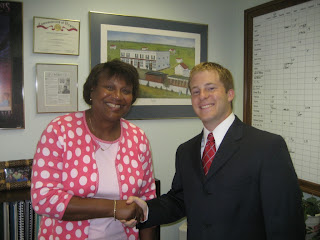 Shaking hands with HCPS HR head Patrese Pruden to "seal the deal."
Thank God for cruise control. As would happen when one spends 800 miles on the road in one stretch, I encountered a variety of speed limits, such as the 70 mph in Michigan, 65 mph in our backwards-minded southeastern neighbor, or 55 mph through all the work-absent "construction" zones along the Pennsylvania Turnpike. Speed limits are rules; they're guidelines that must be followed. Yet even in a 65-mph zone, I found myself drifting along with whatever everyone else did, going with the flow of traffic and not giving much heed to how fast I was going--sixty, seventy, even eighty-plus miles per hour.
Isn't this much like our lives as disciples of Jesus in this world? How easy it is to simply watch what everyone else around me is doing and get sucked into that! Even at the bar on Friday night I had to be continually vigilant. And it's more than just unwittingly meshing with the ambient activity; "going with the flow" is really caving in to my own comfort levels and desires versus giving steadfast, alert attention to the truth of God's Word and the authority of Christ. I'm sure that it's more than just a linguistic coincidence that "disciple" and "discipline" both have the same root of vigilant training of one's mind and will. "So roll up your sleeves, put your mind in gear, be totally ready to receive the gift that's coming when Jesus arrives. Don't lazily slip back into those old grooves of evil, doing just what you feel like doing. You didn't know any better then; you do now. As obedient children, let yourselves be pulled into a way of life shaped by God's life, a life energetic and blazing with holiness. God said, 'I am holy; you be holy' " (1 Peter 1:13-16, The Message).
 Richmond the beautiful: row houses in the Church Hill district
Urinal faith. In case you have two X chromosomes and don't know the Urinal Code of Conduct, there is a universal, unspoken rule that you never use a urinal immediately adjacent to a urinal in use. Period. So when I stopped to use a restroom at a highway rest stop, I thought to myself, "This is stupid; there are four urinal in here, but there might as well only be two, since by The Rule only two could be in use at any point in time. It's as if the urinal next to me weren't even there." But then I had a reality check: No, the urinal really is there, an objective reality, for anyone to use. We've simply excluded its use by our own made-up rules.
How much this is like our reconciliation to God in Christ! In 2 Corinthians 5 St. Paul writes of our reconciliation as an accomplished fact. "God . . . reconciled us to Himself through Christ . . . . God was in Christ reconciling the world to Himself, not counting their trespasses against them" (vv. 18, 19). In a twist of logic that undermines all human reason, the sins of all people have already been dealt with and put away. But we can fail to believe its truth and thus not receive its saving benefits. Christ is there for us, but we do not "have" him (1 John 5:12).
Likewise we can read in the Holy Scriptures that "if anyone is in Christ, he is a new creation" (2 Corinthians 5:17); "we have been buried with [Christ] through baptism into death, so that as Christ was raised from the dead through the glory of the Father, so we too might walk in newness of life. . . . Even so consider yourselves to be dead to sin, but alive to God in Christ Jesus" (Romans 6:4, 11); "This [bread] is My body which is given for you" (Luke 22:19). I do not understand it at all, but it's as if the apostles preached in this way: "Your redemption has taken place. If you repent of your ways and believe it, you receive it, and your salvation is truly effective. But if you don't believe it, you reject the Son of God and the Father's gracious gifts through him, and you judge yourself unworthy of eternal life." If we believe that we are in fact reconciled to Christ, that we have been made anew by his Spirit, and that he is in the Sacraments indeed present with his forgiveness and resurrection-life, then all those things are in fact ours to use. Jesus and his saving benefits are there whether we reckon it or not. We can believe and receive, or we can cast a suspicious eye of unbelief and fail to take hold of all that he promises and offers.
 More well-kept row houses in my district, The Fan
 Shaking hands with HCPS HR head Patrese Pruden to "seal the deal."
Thank God for cruise control. As would happen when one spends 800 miles on the road in one stretch, I encountered a variety of speed limits, such as the 70 mph in Michigan, 65 mph in our backwards-minded southeastern neighbor, or 55 mph through all the work-absent "construction" zones along the Pennsylvania Turnpike. Speed limits are rules; they're guidelines that must be followed. Yet even in a 65-mph zone, I found myself drifting along with whatever everyone else did, going with the flow of traffic and not giving much heed to how fast I was going--sixty, seventy, even eighty-plus miles per hour.
Isn't this much like our lives as disciples of Jesus in this world? How easy it is to simply watch what everyone else around me is doing and get sucked into that! Even at the bar on Friday night I had to be continually vigilant. And it's more than just unwittingly meshing with the ambient activity; "going with the flow" is really caving in to my own comfort levels and desires versus giving steadfast, alert attention to the truth of God's Word and the authority of Christ. I'm sure that it's more than just a linguistic coincidence that "disciple" and "discipline" both have the same root of vigilant training of one's mind and will. "So roll up your sleeves, put your mind in gear, be totally ready to receive the gift that's coming when Jesus arrives. Don't lazily slip back into those old grooves of evil, doing just what you feel like doing. You didn't know any better then; you do now. As obedient children, let yourselves be pulled into a way of life shaped by God's life, a life energetic and blazing with holiness. God said, 'I am holy; you be holy' " (1 Peter 1:13-16, The Message).
 Richmond the beautiful: row houses in the Church Hill district
Urinal faith. In case you have two X chromosomes and don't know the Urinal Code of Conduct, there is a universal, unspoken rule that you never use a urinal immediately adjacent to a urinal in use. Period. So when I stopped to use a restroom at a highway rest stop, I thought to myself, "This is stupid; there are four urinal in here, but there might as well only be two, since by The Rule only two could be in use at any point in time. It's as if the urinal next to me weren't even there." But then I had a reality check: No, the urinal really is there, an objective reality, for anyone to use. We've simply excluded its use by our own made-up rules.
How much this is like our reconciliation to God in Christ! In 2 Corinthians 5 St. Paul writes of our reconciliation as an accomplished fact. "God . . . reconciled us to Himself through Christ . . . . God was in Christ reconciling the world to Himself, not counting their trespasses against them" (vv. 18, 19). In a twist of logic that undermines all human reason, the sins of all people have already been dealt with and put away. But we can fail to believe its truth and thus not receive its saving benefits. Christ is there for us, but we do not "have" him (1 John 5:12).
Likewise we can read in the Holy Scriptures that "if anyone is in Christ, he is a new creation" (2 Corinthians 5:17); "we have been buried with [Christ] through baptism into death, so that as Christ was raised from the dead through the glory of the Father, so we too might walk in newness of life. . . . Even so consider yourselves to be dead to sin, but alive to God in Christ Jesus" (Romans 6:4, 11); "This [bread] is My body which is given for you" (Luke 22:19). I do not understand it at all, but it's as if the apostles preached in this way: "Your redemption has taken place. If you repent of your ways and believe it, you receive it, and your salvation is truly effective. But if you don't believe it, you reject the Son of God and the Father's gracious gifts through him, and you judge yourself unworthy of eternal life." If we believe that we are in fact reconciled to Christ, that we have been made anew by his Spirit, and that he is in the Sacraments indeed present with his forgiveness and resurrection-life, then all those things are in fact ours to use. Jesus and his saving benefits are there whether we reckon it or not. We can believe and receive, or we can cast a suspicious eye of unbelief and fail to take hold of all that he promises and offers.
 More well-kept row houses in my district, The Fan
Subscribe to:
Posts (Atom)