While reading a book by Eugene Peterson a few months ago, I came across some quotes on eschatology from the Lutheran theologian Juergen Moltmann, one of Europe's foremost 20th-century philosopher-theologians, along with Karl Barth, Dietrich Bonhoeffer, Reinhold Niebuhr, and Rudolf Bultmann, several of whose theology bears some flavor of existentialism, liberation theology, or marxism. Now I'll be the first to say that I'm a huge fan of Bonhoeffer, but I've always had an uneasy response to his involvement in an assassination plot on Adolf Hitler in 1944. Moltmann and Niebuhr were strong political and social activitists, whose theologies were largely developed around the practical outworkings of the "Christian faith".**
Then, last month, I read a wonderfully thought-provoking little book by some leading evangelicals in the field of hermeutics (the process of interpreting Scripture for modern contexts) titled Beyond the Bible: Moving From Scripture to Theology (Baker Academic, 2004). It has helped me to become aware of how incredibly important thinking about theology is for every decision we make today (and by what methods we go about doing that). Pepsi has produced new cans printed with the Pledge of Allegiance, but without the words "under God." Most evangelicals would raise a stink about this, but I'm not really one to waste my energy in such an inconsequential and unwinnable battle. But what I did begin wondering is whether or not I can even honestly say, "I pledge allegiance to the flag and to the United States of America and to the republic for which it stands." After all, Paul writes that our "citizenship is in heaven" (Philippians 3:20). And how would I go about forming a biblical theology concerning pacifism/involvement or euthanasia or capital punishment or contraceptives or stem cell research? My personal jury is currently hung on all of these issues.
In the midst of this, part of me begs the difficult question, Is it possible to have pure interpretation of Scripture apart from any philosophical presuppositions? Take Bultmann, for example: his NT theology developed strongly from the existentialism of Martin Heidegger. Or Moltmann with marxist Ernst Bloch. I look at my own opinions regarding the Bible and see clearly that I believe certain things: the Bible contains absolute propositional claims and is a factual record of God's work in history. This stands opposed to much of the liberal theology built around the Bible as personal or community records of their own experience of God, as communicated through images and metaphor. (But what do we do with the ends of history and the Scriptural communiques concerning creation [Genesis 1-11] and re-creation [The Revelation]? After all, even Bonhoeffer wavered over the literal existence of an Adam and Eve [see his Creation and Fall]. And I'm still not sure about Jonah.) Likewise, I know I have presuppositions governing my view of science.
And then what do you make of Barth, the champion of neo-orthodoxy, who says that the Bible is not actually the revelation of God (for Scripture is finite and the product of fallen, finite man), but rather the record of the revelation of God to men whom he inspired? Barth says that because God is "wholly other" and transcendant to mankind and creation, although Scripture can express God in human concepts, it does not truly reveal God himself. However, in his sovereign freedom and love, God does reveal himself through this human expression in the preaching of the written Word.
Anyway, this has left me with a lot of questions that hang uneasily in my mind right now, forcing me toward prayer and gratitude that my acceptance and security before God rests in his might and love in Christ rather than in my strength of faith. "Faith, if it ever is to be a noun, is properly the whole play, from the first scene to the last" (Walter Wangerin, Jr.).
_____________________________________
*For a primer on proto-liberal Christianity, please see Rob Bell's new book, Velvet Elvis. From what I've read of it so far--and I'll admit it's not much--Bell is well-intentioned but wrong.
** I say "Christian faith" because some of these men are considered to belong to the "liberal" camp, with Christologies and/or views of Scripture that diverge from orthodox Christianity.
Wednesday, January 25, 2006


Wednesday, January 18, 2006
When it's good to be self-centered
"Therefore I will judge you, O house of Israel Israel
__________________________________
*I am in no way saying that the opinions of Pat Robertson or The 700 Club are necessarily aligned with biblical judgments on the ways and purposes of God.
**The Greek eudokia ("good pleasure"; NASB "kind intention", but see margin notes) has the meaning of a purpose, intention, or desire in which its author finds pleasure or satisfaction (cf. Matthew 11.26; Luke 2.14; 10.21; Romans 10.1; Ephesians 1.5, 9; Philippians 1.15; 2.13; 2 Thessalonians 1.11).
__________________________________
*I am in no way saying that the opinions of Pat Robertson or The 700 Club are necessarily aligned with biblical judgments on the ways and purposes of God.
**The Greek eudokia ("good pleasure"; NASB "kind intention", but see margin notes) has the meaning of a purpose, intention, or desire in which its author finds pleasure or satisfaction (cf. Matthew 11.26; Luke 2.14; 10.21; Romans 10.1; Ephesians 1.5, 9; Philippians 1.15; 2.13; 2 Thessalonians 1.11).
Friday, January 13, 2006
Kurban Bayramı
This week of January 9-13 here in Turkey is Kurban Bayramı (KOOR-bon BYE-rom-uh), the Sacrifice Festival celebrated by observant Muslims. It is an extra-qur'anic holiday in remembrance of when Ibrahim (Abraham) was commanded by Al'lah to sacrifice his then-only son Ishmael (not Isaac). Seeing the obedient faith of Ibrahim, Al'lah provided a substitute ram, allowing Ishmael to live and become the father of the Arabic peoples, from whom the prophet Muhammad later came.
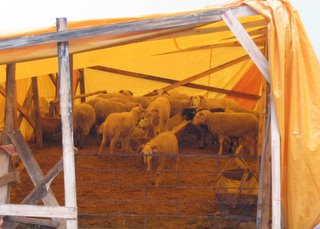
According to popular Islam, there is a "narrow bridge" that all must cross is they wish to get to Paradise and receive Al'lah's mercy. From what I can gather from the Qur'an and from other Muslims, this mercy is based upon what Muslims do to prove themselves faithful (the "five pillars": Ramadan fasting, daily ritual prayer, almsgiving, confession of their monotheistic faith, and pilgrimage to Mecca) and what they do to please Al'lah. One thing many people believe is that a way across this narrow bridge includes animal sacrifice. The sacrificed animal will carry you on its back across the bridge, and so you will safely make it across.
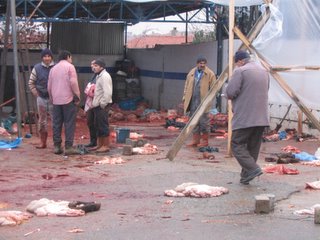
For the holiday, Muslims will purchase either a "large-headed" animal (cows and camels) or a "small-headed" one (rams and goats). All I've seen here are rams, althought I've seen what I think are cow legs on the ground. Then, while holding the animal's head to the ground facing Mecca, its throat is slit, and its meat is cut up and given to families who've purchased it. At least one-third of the meat is to be given to the poor and needy, much like during the Ramadan fasting.
At Christmastime I was talking about candy canes with a friend of mine here. I told him how the thick red stripe represents Jesus' shed blood, and the stripes are the whipmarks, a constant reminder that Jesus came into this world not only to preach the kingdom of God, but also to be a kurban, a lamb slaughtered to bear our pains and bring us healing:
Surely our griefs He Himself bore,
And our sorrows He carried;
Yet we ourselves esteemed Him stricken,
Smitten of God and afflicted.
But He was pierced through for our transgressions,
He was crushed for our iniquities;
The chastening for our well-being fell upon Him,
And by His scourging we are healed.
All of us like sheep have gone astray,
Each of us to his own way;
But the LORD has caused the iniquity of us all
To fall on Him. (Isaiah 53.4-6)
"Blood? That's disgusting! How can you give candy canes to children?" The cross will always be a stumbling block. "Well, isn't the Sacrifice Festival awful bloody?" "Yes, but we don't let little children watch it, and it's not a human."
Isaac laboring up Mount Moriah, bearing the wood for the sacrificial pyre upon his back ... His father willing to bring down the knife on his only son ... An innocent Jewish rabbi laboring up Skull Hill, bearing his wooden cross ... His Father, no substitute ram in sight this time, putting to death his only Son ...
"Now [Caiaphas] did not say this on his own initiative, but being high priest that year, he prophesied that Jesus was going to die for the nation, and not for the nation only, but in order that He might also gather together into one the children of God who are scattered abroad" (John 11.51-52).
How on Earth can Islam claim to be the final revelation of God for all peoples? Goats, camels, rams, and sheep don't live everywhere on the earth. How can the natives of Borneo or the Pacific Northwest obtain such animals to please Al'lah and cross the bridge? How can they make the hajj to Mecca? I don't care what they try to say, Islam is a religion which, in its purest expression, is geographically limited. God destroyed Jerusalem in A.D. 70 to prove that his kingdom would not be only for the Jews, but rather for all the nations of the world. The gospel knows no geographical or ethnic boundaries, for the risen Christ is Lord over the whole world, not a local moon-god like Al'lah (hence the crescent as the symbol of Islam). Praise God for his mercy upon the world.

According to popular Islam, there is a "narrow bridge" that all must cross is they wish to get to Paradise and receive Al'lah's mercy. From what I can gather from the Qur'an and from other Muslims, this mercy is based upon what Muslims do to prove themselves faithful (the "five pillars": Ramadan fasting, daily ritual prayer, almsgiving, confession of their monotheistic faith, and pilgrimage to Mecca) and what they do to please Al'lah. One thing many people believe is that a way across this narrow bridge includes animal sacrifice. The sacrificed animal will carry you on its back across the bridge, and so you will safely make it across.
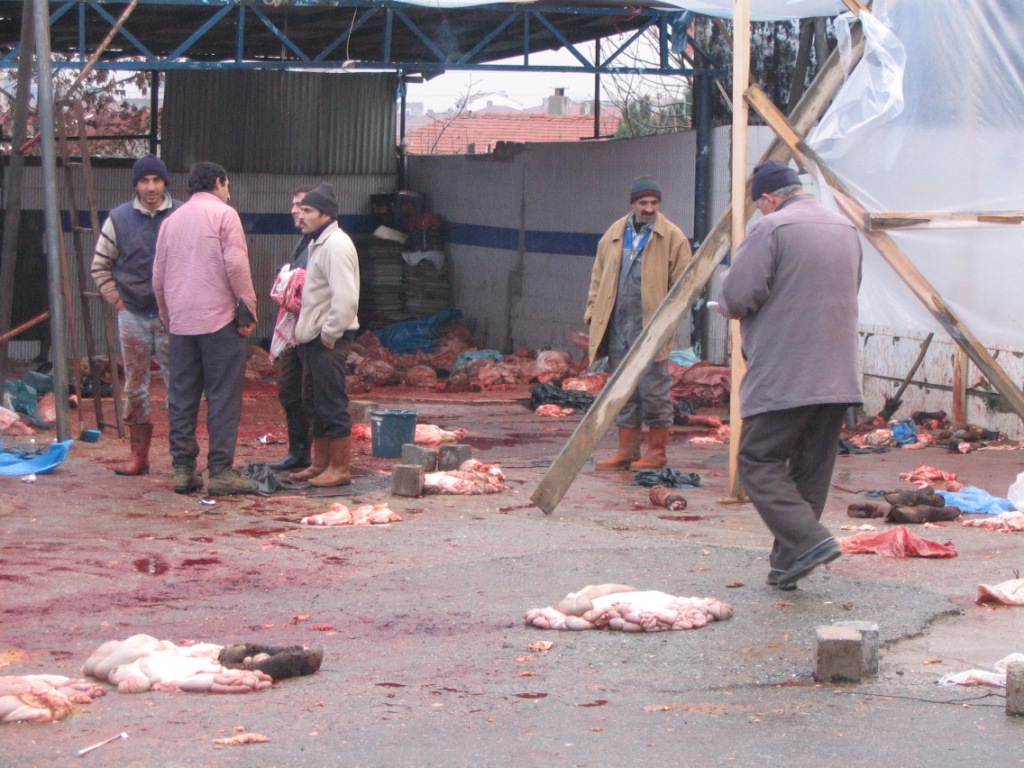
For the holiday, Muslims will purchase either a "large-headed" animal (cows and camels) or a "small-headed" one (rams and goats). All I've seen here are rams, althought I've seen what I think are cow legs on the ground. Then, while holding the animal's head to the ground facing Mecca, its throat is slit, and its meat is cut up and given to families who've purchased it. At least one-third of the meat is to be given to the poor and needy, much like during the Ramadan fasting.
At Christmastime I was talking about candy canes with a friend of mine here. I told him how the thick red stripe represents Jesus' shed blood, and the stripes are the whipmarks, a constant reminder that Jesus came into this world not only to preach the kingdom of God, but also to be a kurban, a lamb slaughtered to bear our pains and bring us healing:
Surely our griefs He Himself bore,
And our sorrows He carried;
Yet we ourselves esteemed Him stricken,
Smitten of God and afflicted.
But He was pierced through for our transgressions,
He was crushed for our iniquities;
The chastening for our well-being fell upon Him,
And by His scourging we are healed.
All of us like sheep have gone astray,
Each of us to his own way;
But the LORD has caused the iniquity of us all
To fall on Him. (Isaiah 53.4-6)
"Blood? That's disgusting! How can you give candy canes to children?" The cross will always be a stumbling block. "Well, isn't the Sacrifice Festival awful bloody?" "Yes, but we don't let little children watch it, and it's not a human."
Isaac laboring up Mount Moriah, bearing the wood for the sacrificial pyre upon his back ... His father willing to bring down the knife on his only son ... An innocent Jewish rabbi laboring up Skull Hill, bearing his wooden cross ... His Father, no substitute ram in sight this time, putting to death his only Son ...
* * *
"Now [Caiaphas] did not say this on his own initiative, but being high priest that year, he prophesied that Jesus was going to die for the nation, and not for the nation only, but in order that He might also gather together into one the children of God who are scattered abroad" (John 11.51-52).
How on Earth can Islam claim to be the final revelation of God for all peoples? Goats, camels, rams, and sheep don't live everywhere on the earth. How can the natives of Borneo or the Pacific Northwest obtain such animals to please Al'lah and cross the bridge? How can they make the hajj to Mecca? I don't care what they try to say, Islam is a religion which, in its purest expression, is geographically limited. God destroyed Jerusalem in A.D. 70 to prove that his kingdom would not be only for the Jews, but rather for all the nations of the world. The gospel knows no geographical or ethnic boundaries, for the risen Christ is Lord over the whole world, not a local moon-god like Al'lah (hence the crescent as the symbol of Islam). Praise God for his mercy upon the world.
Wednesday, January 11, 2006
My wish list
Okay, so I know Christmas came and went nearly three weeks ago, but there are some things a guy just has to have. In my case, some of them are well beyond my pocketbook's reach. But hey, a guy can dream, can't he?
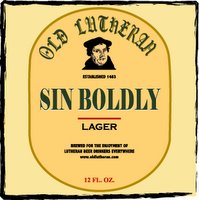 If you know me, you know I have a weak spot for good beer, with my current favorites being Samuel Adams Boston Lager and Bell's Best Brown Ale. A while back I stumbled across the crazy Jell-O-eating Norwegians at Old Lutheran. When I saw they make a beer called Sin Boldy Lager, well, I about keeled over in euphoria. Of course, ol' Martin is known for his infamous and oft misunderstood "Be a sinner, and sin boldly, but trust in Christ more strongly still, and rejoice in him who is the Victor over sin, death, and the world." But did you know that he also once said, "Who loves not women, wine, and song remains a fool his whole life long"?
 Now what good is 16 ounces of a refreshing ale without a container from which to drink it? Hence one of my favorite things is the pint glass (hint, hint). Now cycling and beer go together like ham and cheese (or, here in Turkey, cigarettes and mayonnaise), so when my eyes glanced upon this argyle-wearin' beauty-on-a-bike pint glass from Dirt Rag magazine, the salivating began. (No, it's not just because she's a cute girl on a bike! Although, ladies, that's a big bonus.)
 To keep up with the flow of things, why not introduce you to my dream mountain bike: the Independent Fabrication Deluxe? These Massachusetts framebuilders know their craft. Full suspension bikes are great, but in forested, sandy Michigan, I think the hardtail is still where it's at. The Deluxe is one helluva sweet piece of steel--and it had better be, at $1400 for the frame alone. (The complete bike, tricked out like I'd like, would run about $3800.) IF bikes simply have soul, and isn't that what mountain biking is all about, anyway? I even have my dream paint job all picked out : a sparkly, deep black cherry, with autumn leaves hand-painted on near where the seat tube, top tube, and seatstays intersect.
 While America is known as the home of mountain biking, road cycling has its traditions in the coastlines of Italy, the fields of France, and the cobblestones of Belgium. And while the Colnago C50 is one sweet bike, I'm an American, and American cycling is on the rise. Once again, gimme a road bike by Indy Fab: their steel Crown Jewel. Steel bike frames may be old-school, but they're durable, lively, and easy to repair. Once again, the frame will set me back about $1600, but I'm only dreaming. Rock 'n' roll.
 Call it the mark of the beast or whatever you wish, but iPods are just plain cool. And they're also $300 that I don't have. But sitting on public transportation for up to three hours per day would be a lot better if accompanied by more than just one CD. I wouldn't mind reading, either, if I didn't have to stand for much of the time while getting jostled around on a minibus. Blech. I suppose I could justify it by saying I'll use it to listen to sermons while traveling.
(In case you can't tell, I have the week off due to campuses being closed for Kurban Bayrami, the Sacrifice Festival commemorating Abraham's willingness to sacrifice Ishmael. I've been blogging like a fiend.)
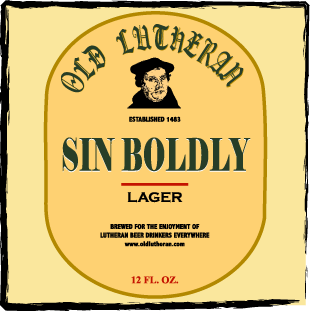 If you know me, you know I have a weak spot for good beer, with my current favorites being Samuel Adams Boston Lager and Bell's Best Brown Ale. A while back I stumbled across the crazy Jell-O-eating Norwegians at Old Lutheran. When I saw they make a beer called Sin Boldy Lager, well, I about keeled over in euphoria. Of course, ol' Martin is known for his infamous and oft misunderstood "Be a sinner, and sin boldly, but trust in Christ more strongly still, and rejoice in him who is the Victor over sin, death, and the world." But did you know that he also once said, "Who loves not women, wine, and song remains a fool his whole life long"?
 Now what good is 16 ounces of a refreshing ale without a container from which to drink it? Hence one of my favorite things is the pint glass (hint, hint). Now cycling and beer go together like ham and cheese (or, here in Turkey, cigarettes and mayonnaise), so when my eyes glanced upon this argyle-wearin' beauty-on-a-bike pint glass from Dirt Rag magazine, the salivating began. (No, it's not just because she's a cute girl on a bike! Although, ladies, that's a big bonus.)
 To keep up with the flow of things, why not introduce you to my dream mountain bike: the Independent Fabrication Deluxe? These Massachusetts framebuilders know their craft. Full suspension bikes are great, but in forested, sandy Michigan, I think the hardtail is still where it's at. The Deluxe is one helluva sweet piece of steel--and it had better be, at $1400 for the frame alone. (The complete bike, tricked out like I'd like, would run about $3800.) IF bikes simply have soul, and isn't that what mountain biking is all about, anyway? I even have my dream paint job all picked out : a sparkly, deep black cherry, with autumn leaves hand-painted on near where the seat tube, top tube, and seatstays intersect.
 While America is known as the home of mountain biking, road cycling has its traditions in the coastlines of Italy, the fields of France, and the cobblestones of Belgium. And while the Colnago C50 is one sweet bike, I'm an American, and American cycling is on the rise. Once again, gimme a road bike by Indy Fab: their steel Crown Jewel. Steel bike frames may be old-school, but they're durable, lively, and easy to repair. Once again, the frame will set me back about $1600, but I'm only dreaming. Rock 'n' roll.
 Call it the mark of the beast or whatever you wish, but iPods are just plain cool. And they're also $300 that I don't have. But sitting on public transportation for up to three hours per day would be a lot better if accompanied by more than just one CD. I wouldn't mind reading, either, if I didn't have to stand for much of the time while getting jostled around on a minibus. Blech. I suppose I could justify it by saying I'll use it to listen to sermons while traveling.
(In case you can't tell, I have the week off due to campuses being closed for Kurban Bayrami, the Sacrifice Festival commemorating Abraham's willingness to sacrifice Ishmael. I've been blogging like a fiend.)
Tuesday, January 10, 2006
Let the high praises of God be in our mouths
It's no surprise that the apostle John's Revelation (Greek apokalypsos: something revealed or made known, not some end-time cataclysmic event) is one of my favorite books of the Bible. It not only brings everything to a fluorishing finish, but it shows the depth and meaning of how we live our lives today. And with the stuff on apostasy I posted about yesterday, it again found its way into my thoughts. The following is from a lengthy (sorry!) journal entry I wrote two months ago after reading this book several times.
"They said to the mountains and to the rocks, 'Fall on us and hide us from the presence of Him who sits on the throne, and from the wrath of the Lamb; for the great day of their wrath has come, and who is able to stand? ... After these things I looked, and behold, a great multitude which no one could count ... standing before the throne and before the Lamb, clothed in white robes and palm branches were in their hands" (The Revelation 6.16-17; 7.9).
A day is coming--it's in motion already--when Jesus the King will be revealed in flaming fire with all his angels (Matt. 25.31; 2 Ths. 1.7-10). I don't know what it will look like, though the Son of Man promises to come as stunningly and obviously as lightning that lights up the dark skies from one horizon to the other (Matt. 24.27). There are "myriads of myriads, and thousands of thousands" of heavenly host who will all come and fill the skies. Could they look like flaming nightmares, with white, streaming hair and swords of such flame that no man can bear the sight (Rev. 9)? Surely it will be so for many. But what a welcome sight of beauty they will be for us who have believed!
The world is getting worse, eventually to the point when utter chaos and hopelessness will reign in our sight, and the chorus of man will be, "Who can stand?"
Yet in the face of this there is, in fact, a true hope: some, even a great multitude, do stand before the throne and the Lamb! Who are such people? In addition to the angels (7.1, 11) they are the people purchased by the Lamb's blood and sealed with his mark (7.2-8; 9.4; cf. Ezek. 9.4). The 'sealing' of Christ's purchased saints is more than sufficient to withstand the day of history's awful 'unsealings' (Rev. 6.1 - 8.5). It allows us to stand, to withstand all of evil and judgment. For his blood has washed us of our iniquities (1.5; 7.14) and has bought for us faith and the Holy Spirit.
It is on this hope that Paul writes, "No matter how many promises God has made, they are 'Yes' in Christ. And so though him the 'Amen' is spoken by us to the glory of God. Now it is God who makes both us and you stand firm in Christ. He anointed us, set his seal of ownership on us, and put his Spirit in our hearts as a deposit, guaranteeing what is to come" (2 Cor. 1.20-22, NIV).
What is Paul's response to the Messiah, who has become our righteousness and sure anchor of hope before God? He proclaims "Amen!" to God's glory: he worships! And that is exactly what those standing before the God of glory do: they shout praises and sing hymns, longing for the truth of God the Just and God the King to become ever more manifest in the earthly sphere. That's the resounding "Amen!" and "It will be so!" Sometimes it's in a painful longing: "How long, O Lord, holy and true ...?" (6.10). But all the while they know the end: Christ will reign with an iron scepter and with peace and love and equity for all eternity (11.15-17). So it is the worshiping, praying, waiting community, indwelled by the Spirit and living in his fruitfulness (Eph. 5.18-21), that stands and will stand until the glorious completion of this age. (And it's a completion, not an end merely: God's redemptive plan is moving somewhere, blown by the wind [pneuma] of his Spirit. It is not a terminus, but rather a new beginning of eternity that is approaching us with unstoppable momentum.)
O Jesus, how can we not pray? How we not praise? It is our life, our hope, our great privilege to participate in this triumph you have wrought.
Reading on in the Apocalypse, I see God bring together more threads. In chapter 12, upon Jesus' birth the dragon gets unceremoniously dumped to the earth, a sore loser. God is setting up his unending, covert victory parade in--seriously?--the birth of a little boy laid in a stone feed trough. The downfall of Satan and the world becomes ever the more sharp and decisive in the death of the Lamb (John 12.31). Even I still balk in disbelief--sometimes even a bit of disappointment, perhaps--that God chooses such humble means to bring about his salvation work here on Earth. He even calls today's kingdom-deeds "small things" (Zech. 4.10).
But the glorious fulfillment is coming. Bricks of God's temple are getting fitted into a structure, a paradigm--a kingdom--of heretofore unseen and unfathomed beauty and radiance where everything good will be seen and known and felt in the face of Christ.
Even now God invites us to participate in what he's doing in the downfall of evil and in the spread of his renown (Luke 10.17-20; Acts 1.5-8). Somehow, some way, our actions and prayers matter and influence and take part in the history of the cosmos that has been decreed to pass according to the minutiae of God's unalterable will (Eph. 1.9-11). This is clear from Rev. 8.1-5 and 12.11 and the Lukan text. Yet it's never about us or what we do. It's about God and what he has said, is saying, and will say; what he has done, is doing, and will yet do. The only right and enduring response is worship. Even Jesus acknowledged this: "Nevertheless, do not rejoice in this, that the spirits are subject to you"--what we're doing--"but rejoice that your names are recorded in heaven." Eugene H. Peterson writes in Reversed Thunder: "Their work was ancillary to his [Jesus']; to keep their focus sharp, they should aim their rejoicing at his accomplishment on their behalf. We are the recipients and participants in salvation, not its makers and shapers." *
It's inescapable: the call to worship beckons to all of us in all stages, in all places, in all circumstances. It's what fixes our eyes on our one sure hope: the risen Lord Jesus Christ. It keeps us in tune with the Almighty God who declares and who judges, who shapes and who saves. Those who don't worship and fight for faith and seek God's mercy and his Spirit lose focus. They fall for the sellouts that promise so much but deliver so little. That is the 'mark of the beast,' the 666. It's lack of worship that makes us run after unnecessary 'oil and wine when we clearly don't get our needed nourishment of 'wheat and barley' (Rev. 6.6). It's no wonder that the chief act of God's holy people in the Apocalypse is worship. It keeps them--and us--sane and ordered, focused on what we have and what is to come in Christ from God's giving hands, rather than on what we think we lack. Worship and thanksgiving allow us to say and see, "I belong," not "I need more belongings." They allow us to say, "Even when are faithless, he remains faithful, for he cannot deny himself." They give us direction--God--and not a chaotic fretting and pursuit of empty desires and false securities.
In light of this, it's a wonder how muted and dulled, how vapid my worship and desire to truly see God is. When was the last time I voiced--let alone shouted--praises to God my Savior with my roommates, in my prayers, or in the assembly? I can't think of it. Father, I know David wasted away when he held back speaking the good (Ps. 39.2). It's a fight, it's a knock-down, bare-knuckle fight for faith and joy, and because I'm part of the same church as the apostle John's, the same called and chosen and faithful ones who've overcome through Jesus (Rev. 17.14), I must and will praise you with words, my heart, my mind, my daily living.
The LORD takes pleasure in His people;
He will beautify the afflicted ones with salvation.
Let the godly ones exult in glory;
Let them sing for joy on their beds.
Let the high praises of God be in their mouth,
And a two-edged sword in their hand.
(Psalm 149.4-6)
________________________________
*Eugene H. Peterson, Reversed Thunder: The Revelation of John & the Praying Imagination (New York: HarperCollins, 1988), 161.
"They said to the mountains and to the rocks, 'Fall on us and hide us from the presence of Him who sits on the throne, and from the wrath of the Lamb; for the great day of their wrath has come, and who is able to stand? ... After these things I looked, and behold, a great multitude which no one could count ... standing before the throne and before the Lamb, clothed in white robes and palm branches were in their hands" (The Revelation 6.16-17; 7.9).
A day is coming--it's in motion already--when Jesus the King will be revealed in flaming fire with all his angels (Matt. 25.31; 2 Ths. 1.7-10). I don't know what it will look like, though the Son of Man promises to come as stunningly and obviously as lightning that lights up the dark skies from one horizon to the other (Matt. 24.27). There are "myriads of myriads, and thousands of thousands" of heavenly host who will all come and fill the skies. Could they look like flaming nightmares, with white, streaming hair and swords of such flame that no man can bear the sight (Rev. 9)? Surely it will be so for many. But what a welcome sight of beauty they will be for us who have believed!
The world is getting worse, eventually to the point when utter chaos and hopelessness will reign in our sight, and the chorus of man will be, "Who can stand?"
Yet in the face of this there is, in fact, a true hope: some, even a great multitude, do stand before the throne and the Lamb! Who are such people? In addition to the angels (7.1, 11) they are the people purchased by the Lamb's blood and sealed with his mark (7.2-8; 9.4; cf. Ezek. 9.4). The 'sealing' of Christ's purchased saints is more than sufficient to withstand the day of history's awful 'unsealings' (Rev. 6.1 - 8.5). It allows us to stand, to withstand all of evil and judgment. For his blood has washed us of our iniquities (1.5; 7.14) and has bought for us faith and the Holy Spirit.
It is on this hope that Paul writes, "No matter how many promises God has made, they are 'Yes' in Christ. And so though him the 'Amen' is spoken by us to the glory of God. Now it is God who makes both us and you stand firm in Christ. He anointed us, set his seal of ownership on us, and put his Spirit in our hearts as a deposit, guaranteeing what is to come" (2 Cor. 1.20-22, NIV).
What is Paul's response to the Messiah, who has become our righteousness and sure anchor of hope before God? He proclaims "Amen!" to God's glory: he worships! And that is exactly what those standing before the God of glory do: they shout praises and sing hymns, longing for the truth of God the Just and God the King to become ever more manifest in the earthly sphere. That's the resounding "Amen!" and "It will be so!" Sometimes it's in a painful longing: "How long, O Lord, holy and true ...?" (6.10). But all the while they know the end: Christ will reign with an iron scepter and with peace and love and equity for all eternity (11.15-17). So it is the worshiping, praying, waiting community, indwelled by the Spirit and living in his fruitfulness (Eph. 5.18-21), that stands and will stand until the glorious completion of this age. (And it's a completion, not an end merely: God's redemptive plan is moving somewhere, blown by the wind [pneuma] of his Spirit. It is not a terminus, but rather a new beginning of eternity that is approaching us with unstoppable momentum.)
O Jesus, how can we not pray? How we not praise? It is our life, our hope, our great privilege to participate in this triumph you have wrought.
* * *
Reading on in the Apocalypse, I see God bring together more threads. In chapter 12, upon Jesus' birth the dragon gets unceremoniously dumped to the earth, a sore loser. God is setting up his unending, covert victory parade in--seriously?--the birth of a little boy laid in a stone feed trough. The downfall of Satan and the world becomes ever the more sharp and decisive in the death of the Lamb (John 12.31). Even I still balk in disbelief--sometimes even a bit of disappointment, perhaps--that God chooses such humble means to bring about his salvation work here on Earth. He even calls today's kingdom-deeds "small things" (Zech. 4.10).
But the glorious fulfillment is coming. Bricks of God's temple are getting fitted into a structure, a paradigm--a kingdom--of heretofore unseen and unfathomed beauty and radiance where everything good will be seen and known and felt in the face of Christ.
Even now God invites us to participate in what he's doing in the downfall of evil and in the spread of his renown (Luke 10.17-20; Acts 1.5-8). Somehow, some way, our actions and prayers matter and influence and take part in the history of the cosmos that has been decreed to pass according to the minutiae of God's unalterable will (Eph. 1.9-11). This is clear from Rev. 8.1-5 and 12.11 and the Lukan text. Yet it's never about us or what we do. It's about God and what he has said, is saying, and will say; what he has done, is doing, and will yet do. The only right and enduring response is worship. Even Jesus acknowledged this: "Nevertheless, do not rejoice in this, that the spirits are subject to you"--what we're doing--"but rejoice that your names are recorded in heaven." Eugene H. Peterson writes in Reversed Thunder: "Their work was ancillary to his [Jesus']; to keep their focus sharp, they should aim their rejoicing at his accomplishment on their behalf. We are the recipients and participants in salvation, not its makers and shapers." *
It's inescapable: the call to worship beckons to all of us in all stages, in all places, in all circumstances. It's what fixes our eyes on our one sure hope: the risen Lord Jesus Christ. It keeps us in tune with the Almighty God who declares and who judges, who shapes and who saves. Those who don't worship and fight for faith and seek God's mercy and his Spirit lose focus. They fall for the sellouts that promise so much but deliver so little. That is the 'mark of the beast,' the 666. It's lack of worship that makes us run after unnecessary 'oil and wine when we clearly don't get our needed nourishment of 'wheat and barley' (Rev. 6.6). It's no wonder that the chief act of God's holy people in the Apocalypse is worship. It keeps them--and us--sane and ordered, focused on what we have and what is to come in Christ from God's giving hands, rather than on what we think we lack. Worship and thanksgiving allow us to say and see, "I belong," not "I need more belongings." They allow us to say, "Even when are faithless, he remains faithful, for he cannot deny himself." They give us direction--God--and not a chaotic fretting and pursuit of empty desires and false securities.
In light of this, it's a wonder how muted and dulled, how vapid my worship and desire to truly see God is. When was the last time I voiced--let alone shouted--praises to God my Savior with my roommates, in my prayers, or in the assembly? I can't think of it. Father, I know David wasted away when he held back speaking the good (Ps. 39.2). It's a fight, it's a knock-down, bare-knuckle fight for faith and joy, and because I'm part of the same church as the apostle John's, the same called and chosen and faithful ones who've overcome through Jesus (Rev. 17.14), I must and will praise you with words, my heart, my mind, my daily living.
The LORD takes pleasure in His people;
He will beautify the afflicted ones with salvation.
Let the godly ones exult in glory;
Let them sing for joy on their beds.
Let the high praises of God be in their mouth,
And a two-edged sword in their hand.
(Psalm 149.4-6)
________________________________
*Eugene H. Peterson, Reversed Thunder: The Revelation of John & the Praying Imagination (New York: HarperCollins, 1988), 161.
Monday, January 9, 2006
On apostasy and 'the last hour'
"I know that after my departure savage wolves will come in among you, not sparing the flock; and from among your own selves men will arise, speaking perverse things, to draw away the disciples after them" (Paul to the elders of the church at Ephesus, during his farewell to them in c. A.D. 54).
"Children, it is the last hour; and just as you have heard that antichrist is coming, even now many antichrists have appeared; from this we know that it is the last hour. They went out from us, but they were not really of us; for if they had been of us, they would have remained with us; but they went out, so that it would be shown that they all are not of us" (John the Elder, reassuring his congregation at Ephesus about Gnostic deceivers within the church, c. A.D. 90).
I never cease to be amazed when I read either of these passages at how exactly what Paul predicted would happen in Ephesus did in fact come true: Gnostic apostates arose from within the church and left, trying to draw away the young and unstable. Even as it was in John's days, it is yet "the last hour", when "false Christs and false prophets will arise ... in order to lead astray, if possible, the elect" (Mark 13.22). This is crazy to think of how imminent Jesus' return in glory is.
Over the past few years here in Turkey, there have been some pastors who've done the same, renouncing their profession of Christian faith and returning to Islam. The latest has just happened a few weeks ago. (Nevermind the date on the TDL article nor its hazy usage of quotation marks and lack of clarifying statements.) Two years ago, a pastor with many connections who reverted back to Islam made known vital information about most of the missions organizations here and the people working for them. Please pray for the church's safety here, that the lies being spread by the newest pastor will not harm local believers nor those working to spread the good news of Jesus Christ our King.
My first reaction at people like this is a sense of anger: How can they do such a thing? How can they forsake the goodness of God and the wonderful cross of Christ? But then I forget that it is only by God's sustaining grace that my faith in the gospel remains: "By the grace of God I am what I am" (1 Cor. 15.10). Blessed be God for turning this bad event into a source of encouragement for me and his church to further cling to his free and sovereign grace!
"Children, it is the last hour; and just as you have heard that antichrist is coming, even now many antichrists have appeared; from this we know that it is the last hour. They went out from us, but they were not really of us; for if they had been of us, they would have remained with us; but they went out, so that it would be shown that they all are not of us" (John the Elder, reassuring his congregation at Ephesus about Gnostic deceivers within the church, c. A.D. 90).
I never cease to be amazed when I read either of these passages at how exactly what Paul predicted would happen in Ephesus did in fact come true: Gnostic apostates arose from within the church and left, trying to draw away the young and unstable. Even as it was in John's days, it is yet "the last hour", when "false Christs and false prophets will arise ... in order to lead astray, if possible, the elect" (Mark 13.22). This is crazy to think of how imminent Jesus' return in glory is.
Over the past few years here in Turkey, there have been some pastors who've done the same, renouncing their profession of Christian faith and returning to Islam. The latest has just happened a few weeks ago. (Nevermind the date on the TDL article nor its hazy usage of quotation marks and lack of clarifying statements.) Two years ago, a pastor with many connections who reverted back to Islam made known vital information about most of the missions organizations here and the people working for them. Please pray for the church's safety here, that the lies being spread by the newest pastor will not harm local believers nor those working to spread the good news of Jesus Christ our King.
My first reaction at people like this is a sense of anger: How can they do such a thing? How can they forsake the goodness of God and the wonderful cross of Christ? But then I forget that it is only by God's sustaining grace that my faith in the gospel remains: "By the grace of God I am what I am" (1 Cor. 15.10). Blessed be God for turning this bad event into a source of encouragement for me and his church to further cling to his free and sovereign grace!
Sunday, January 8, 2006
Christian ecology
I once read somewhere than in one of his renowned commentaries on Romans, Douglas Moo makes a case for a Christian focus on ecology, presumably from Romans 8.20-22 (but perhaps also 1.20): "For the creation was subjected to futility, not willingly, but because of Him who subjected it, in hope that the creation itself also will be set free from its slavery to corruption into the freedom of the glory of the children of God. For we know that the whole creation groans and suffers the pains of childbirth together until now." Reading through the first chapters of Genesis this past week as I start another round of read-the-Bible-in-a-year has made me think of this again. Adam, as a prototype of all humanity, was put in Eden and told to cultivate and care for it (2.15). And both he and Eve were to be governors of the whole of living creation: plant and animal, mold and mollusk, grasshopper and ginko (1.28; cf. Psalm 8.3-8). But as a result of his sin, the ground became cursed; weeds and invasive species crept in, and crop yields dwindled radically (3.17-19).
As God's redeemed "new creations" and kingdom-workers, our new life in Christ involves regaining the image fractured by the Fall (Col. 3.10). Does it not follow that we ought to regain our status as nature's caretakers?
My friend Dan has a t-shirt bearing the slogan "Forget the trees; save the kids." This of course reflects God's priorities. But are we really to neglect nature? Surely not. After all, nature also serves as an image-bearer of God (e.g., Ps. 19.1; Rom. 1.20) and exists for God's pleasure and praise (Ps. 148). Biblically, the bestowal of blessing comes in the form of rain, snow, milk and honey, goats and sheep, and fruitful crops. And how can we rightly respect, teach, and learn from Jesus' teaching that points to "the lilies of the field" (Matt. 6.28) if they're unhealthy or fail to even exist for future generations?
As I think more about a career as a biology teacher, the more excited I get about environmental bio and related sciences (e.g., geology and geochemistry). Ecology has always been my favorite branch of the sciences; perhaps this is why! With the desire of leading students to a greater understanding and appreciation of the world around them and how they can--and do--influence it, even that plays a role in restoring the world and spreading the kingdom of God into every niche (pun intended; but then again, you won't get the joke if you're not an ecologist). How much more should the church value and encourage those in forestry, agricultural sciences, geology, or wildlife conservation! What about people within the church starting a recycling group or helping to pick up roadside trash or restore a habitat through removal of an invasive weed (such as the ubiquitous purple loosestrife)? The Fall was pervasive; no corner was spared from being "subjected to futility ... and slavery to corruption." Should we not also, in regaining our pre-Fall image and God-ordered life, take seriously our responsibilities as those entrusted with the care of all living things?
(Incidentally, this comes at a time when I've been praying for God's direction for my future, particularly with reference to this coming fall. To teach, or not to teach: That is the question.)
P. S. -- Iz, if you're reading this, keep rockin' that garden of yours to the glory of God!
As God's redeemed "new creations" and kingdom-workers, our new life in Christ involves regaining the image fractured by the Fall (Col. 3.10). Does it not follow that we ought to regain our status as nature's caretakers?
My friend Dan has a t-shirt bearing the slogan "Forget the trees; save the kids." This of course reflects God's priorities. But are we really to neglect nature? Surely not. After all, nature also serves as an image-bearer of God (e.g., Ps. 19.1; Rom. 1.20) and exists for God's pleasure and praise (Ps. 148). Biblically, the bestowal of blessing comes in the form of rain, snow, milk and honey, goats and sheep, and fruitful crops. And how can we rightly respect, teach, and learn from Jesus' teaching that points to "the lilies of the field" (Matt. 6.28) if they're unhealthy or fail to even exist for future generations?
As I think more about a career as a biology teacher, the more excited I get about environmental bio and related sciences (e.g., geology and geochemistry). Ecology has always been my favorite branch of the sciences; perhaps this is why! With the desire of leading students to a greater understanding and appreciation of the world around them and how they can--and do--influence it, even that plays a role in restoring the world and spreading the kingdom of God into every niche (pun intended; but then again, you won't get the joke if you're not an ecologist). How much more should the church value and encourage those in forestry, agricultural sciences, geology, or wildlife conservation! What about people within the church starting a recycling group or helping to pick up roadside trash or restore a habitat through removal of an invasive weed (such as the ubiquitous purple loosestrife)? The Fall was pervasive; no corner was spared from being "subjected to futility ... and slavery to corruption." Should we not also, in regaining our pre-Fall image and God-ordered life, take seriously our responsibilities as those entrusted with the care of all living things?
(Incidentally, this comes at a time when I've been praying for God's direction for my future, particularly with reference to this coming fall. To teach, or not to teach: That is the question.)
P. S. -- Iz, if you're reading this, keep rockin' that garden of yours to the glory of God!
Wednesday, January 4, 2006
"God damn the black night ..."
Once again--and on a seemingly not-too-infrequent basis--I'm forced to reckon with just how far short of graceful, pure living I can fall. I'll think or say or do something wrong, varying from a mere moment's connivance to the downright icky. Sometimes I come to my senses quickly enough, get on my knees and pray, and confess the sin to God and to a roommate or the offended party. But how often I instead prefer not to deal with it, shrug it off as having been already forgiven through Christ, and lurk around the day with dark cloud over my head!
Either Jesus or the apostle John (it's not totally sure; I favor the latter) is recorded as saying that "men loved darkness instead of light because their deeds were evil. Everyone who does evil hates the light, and will not come to the light for fear that his deeds will be exposed" (John 3.19-20, emphasis mine because I think fear is the most crippling thing in our lives). Some fundies will get all super twisted and make it seem like "the unbelievers" totally run and reject even the notion that we can be sinful or that something's wrong with them. But check out these lyrics from "We Looked Like Giants" by Death Cab For Cutie:
God bless the daylight, the sugary smell of springtime
Remembering when you were mine
In a still suburban town
When every Thursday I'd brave those mountain passes
And you'd skip your early classes
And we'd learn how our bodies worked.
God damn the black night with all its foul temptation
I become what I always hated
When I was with you then
We looked like giants in the back of my gray subcompact
Fumbling to make contact
As the others slept inside ...
Do you remember the JAMC
And reading aloud from magazines?
I don't know about you, but I swear on my name they could smell it on me
I've never been too good with secrets.
No ...
How on Earth can Ben Gibbard write stuff like that? It just hurts how much we as people can know what's good and right, what we really desire deep down inside (verse 1), and then in our sin stumble into being the very Mr. Hyde we don't want to be. Or what about Adam Gardner of Guster when he writes, "When I speak I cross my fingers; will you know you've been deceived? I find I need to be a demon; a demon cannot be hurt" ("Demons"). No, the reality is that we do know we're disastrously deceptive and ruinous both to others and ourselves. The pain comes in finding a solution. It forces us to reckon with ourselves a whole lot more than building up layers of coping mechanisms.
Okay, so there was no real flow or point to this post, but it just cuts me in a weird way that all of us can know how screwed up we are, hating ourselves and longing to be restored and honest, yet all the while being passively okay with it if we can just get through another day.
Students of Scripture often wrestle with whether the apostle Paul is speaking from a pre- or a post-regeneration standpoint in Romans 7.13-25. But I think it's actually both, because I see the same struggle in everyone. Paul says, "I find this law [or principle] at work: When I want to do good, evil is right there with me. For in my inner being I delight in God's law; but I see another law at work in the members of my body, waging war against the law of my mind and making me a prisoner of the law of sin at work within my members. What a wretched man I am! Who will rescue me from this body of death?" Because by grace he knows his Savior, he can then exclaim, "Thanks be to God--through Jesus Christ our Lord!" It's difficult to think that so many of us--believers and unbelievers alike--all wrestle with these feelings, this inner twisting and wrestling. Along with Paul, I consider myself blessed to be able to say, "Thanks be to God!" because I know Jesus. And I believe that no one can know Jesus without God's free choice and enabling (Luke 10.21-22; John 6.44). On one hand, it makes me marvel at God's gracious, undeserved blessings upon me: that he has given me eyes to see Christ and ears to hear him. But although I concede that his wisdom is infinitely higher than mine, it still irks me that he chooses to only truly reveal his help and salvation to some people and put an end to their painful wondering, "Who will rescue me from this body of death?" We deal with an awesome, mysterious God (but not an abstract one!) for sure.
(On another note, though, it's a blessing to see that people don't simply fall into cut-and-dried categories of "prideful" and "humble" or those who run to the light and those who run away. I think it's slowly causing me to take every person as being really real, with a lot of the same yearnings for restoration that I sometimes feel. We're people, with complex emotions and fears, not robots. I can only pray that everyone in the church learns this, too.)
Either Jesus or the apostle John (it's not totally sure; I favor the latter) is recorded as saying that "men loved darkness instead of light because their deeds were evil. Everyone who does evil hates the light, and will not come to the light for fear that his deeds will be exposed" (John 3.19-20, emphasis mine because I think fear is the most crippling thing in our lives). Some fundies will get all super twisted and make it seem like "the unbelievers" totally run and reject even the notion that we can be sinful or that something's wrong with them. But check out these lyrics from "We Looked Like Giants" by Death Cab For Cutie:
God bless the daylight, the sugary smell of springtime
Remembering when you were mine
In a still suburban town
When every Thursday I'd brave those mountain passes
And you'd skip your early classes
And we'd learn how our bodies worked.
God damn the black night with all its foul temptation
I become what I always hated
When I was with you then
We looked like giants in the back of my gray subcompact
Fumbling to make contact
As the others slept inside ...
Do you remember the JAMC
And reading aloud from magazines?
I don't know about you, but I swear on my name they could smell it on me
I've never been too good with secrets.
No ...
How on Earth can Ben Gibbard write stuff like that? It just hurts how much we as people can know what's good and right, what we really desire deep down inside (verse 1), and then in our sin stumble into being the very Mr. Hyde we don't want to be. Or what about Adam Gardner of Guster when he writes, "When I speak I cross my fingers; will you know you've been deceived? I find I need to be a demon; a demon cannot be hurt" ("Demons"). No, the reality is that we do know we're disastrously deceptive and ruinous both to others and ourselves. The pain comes in finding a solution. It forces us to reckon with ourselves a whole lot more than building up layers of coping mechanisms.
Okay, so there was no real flow or point to this post, but it just cuts me in a weird way that all of us can know how screwed up we are, hating ourselves and longing to be restored and honest, yet all the while being passively okay with it if we can just get through another day.
Students of Scripture often wrestle with whether the apostle Paul is speaking from a pre- or a post-regeneration standpoint in Romans 7.13-25. But I think it's actually both, because I see the same struggle in everyone. Paul says, "I find this law [or principle] at work: When I want to do good, evil is right there with me. For in my inner being I delight in God's law; but I see another law at work in the members of my body, waging war against the law of my mind and making me a prisoner of the law of sin at work within my members. What a wretched man I am! Who will rescue me from this body of death?" Because by grace he knows his Savior, he can then exclaim, "Thanks be to God--through Jesus Christ our Lord!" It's difficult to think that so many of us--believers and unbelievers alike--all wrestle with these feelings, this inner twisting and wrestling. Along with Paul, I consider myself blessed to be able to say, "Thanks be to God!" because I know Jesus. And I believe that no one can know Jesus without God's free choice and enabling (Luke 10.21-22; John 6.44). On one hand, it makes me marvel at God's gracious, undeserved blessings upon me: that he has given me eyes to see Christ and ears to hear him. But although I concede that his wisdom is infinitely higher than mine, it still irks me that he chooses to only truly reveal his help and salvation to some people and put an end to their painful wondering, "Who will rescue me from this body of death?" We deal with an awesome, mysterious God (but not an abstract one!) for sure.
(On another note, though, it's a blessing to see that people don't simply fall into cut-and-dried categories of "prideful" and "humble" or those who run to the light and those who run away. I think it's slowly causing me to take every person as being really real, with a lot of the same yearnings for restoration that I sometimes feel. We're people, with complex emotions and fears, not robots. I can only pray that everyone in the church learns this, too.)
Wednesday, December 21, 2005
Evolution: Intelligent Deception
If you've been following the news recently, a Philadelphia court has banned the teaching of Intelligent Design theories (ID) in public schools. The judge said "that while intelligent design, or ID, arguments 'may be true, a proposition on which the court takes no position, ID is not science.' Among other things, he said intelligent design 'violates the centuries-old ground rules of science by invoking and permitting supernatural causation'; it relies on 'flawed and illogical' arguments; and its attacks on evolution 'have been refuted by the scientific community'"(MSNBC). These are the same rebuttals the Neo-Darwinians have been throwing in the air for twenty years, but they're just not true. And I find this all the more annoying, being myself a high school biology teacher.
1. "ID violates the centuries-old ground rules of science." But there are two ways in which Evolutionists (my name for those who hold to Darwin's theory of "Descent with Modification by Natural Selection") also violate the "ground rules" of empiricism: (1) Things can only be stated as facts that have occurred (1) during the time of experimentation, observation, or recoding. Thus their absolute claims upon past events prior to, say, the 1870s, are illegitimate. (2) Scientific patterns of cause-and-effect can only conclusively be determined within the boundaries of a controlled experiment. Outside of the exact time and conditions of a given experiment, we cannot make definitive causal statements.
2. "ID relies on flawed and illogical arguments." For an easy way to blow this statement out of the water, one only has to read Michael Behe's Darwin's Black Box: The Biochemical Challenge to Evolution (New York: Touchstone, 1996). His biochemical analyses of "irreducibly complex" biological systems such as the blood clotting cascade make it incredibly difficult to attribute such systems to random genetic changes acted upon by natural selection. Also, his mathematical analyses of the formation of functional classes of proteins sock Evolution in the jaw.
Beyond biochemistry lies the ultimate aim of both ID and, unadmittedly, Evolution: origins. And here is where ID shines or, more accurately, Evolution's demand for scientific naturalism and materialism falls to pieces. Over the past several decades, the Big Bang theory has become widely accepted and confirmed as showing that the universe had an origin in time. Its chief competitor, Steady State theory, has been all but wholly dismissed. (Although nowadays new theories about a "cycling" universe of continual expansion-contraction-expansion are developing.)
You see, any chemist will tell you that if within a system of atoms or molecules, if all the given forces at work are truly balanced, no reaction will happen. The system is at equilibrium. But as soon as there is a disruption, then reactions happen. Now according to laws of thermodynamics, unless outside energy is added to a system (in the case of the Big Bang, the whole of the universe), no reaction will occur within a truly homogenous, stable system. So if the universe's matter just happened to exist in a truly homogenous state with no unbalanced forces, the Big Bang could have only occurred with the assist of a "nudge" from some extra-cosmic Mover, an impetus or source of energy from outside of the universe itself. Or, to look at it from a different angle, if no such "push" occurred, then for the Big Bang to have happened, the universe's matter could never have eternally existed in some homogenous state. So it had to have a creation point. Either way, we see that a Being either had to have existed prior to matter and has brought matter forth (creationism, spiritualism/supermaterialism, and supernaturalism), or this Mover had to exist separate from matter and has acted upon it (supernaturalism and supermaterialism). And I won't even get into the Big Bang and the law of efficient causality.
I'm not saying ID is the answer. From a purely scientific basis, it probably isn't. But the dogmatism with which Evolution is taught and its necessary presuppositions of materialism and naturalism have got to go. Even when we don't have a better answer, we can't say something is true simply because it's "the best we've got."
1. "ID violates the centuries-old ground rules of science." But there are two ways in which Evolutionists (my name for those who hold to Darwin's theory of "Descent with Modification by Natural Selection") also violate the "ground rules" of empiricism: (1) Things can only be stated as facts that have occurred (1) during the time of experimentation, observation, or recoding. Thus their absolute claims upon past events prior to, say, the 1870s, are illegitimate. (2) Scientific patterns of cause-and-effect can only conclusively be determined within the boundaries of a controlled experiment. Outside of the exact time and conditions of a given experiment, we cannot make definitive causal statements.
2. "ID relies on flawed and illogical arguments." For an easy way to blow this statement out of the water, one only has to read Michael Behe's Darwin's Black Box: The Biochemical Challenge to Evolution (New York: Touchstone, 1996). His biochemical analyses of "irreducibly complex" biological systems such as the blood clotting cascade make it incredibly difficult to attribute such systems to random genetic changes acted upon by natural selection. Also, his mathematical analyses of the formation of functional classes of proteins sock Evolution in the jaw.
Beyond biochemistry lies the ultimate aim of both ID and, unadmittedly, Evolution: origins. And here is where ID shines or, more accurately, Evolution's demand for scientific naturalism and materialism falls to pieces. Over the past several decades, the Big Bang theory has become widely accepted and confirmed as showing that the universe had an origin in time. Its chief competitor, Steady State theory, has been all but wholly dismissed. (Although nowadays new theories about a "cycling" universe of continual expansion-contraction-expansion are developing.)
You see, any chemist will tell you that if within a system of atoms or molecules, if all the given forces at work are truly balanced, no reaction will happen. The system is at equilibrium. But as soon as there is a disruption, then reactions happen. Now according to laws of thermodynamics, unless outside energy is added to a system (in the case of the Big Bang, the whole of the universe), no reaction will occur within a truly homogenous, stable system. So if the universe's matter just happened to exist in a truly homogenous state with no unbalanced forces, the Big Bang could have only occurred with the assist of a "nudge" from some extra-cosmic Mover, an impetus or source of energy from outside of the universe itself. Or, to look at it from a different angle, if no such "push" occurred, then for the Big Bang to have happened, the universe's matter could never have eternally existed in some homogenous state. So it had to have a creation point. Either way, we see that a Being either had to have existed prior to matter and has brought matter forth (creationism, spiritualism/supermaterialism, and supernaturalism), or this Mover had to exist separate from matter and has acted upon it (supernaturalism and supermaterialism). And I won't even get into the Big Bang and the law of efficient causality.
I'm not saying ID is the answer. From a purely scientific basis, it probably isn't. But the dogmatism with which Evolution is taught and its necessary presuppositions of materialism and naturalism have got to go. Even when we don't have a better answer, we can't say something is true simply because it's "the best we've got."
Silent Night
The other night while praying, something came to my mind. I pictured a small church in a snowy countryside at nighttime, with a warm glow coming through its stained glass windows. Inside, the faithful sat (or stood) in the wooden pews, singing the carols and hymns they'd known since childhood and were eager to hear the Christmas story yet again. Something about this image really warmed my heart.
Now this isn't far off from my own experience, having grown up in a pretty conservative Lutheran church. (Shoot, the pastor wears robes and we still use a centuries-old liturgy!) For as much good as it can do to have varied styles of worship services that seek to bring the gospel of Jesus Christ to people in fresh way, I think a lot is to be said for the traditional (or is that timeless?), "culturally irrelevant" churches out there. What good is it when a church has organ music, lots of older people, and the King James Version? I think what it tells me is that there are people for whom the gospel has proved its lasting worth, and that it's not just the latest fad. New crazes in culture come and go, and if the church is too tied up in these, what makes it any different than grunge rock, a new pair of jeans, or L. Ron Hubbard's Dianetics (i.e., Scientology)? This is why I'm often leery of the "emergent" movement. And yeah, perhaps pews and crying babies aren't quite like having a church that serves lattes and has fancy PowerPoint presentations, but it shows me that coming to church is more about Christ and community than about entertainment and ease. Faithfully attending such a church is itself an act of worship and death to self, an esteeming of God above allother pleasantries.
I guess this just all led me to praise God's constancy and unchanging love. It's so common to quote Psalm 23 or John 10, but it's really true. It was nearly in tears at the knowledge that God never changes and that the gospel isn't more new than true, and even when I'm nervous or tired or scared or ware of nothing by my sin, all I need to do is get on my knees and know that our Jesus "will sustain [us] to the end, guiltless in the day of our Lord Jesus Christ. God is faithful, by whom you were called into the fellowship of his Son, Jesus Christ our Lord" (1 Cor 1.8-9).
Now this isn't far off from my own experience, having grown up in a pretty conservative Lutheran church. (Shoot, the pastor wears robes and we still use a centuries-old liturgy!) For as much good as it can do to have varied styles of worship services that seek to bring the gospel of Jesus Christ to people in fresh way, I think a lot is to be said for the traditional (or is that timeless?), "culturally irrelevant" churches out there. What good is it when a church has organ music, lots of older people, and the King James Version? I think what it tells me is that there are people for whom the gospel has proved its lasting worth, and that it's not just the latest fad. New crazes in culture come and go, and if the church is too tied up in these, what makes it any different than grunge rock, a new pair of jeans, or L. Ron Hubbard's Dianetics (i.e., Scientology)? This is why I'm often leery of the "emergent" movement. And yeah, perhaps pews and crying babies aren't quite like having a church that serves lattes and has fancy PowerPoint presentations, but it shows me that coming to church is more about Christ and community than about entertainment and ease. Faithfully attending such a church is itself an act of worship and death to self, an esteeming of God above allother pleasantries.
I guess this just all led me to praise God's constancy and unchanging love. It's so common to quote Psalm 23 or John 10, but it's really true. It was nearly in tears at the knowledge that God never changes and that the gospel isn't more new than true, and even when I'm nervous or tired or scared or ware of nothing by my sin, all I need to do is get on my knees and know that our Jesus "will sustain [us] to the end, guiltless in the day of our Lord Jesus Christ. God is faithful, by whom you were called into the fellowship of his Son, Jesus Christ our Lord" (1 Cor 1.8-9).
Friday, December 16, 2005
"Now we know only in part ..."
As I was writing an e-mail this morning to friend who's wrestling with understanding belief in the deity of Christ and how we can truly know an "invisible" God, I began to ponder the nature of biblical revelation.
The revelation God has mercifully given to us in his Word is sufficient for all of salvation, life, and doctrine: it is "able to make you wise for salvation through faith in Christ Jesus. All Scripture is God-breathed and is useful for teaching, rebuking, correcting, and training in righteousness, so that the man of God may be thoroughly equipped for every good work" (2 Tim 3.15-17). But it's not a complete revelation, according to Paul in 1 Corinthians 3.9-13: "[Now] we know only in part, and we prophesy only in part; but when the complete comes, the partial will come to an end. . . . For now we see in a mirror, dimly, but then we will see face to face. Now I know only in part; then I will know fully, even as I have been fully known" (NRSV). In addition to that, we know God withholds revelation: "The secret things belong to the LORD our God, but the things revealed belong to us and to our children forever, that we may follow all the words of this law" (Deut 29.29). "It is the glory of God to conceal a matter" (Prov 25.2).
I've long been trusting that we can and must use the whole of the Bible to interpret the rest of the Bible (e.g., that Jesus' body and blood must be "eaten" and "drunk"). But can we actually do so? That is to say, is what is written ultimately able to be synthesized into coherent and whole theologies of eschatology, the person and work of Christ, the nature of man, et cetera? Scripture does come from and reflect the mind and voice of an immutable God perfect in wisdom. But is what he has revealed in it complete enough so that all contradictions and inconsistencies can be resolved internally (insofar as the concerned parties conduct their study in humility and prayer)? Or is it that we must take each book or writing at its face value and not attempt to resolve seeming contradictions or vagueries in Scripture because it doesn't promise (or perhaps demand) such smoothed-out resolutions itself? Or even if Scripture maintains complete internal coherence, are we limited by our own finite minds and cultural distance? On the one hand, "we have the mind of Christ" (1 Cor 2.16), but God's ways and thoughts are, ultimately, unattainable (Isa 55.8-9).
Your thoughts would be appreciated.
On another note, I like what Kevin VanHoozer writes on the nature of doctrine:
"Are doctrines informative truth claims or propositions about objective realities (the traditional view), or are they articulations of human feelings and experiences set forth in speech for church language and church life ([George] Lindbeck's own 'cultural-linguistic' view)? Clearly, if the aim is to develop doctrine from Scripture, one first has to decide what doctrine is.
"My own view is that doctrine is direction for the church's fitting participation in the ongoing drama of redemption. Doctrine has a cognitive component, for we must understand what God has done in Christ for our salvation (and this includes getting the identity of the divine dramatis personae right), but the thrust of Christian doctrine is not mere knowledge, but rather wisdom: we demonstrate our understanding by speaking and acting in manners that correspond to reality as it is disclosed by (and being conformed to) Jesus Christ. . . . I believe that this understanding of doctrine yields a theodramatic principle for continuing (I won't say 'going beyond') Scripture in new contexts." *
________________________
* I. Howard Marshall, Beyond the Bible: Moving From Scripture to Theology (Grand Rapids, Mich: Baker Academic, 2004), 87-88.
The revelation God has mercifully given to us in his Word is sufficient for all of salvation, life, and doctrine: it is "able to make you wise for salvation through faith in Christ Jesus. All Scripture is God-breathed and is useful for teaching, rebuking, correcting, and training in righteousness, so that the man of God may be thoroughly equipped for every good work" (2 Tim 3.15-17). But it's not a complete revelation, according to Paul in 1 Corinthians 3.9-13: "[Now] we know only in part, and we prophesy only in part; but when the complete comes, the partial will come to an end. . . . For now we see in a mirror, dimly, but then we will see face to face. Now I know only in part; then I will know fully, even as I have been fully known" (NRSV). In addition to that, we know God withholds revelation: "The secret things belong to the LORD our God, but the things revealed belong to us and to our children forever, that we may follow all the words of this law" (Deut 29.29). "It is the glory of God to conceal a matter" (Prov 25.2).
I've long been trusting that we can and must use the whole of the Bible to interpret the rest of the Bible (e.g., that Jesus' body and blood must be "eaten" and "drunk"). But can we actually do so? That is to say, is what is written ultimately able to be synthesized into coherent and whole theologies of eschatology, the person and work of Christ, the nature of man, et cetera? Scripture does come from and reflect the mind and voice of an immutable God perfect in wisdom. But is what he has revealed in it complete enough so that all contradictions and inconsistencies can be resolved internally (insofar as the concerned parties conduct their study in humility and prayer)? Or is it that we must take each book or writing at its face value and not attempt to resolve seeming contradictions or vagueries in Scripture because it doesn't promise (or perhaps demand) such smoothed-out resolutions itself? Or even if Scripture maintains complete internal coherence, are we limited by our own finite minds and cultural distance? On the one hand, "we have the mind of Christ" (1 Cor 2.16), but God's ways and thoughts are, ultimately, unattainable (Isa 55.8-9).
Your thoughts would be appreciated.
* * *
On another note, I like what Kevin VanHoozer writes on the nature of doctrine:
"Are doctrines informative truth claims or propositions about objective realities (the traditional view), or are they articulations of human feelings and experiences set forth in speech for church language and church life ([George] Lindbeck's own 'cultural-linguistic' view)? Clearly, if the aim is to develop doctrine from Scripture, one first has to decide what doctrine is.
"My own view is that doctrine is direction for the church's fitting participation in the ongoing drama of redemption. Doctrine has a cognitive component, for we must understand what God has done in Christ for our salvation (and this includes getting the identity of the divine dramatis personae right), but the thrust of Christian doctrine is not mere knowledge, but rather wisdom: we demonstrate our understanding by speaking and acting in manners that correspond to reality as it is disclosed by (and being conformed to) Jesus Christ. . . . I believe that this understanding of doctrine yields a theodramatic principle for continuing (I won't say 'going beyond') Scripture in new contexts." *
________________________
* I. Howard Marshall, Beyond the Bible: Moving From Scripture to Theology (Grand Rapids, Mich: Baker Academic, 2004), 87-88.
Sunday, December 11, 2005
Konstantinos in Konstantinopolis
"Then the King will say to those on his right, 'Come, you who are blessed by my Father, take your inheritance, the kingdom prepared for yousince the creation of the world. For I was hungry and you gave me something to eat, I was thirsty and you gave me something to drink, I was a stranger, and you invited me in, I needed clothes, and you clothed me, I was sick, and you looked after me, I was in prison, and you came to visit me.' ... The King will reply, 'I tell you the truth, whatever you did for one of the least of these brothers of mine, you did for me' " (Matthew 25.34-36, 40).
Praise God! Dang it! Oddly, these were the back-to-back attitudes I had this afternoon. At church I met a very thin man of about eighty years of age named Konstantinos. We invited him out to lunch with us and talked with him over lentil soup and spicy lamb stew. He's among the third and final generation of his family living in Istanbul, and in 1980 he moved back to Greece to try to get his rightful share of his aunt's inheritance. But his uncle forged the legal documents and conned his way into taking his share of the inheritance. Since his return to Istanbul in 1996, Konstantinos has been without family. He has spent several years now living by himself in a sometimes-warm hotel often frequented by a rather seedy cast of vagabonds.
After lunch I walked him back to Taksim Square so that he wouldn't have to brave the dense crowds and repaving efforts by himself. Independence Street in Taksim is not a good place for slow-moving elderly men. I really felt a love for this man, and I wanted to spend more time with him and show him Jesus' love. Praise God for his work in me that made me really want to help him out and give him some companionship. But when he asked me if I wanted to go to McDonalds and get a cup of coffee with him, I gratefully declined. He energetically thanked me for walking with him and taking him to lunch, and he smiled (as much as a person can smile without front teeth) and told me I was such "a good boy."
But I actually declined his invitation because I had plans to go and spend some time reading by myself before meeting some German friends for a Weinachtsfest, a Christmas party. We made desserts, sang German hymns in four-part harmony (I sang tenor), and had fun. I felt sickly evil while I sent Konstantinos on his way, receiving his blessing while my duplicitous, selfish heart lay hidden underneath my wool winter coat. "Judas, are you betraying the Son of Man with a kiss?" Here was a gentle, lonely old man living in crappy conditions. I had the opportunity to show him he's valued and worthy of God's love and mine, yet I chose my own pursuits instead. Dang it. Yet in God's abundant grace, I had a great afternoon and had a lot of fun at the party.
Coincidentally, my friend Ryan wrote about "compassion pharisaism" and how easily we simply look for limits to how good we need to be to gain another pat on the back from God or, perhaps more accurately, from ourselves. Funny, I actually thought to myself this afternoon as Konstantinos and I parted, I've done enough. Enough for what? The real call is to "be imitators of God ... and live a life of love" (Eph 5.1-2). "God is love. Whoever lives in love lives in God, and God in him. In this way, love is made complete among us so that we will have confidence on the day of judgment, because in this world we are like him" (1 John 4.16b-17). Live (or 'abide') in love; be immersed in it and never leave it, letting all our actions be conducted in a sphere of other-centeredness. Living in love would make serving others as spontaneous as exhaling. And through Christ's presence in us--blessed be God--this does work itself into our lives as we are drawn to the cross. The source of and pattern for all love is God-in-Jesus upon the cross. Paul finishes his thought by saying to "live a life of love, just as Jesus loved us and gave himself up for us as a fragrant offering and sacrifice to God." And John does likewise: "This is love: not that we loved God, but that he loved us and sent his Son as the one who would turn aside his wrath, taking away our sins. ... We love because God first loved us" (1 John 4.10, 20; cf. 3:16).
Dear Jesus, our only hope both now and forevermore, help us to know you and the depths of your love for us, that we may live in it as you are formed in us (Gal 1.15; 4.19). Amen.
Praise God! Dang it! Oddly, these were the back-to-back attitudes I had this afternoon. At church I met a very thin man of about eighty years of age named Konstantinos. We invited him out to lunch with us and talked with him over lentil soup and spicy lamb stew. He's among the third and final generation of his family living in Istanbul, and in 1980 he moved back to Greece to try to get his rightful share of his aunt's inheritance. But his uncle forged the legal documents and conned his way into taking his share of the inheritance. Since his return to Istanbul in 1996, Konstantinos has been without family. He has spent several years now living by himself in a sometimes-warm hotel often frequented by a rather seedy cast of vagabonds.
After lunch I walked him back to Taksim Square so that he wouldn't have to brave the dense crowds and repaving efforts by himself. Independence Street in Taksim is not a good place for slow-moving elderly men. I really felt a love for this man, and I wanted to spend more time with him and show him Jesus' love. Praise God for his work in me that made me really want to help him out and give him some companionship. But when he asked me if I wanted to go to McDonalds and get a cup of coffee with him, I gratefully declined. He energetically thanked me for walking with him and taking him to lunch, and he smiled (as much as a person can smile without front teeth) and told me I was such "a good boy."
But I actually declined his invitation because I had plans to go and spend some time reading by myself before meeting some German friends for a Weinachtsfest, a Christmas party. We made desserts, sang German hymns in four-part harmony (I sang tenor), and had fun. I felt sickly evil while I sent Konstantinos on his way, receiving his blessing while my duplicitous, selfish heart lay hidden underneath my wool winter coat. "Judas, are you betraying the Son of Man with a kiss?" Here was a gentle, lonely old man living in crappy conditions. I had the opportunity to show him he's valued and worthy of God's love and mine, yet I chose my own pursuits instead. Dang it. Yet in God's abundant grace, I had a great afternoon and had a lot of fun at the party.
Coincidentally, my friend Ryan wrote about "compassion pharisaism" and how easily we simply look for limits to how good we need to be to gain another pat on the back from God or, perhaps more accurately, from ourselves. Funny, I actually thought to myself this afternoon as Konstantinos and I parted, I've done enough. Enough for what? The real call is to "be imitators of God ... and live a life of love" (Eph 5.1-2). "God is love. Whoever lives in love lives in God, and God in him. In this way, love is made complete among us so that we will have confidence on the day of judgment, because in this world we are like him" (1 John 4.16b-17). Live (or 'abide') in love; be immersed in it and never leave it, letting all our actions be conducted in a sphere of other-centeredness. Living in love would make serving others as spontaneous as exhaling. And through Christ's presence in us--blessed be God--this does work itself into our lives as we are drawn to the cross. The source of and pattern for all love is God-in-Jesus upon the cross. Paul finishes his thought by saying to "live a life of love, just as Jesus loved us and gave himself up for us as a fragrant offering and sacrifice to God." And John does likewise: "This is love: not that we loved God, but that he loved us and sent his Son as the one who would turn aside his wrath, taking away our sins. ... We love because God first loved us" (1 John 4.10, 20; cf. 3:16).
Dear Jesus, our only hope both now and forevermore, help us to know you and the depths of your love for us, that we may live in it as you are formed in us (Gal 1.15; 4.19). Amen.
Thursday, December 8, 2005
Zechariah 4: Kingdom building through earthly losers
Sorry, folks; I know you've been eagerly waiting for my next post on the rarely-read and even more rarely-understood oracles by the prophet Zechariah, who served to encourage the post-exilic remnant in rebuilding Jerusalem and the temple as part of a new dawn for Yahweh Tsavaoth's kingdom on earth. Or maybe you haven't been as anxious for this as I am to open the birthday present my uncle mailed me (eight more days!). But here it comes nonetheless.
Zechariah chapters 3 and 4 represent the 4th and 5th night visions the prophet receives, and these form the center of the message(s) of what GOD-of-the-Angel-Armies gives to strengthen his people in the midst of external opposition, financial destitution, internal despair, nostalgia, and one huge ol' heap of rubble. And--might I add--I think it's of no minor importance that the core of God's kingdom-building work on Earth deals not with the nations or wrath, but his gracious work within his people's lives. This 5th vision essentially consists of a vision that is explained (vv. 1-5, 10b-14), with a prophetic oracle placed in the middle, like chapter 2, and similar to chapter 6.
Because of it's seeming back-and-forth jumbledness, normal flow of thought is pretty well done away with. This is no epistle to the Romans; it's a vivid, hope-giving illustration. So I'll just go ahead and define the main elements: the lampstand (likely the temple building project; vv. 9-10), seven lamp spouts ("the eyes of the LORD which range to and fro throughout the earth;" v. 10), fresh olive oil (the Holy Spirit; v. 6), and two clusters of olives ("sons of fresh oil;" v. 14).
Lamps were fueled by a refined oil made from olives, and God gives a vision of whole olive trees funneling oil directly into the bowl with seven lamps. You see, God's Spirit is being poured out right into the temple rebuilding in abudant supply that won't run out soon (cf. 1 Chr 28.20). This is no ordinary work. To the Jews, God's temple has long been not only the symbol of his promise to dwell among his people, but also the seat from which his reign and redemption flow over the earth. Hence we have here the wide-ranging "eyes of the LORD" coming from his temple, showing the seat of his judging and rewarding presence upon earth seated at the temple (see 2 Chr 16.9).
But before this temple gets rebuilt, some tremendous obstacles need to be cleared (see above). But over against all these God mocks, "What are you, O great mountain? Before Zerubbabel you will become a plain; and he will bring forth the top stone with shouts of, 'Grace, grace to it!'" Now, this whole mountains-becoming-level seems quite familiar to those of us acquainted with the gospels. Jesus spoke of the overcoming of the power of wordly enemies* by faith (Mt 21.18-22), and John the Baptist called people to repentance as to make level the paths for God's salvation in the Messiah (Lk 3.3-6). Well, this is all actually from Isaiah's foretelling of the coming of the kingdom of God (40.4; 41.15; 49.11). And it's no different today: our best efforts to the contrary aside, the Lord Almighty has acted and is now acting to bring his just rule into this world. And he calls us to embrace him and his work through repentance and faith.
But wait a second, it's through Zerubbabel that God will build his temple? Are you kidding? This guy was a powerless governor established by Cyrus and was ultimately rejected by his people. Besides, he was the governor who left the temple rebuilding lie fallow for sixteen years! But this works because it is "not by might nor by power, but by My Spirit," says God. (And boy, do I fail to believe this. But there's no room for me to go into that here.) What is more, Zerubbabel isn't the only participant in the temple building effort. We see two "anointed ones" (literally "sons of fresh oil", and this word for oil is not used in the OT for anointing) who stand by the Lord, through whom the oil of the Spirit flows into the lamp. Many people favor these as being Joshua and Zerubbabel, but I find that they are rather prophets, probably Zechariah and Haggai.* Now, the LORD of hosts, he who created ex nihilo, could use any means at all to accomplish his purposes on earth, but he chooses to use his people as his agents upon earth. Surely, as seen above, he desires repentant, faithful, people committed to him (see Zech 1.1-6 and above). And there's also a clear primacy upon prophecy, that is, speaking forth the mind and counsel of God through communicating his written Word (see also Acts 2.17-21; Rev 11. 3-6).
Lastly comes the enigmatic verse 10: "For who has despised the day of small things? But these seven will be glad when they see the plumb line [lit. 'stone of tin'] in the hand of Zerubbabel--these are the eyes of the LORD which range to and fro throughout the earth" (NASB; similar NKJV; but see ESV/NIV). God encourages his people in the temple work because his eyes, which test all men's hearts, rejoices in seeing even "small things" done in his name. As of this point, only the foundation had been laid on the newer, smaller and less glorious incarnation of the temple. But God isn't so small and helpless as to fret or crack the whip; no, his Spirit is at work with abundant provision! So he puts himself within people like Zerubbabel who, though weak, cling to God and are filled with his Spirit, to do his work on earth. Work done for God's honor and pleasure (Hag 1.8), done in his name and by faith, will never lack for promise and God's empowering.
So as we preach and teach the gospel of Christ incarnate, crucified, and risen, as we seek to see people come to faith in him and grow to maturity, as we strive to help the needy, as we labor to be stewards of this planet's resources and living things, we must not despair in the seeming triviality of what we're doing or the "great mountains" we face. God is using us and strengthening us to do his will and elicit his praise, with unlimited supply of his Spirit and his strong support.
_______________________
*If you really want me to explain these, please e-mail me at thedrewhallkid@hotmail.com.
Zechariah chapters 3 and 4 represent the 4th and 5th night visions the prophet receives, and these form the center of the message(s) of what GOD-of-the-Angel-Armies gives to strengthen his people in the midst of external opposition, financial destitution, internal despair, nostalgia, and one huge ol' heap of rubble. And--might I add--I think it's of no minor importance that the core of God's kingdom-building work on Earth deals not with the nations or wrath, but his gracious work within his people's lives. This 5th vision essentially consists of a vision that is explained (vv. 1-5, 10b-14), with a prophetic oracle placed in the middle, like chapter 2, and similar to chapter 6.
Because of it's seeming back-and-forth jumbledness, normal flow of thought is pretty well done away with. This is no epistle to the Romans; it's a vivid, hope-giving illustration. So I'll just go ahead and define the main elements: the lampstand (likely the temple building project; vv. 9-10), seven lamp spouts ("the eyes of the LORD which range to and fro throughout the earth;" v. 10), fresh olive oil (the Holy Spirit; v. 6), and two clusters of olives ("sons of fresh oil;" v. 14).
Lamps were fueled by a refined oil made from olives, and God gives a vision of whole olive trees funneling oil directly into the bowl with seven lamps. You see, God's Spirit is being poured out right into the temple rebuilding in abudant supply that won't run out soon (cf. 1 Chr 28.20). This is no ordinary work. To the Jews, God's temple has long been not only the symbol of his promise to dwell among his people, but also the seat from which his reign and redemption flow over the earth. Hence we have here the wide-ranging "eyes of the LORD" coming from his temple, showing the seat of his judging and rewarding presence upon earth seated at the temple (see 2 Chr 16.9).
But before this temple gets rebuilt, some tremendous obstacles need to be cleared (see above). But over against all these God mocks, "What are you, O great mountain? Before Zerubbabel you will become a plain; and he will bring forth the top stone with shouts of, 'Grace, grace to it!'" Now, this whole mountains-becoming-level seems quite familiar to those of us acquainted with the gospels. Jesus spoke of the overcoming of the power of wordly enemies* by faith (Mt 21.18-22), and John the Baptist called people to repentance as to make level the paths for God's salvation in the Messiah (Lk 3.3-6). Well, this is all actually from Isaiah's foretelling of the coming of the kingdom of God (40.4; 41.15; 49.11). And it's no different today: our best efforts to the contrary aside, the Lord Almighty has acted and is now acting to bring his just rule into this world. And he calls us to embrace him and his work through repentance and faith.
But wait a second, it's through Zerubbabel that God will build his temple? Are you kidding? This guy was a powerless governor established by Cyrus and was ultimately rejected by his people. Besides, he was the governor who left the temple rebuilding lie fallow for sixteen years! But this works because it is "not by might nor by power, but by My Spirit," says God. (And boy, do I fail to believe this. But there's no room for me to go into that here.) What is more, Zerubbabel isn't the only participant in the temple building effort. We see two "anointed ones" (literally "sons of fresh oil", and this word for oil is not used in the OT for anointing) who stand by the Lord, through whom the oil of the Spirit flows into the lamp. Many people favor these as being Joshua and Zerubbabel, but I find that they are rather prophets, probably Zechariah and Haggai.* Now, the LORD of hosts, he who created ex nihilo, could use any means at all to accomplish his purposes on earth, but he chooses to use his people as his agents upon earth. Surely, as seen above, he desires repentant, faithful, people committed to him (see Zech 1.1-6 and above). And there's also a clear primacy upon prophecy, that is, speaking forth the mind and counsel of God through communicating his written Word (see also Acts 2.17-21; Rev 11. 3-6).
Lastly comes the enigmatic verse 10: "For who has despised the day of small things? But these seven will be glad when they see the plumb line [lit. 'stone of tin'] in the hand of Zerubbabel--these are the eyes of the LORD which range to and fro throughout the earth" (NASB; similar NKJV; but see ESV/NIV). God encourages his people in the temple work because his eyes, which test all men's hearts, rejoices in seeing even "small things" done in his name. As of this point, only the foundation had been laid on the newer, smaller and less glorious incarnation of the temple. But God isn't so small and helpless as to fret or crack the whip; no, his Spirit is at work with abundant provision! So he puts himself within people like Zerubbabel who, though weak, cling to God and are filled with his Spirit, to do his work on earth. Work done for God's honor and pleasure (Hag 1.8), done in his name and by faith, will never lack for promise and God's empowering.
So as we preach and teach the gospel of Christ incarnate, crucified, and risen, as we seek to see people come to faith in him and grow to maturity, as we strive to help the needy, as we labor to be stewards of this planet's resources and living things, we must not despair in the seeming triviality of what we're doing or the "great mountains" we face. God is using us and strengthening us to do his will and elicit his praise, with unlimited supply of his Spirit and his strong support.
_______________________
*If you really want me to explain these, please e-mail me at thedrewhallkid@hotmail.com.
Monday, December 5, 2005
Cyclocross
October is the most beautiful of months, with bright foliage, crisp air, and harvest time. But the months that follow can be just nasty. That in-between time prior to the consistent snowfalls of January and February leave wretched 35-degree weather, wind, and rain with the remains of dead leaves. There is little for any of the senses to revel in. But there is one thing left for me: cyclocross.
Cyclocross is the craziest of cycling sports, the bastard child of European road racing. It began in the 1940s and '50s as racers would shod their bikes with wider tires for better handling on the wet winter roads. Because northern France, Belgium, and the Netherlands are home to a lot of farmland, cyclists would occasionally need to get off their bikes and carry them through fields or ditches in search of better roads to ride while logging thousands of off-season miles. Now, decades later, this has evolved into an organized sport. On any given weekend in the Netherlands, Belgium, New England, or California's Bay Area, you can find one of such events.

What is cyclocross (CX)? Well, it's mostly contested on short (1-3 miles) courses that may contain pavement, sand, gravel, and grass. Well, that is, before the season's rain or snow turn it into a pit of mud. In order to replicate the trekking through ditches and whatnot, racers must dismount their bikes at high speed and run over natural or man-made barriers or up steep embankments. Races are often short for a cycling event (45-60 minutes), but oh, the pain! And unlike two-hour mountain bike races, these are often hotly contested, with races being decided in only the final lap.
Now, this wouldn't be quite so bad if it were all contested on fat-tired mountain bikes with shock absorbers. But those would be far too slow; and besides, we must keep with its tradition in evolving from road cycling. Imagine riding on 1"-wide tires with downcurved handlebars, no shock absorption, and brakes that will barely stop the weight of your wheels once they get clogged with mud. It gets even more fun riding sidehill on wet grass, hugging tight curves through mud and slush, or slogging through deep sand pits. Add to that the hills and barriers that must be run over in the 40-degree weather, and you've got yourself one helluva psychotic affair. And maybe therein lies why lovers of bike racing like me are so drawn to it.

And what are such CX fans like? Who are these lunatics who brave all kinds of natural phenomena to cheer on the competitors? The general portrait would be a Dutch man who worked on a fishing wharf since he was twelve. After filling himself with sausage and beer, he and his best buds grab their cowbells, rain jackets, and galoshes and head for the top of the course's steepest hill. What sport would be complete without such great fans? And if there is any sport with more color and character than cycling--well, there just isn't.

So, there you have it. That's 'cross. Why did I write a post about it, knowing no one cares? 'Don't know. But it's just damn cool, and I'll always love cycling. Long live December.
VeloNews: your source for bicycle racing coverage.
Cyclocross is the craziest of cycling sports, the bastard child of European road racing. It began in the 1940s and '50s as racers would shod their bikes with wider tires for better handling on the wet winter roads. Because northern France, Belgium, and the Netherlands are home to a lot of farmland, cyclists would occasionally need to get off their bikes and carry them through fields or ditches in search of better roads to ride while logging thousands of off-season miles. Now, decades later, this has evolved into an organized sport. On any given weekend in the Netherlands, Belgium, New England, or California's Bay Area, you can find one of such events.

What is cyclocross (CX)? Well, it's mostly contested on short (1-3 miles) courses that may contain pavement, sand, gravel, and grass. Well, that is, before the season's rain or snow turn it into a pit of mud. In order to replicate the trekking through ditches and whatnot, racers must dismount their bikes at high speed and run over natural or man-made barriers or up steep embankments. Races are often short for a cycling event (45-60 minutes), but oh, the pain! And unlike two-hour mountain bike races, these are often hotly contested, with races being decided in only the final lap.

Now, this wouldn't be quite so bad if it were all contested on fat-tired mountain bikes with shock absorbers. But those would be far too slow; and besides, we must keep with its tradition in evolving from road cycling. Imagine riding on 1"-wide tires with downcurved handlebars, no shock absorption, and brakes that will barely stop the weight of your wheels once they get clogged with mud. It gets even more fun riding sidehill on wet grass, hugging tight curves through mud and slush, or slogging through deep sand pits. Add to that the hills and barriers that must be run over in the 40-degree weather, and you've got yourself one helluva psychotic affair. And maybe therein lies why lovers of bike racing like me are so drawn to it.

And what are such CX fans like? Who are these lunatics who brave all kinds of natural phenomena to cheer on the competitors? The general portrait would be a Dutch man who worked on a fishing wharf since he was twelve. After filling himself with sausage and beer, he and his best buds grab their cowbells, rain jackets, and galoshes and head for the top of the course's steepest hill. What sport would be complete without such great fans? And if there is any sport with more color and character than cycling--well, there just isn't.

So, there you have it. That's 'cross. Why did I write a post about it, knowing no one cares? 'Don't know. But it's just damn cool, and I'll always love cycling. Long live December.
VeloNews: your source for bicycle racing coverage.
Saturday, December 3, 2005
The Skewed Perspective?
If you're a theology nut, or at least you pretend to be one (like me), you may have run across something known as The New Perspective on Paul. Its proponents (E. P. Sanders, James D. G. Dunn, Don Garlington, N. T. Wright, Gordon Fee) aim to restore Pauline theology and his definition of the gospel back to its proper first-century Jewish roots. One's readings of his letters, chiefly Romans and Galatians, is altered greatly by it.
Basically, it all has to do with the function of the Law within God's community: Torah was never meant as a means of meriting God's favor, but as a way of showing that you are part of God's covenant community. This is consistent with the stipulations of the suzerain-vassal covenant form of the Mosaic Law, i.e., a king offers gracious benefits of protection and blessing upon a people, in exchange for which, they embrace their partnership in the covenant by adhereing to the king's resulting stipulations. Thus obeying the Law is not meant as a means of entering into the covenant, but rather serves as a means of identification with the God of the covenant in which you are included. This is defined by Sanders as "covenantal nomism."
Without laboring through all the details, the issue of concern in Paul's letter to the churches in Galatia becomes not one of the use of "works of the law" as a means of meriting righteousness before God (the traditional Reformation view). Rather the concern was the use of specific "works of the law" such as circumcision, New Moon observations, regulations concerning meat, etc. to define who was actually part of God's community as who was not. The Judaizers, then, were using the Law as a means of erecting borders between Gentile and Jew in God's community.
The NPP does a lot of good for several reasons: (1)Even today this crap goes on, bickering about who's in, who's not in on account of worship styles, liturgies (or lack thereof), whether or not Christ's physical body and blood are present in the Eucharist, consumption of alcohol, giftings of the Spirit, etc. (2) We do need the greater emphasis on covenant inclusion used by NPP advocates. (3) We need to be reminded not to read our present experiences into Scripture, but instead interpret it within its historical context. So far, so good. Well, mostly.
But this New Perspective also, in its heart, entails that there may not be a truly fallen nature to mankind. This explains why Paul, although not denying his incompletion or imperfections, often displays a distinct air of confidence in his acceptance by God. NPP proponents claim that the Jewish/Scriptural idea of "the righteousness of God" in Romans 1:17 is his just declarations in saying who belongs, by faith, to his covenant community (cf. Psalm 50.6; 51;4). God's right declaration exists in his conferring citizenship upon those who by faith acknowledge the gospel of Christ's resurrection, reign, and rule as the new Lord and King of the world (see Romans 1:1-4). And in this King's cross, God has dealt with universal sin and makes forgiveness a reality. BUT it is not that the faithful are imputed with Christ's (that is, God's) own righteousness. They are merely cleared of sin's guilt and left with their life's covenant fidelity. And it is in this matter that I greatly digress for now.
I really don't know much about the NPP or the corpus of Pauline theology, but if the NPP is true, how do we make sense of such a statement as "Christ Jesus . . . became to us wisdom from God, and righteousness and sanctification, and redemption, so that, just as it is written, 'Let him who boasts, boast in the Lord'" (1 Cor 1:30-31)? If Christ's merit before God is not imputed to us through union with him by faith, how then can he become our righteousness? Or what about 2 Cor 5:21, which says that God made Christ "who knew no sin to be sin on our behalf, so that we might become the righteousness of God in Him"? If all of salvation-history balances upon Christ, how can we become God's righteousness" if no alien (external) righteousness is given to us? Or, what I see as the death blow to NPP righteousness, stands Romans 10.2-4: "For I testify about them [the Jews] that they have a zeal for God, but not in accordance with knowledge. For not knowing about God's righteousness and seeking to establish their own, they did not subject themselves to the righteousness of God. For Christ is the end [telos: goal or fulfillment] of the law for righteousness to everyone who believes." Here there is a clear distinction between our own righteousness and that of Christ, who seems to fulfill the law's demands of Israel. His righteousness is then "[given] to everyone who believes." This indicates the imputation of an alien righteousness through faith, unless I'm totally misreading this.
These matters are tough for me, since I like to pretend I already know everything there is to know without carefully investigating all sides of the story. This gets even tougher when having lived now for a second year with advocates of some form of the NPP, and my propensity to bicker and demand that my ways are always right. When something comes along that fits a logical argument currently outside the boundaries of my knowledge or abilities to thoughtfully investigate, I either (a) waver and wonderwhat it is I really believe in the first place, or (b) get whiny and prideful and root down in the trenches of my Lutheran/Reformed understandings--which are neither inherently bad or good, but simply the conclusions to which my reading of God's Word has currently brought me. Peter writes that all of Paul's letters contain "some things hard to understand" (2 Pet 3.16). True.
At any rate, you probably think I'm nuts for caring about this stuff. But, trust me, it really does matter. If you've got an hour to give to this, please check out an informative page about NPP at http://www.thepaulpage.com/Summary.html. There is also a tremendous amount of critical response to Wright posted at http://www.monergism.com/thethreshold/articles/topic/new_perspective.html. Cheers.
Basically, it all has to do with the function of the Law within God's community: Torah was never meant as a means of meriting God's favor, but as a way of showing that you are part of God's covenant community. This is consistent with the stipulations of the suzerain-vassal covenant form of the Mosaic Law, i.e., a king offers gracious benefits of protection and blessing upon a people, in exchange for which, they embrace their partnership in the covenant by adhereing to the king's resulting stipulations. Thus obeying the Law is not meant as a means of entering into the covenant, but rather serves as a means of identification with the God of the covenant in which you are included. This is defined by Sanders as "covenantal nomism."
Without laboring through all the details, the issue of concern in Paul's letter to the churches in Galatia becomes not one of the use of "works of the law" as a means of meriting righteousness before God (the traditional Reformation view). Rather the concern was the use of specific "works of the law" such as circumcision, New Moon observations, regulations concerning meat, etc. to define who was actually part of God's community as who was not. The Judaizers, then, were using the Law as a means of erecting borders between Gentile and Jew in God's community.
The NPP does a lot of good for several reasons: (1)Even today this crap goes on, bickering about who's in, who's not in on account of worship styles, liturgies (or lack thereof), whether or not Christ's physical body and blood are present in the Eucharist, consumption of alcohol, giftings of the Spirit, etc. (2) We do need the greater emphasis on covenant inclusion used by NPP advocates. (3) We need to be reminded not to read our present experiences into Scripture, but instead interpret it within its historical context. So far, so good. Well, mostly.
But this New Perspective also, in its heart, entails that there may not be a truly fallen nature to mankind. This explains why Paul, although not denying his incompletion or imperfections, often displays a distinct air of confidence in his acceptance by God. NPP proponents claim that the Jewish/Scriptural idea of "the righteousness of God" in Romans 1:17 is his just declarations in saying who belongs, by faith, to his covenant community (cf. Psalm 50.6; 51;4). God's right declaration exists in his conferring citizenship upon those who by faith acknowledge the gospel of Christ's resurrection, reign, and rule as the new Lord and King of the world (see Romans 1:1-4). And in this King's cross, God has dealt with universal sin and makes forgiveness a reality. BUT it is not that the faithful are imputed with Christ's (that is, God's) own righteousness. They are merely cleared of sin's guilt and left with their life's covenant fidelity. And it is in this matter that I greatly digress for now.
I really don't know much about the NPP or the corpus of Pauline theology, but if the NPP is true, how do we make sense of such a statement as "Christ Jesus . . . became to us wisdom from God, and righteousness and sanctification, and redemption, so that, just as it is written, 'Let him who boasts, boast in the Lord'" (1 Cor 1:30-31)? If Christ's merit before God is not imputed to us through union with him by faith, how then can he become our righteousness? Or what about 2 Cor 5:21, which says that God made Christ "who knew no sin to be sin on our behalf, so that we might become the righteousness of God in Him"? If all of salvation-history balances upon Christ, how can we become God's righteousness" if no alien (external) righteousness is given to us? Or, what I see as the death blow to NPP righteousness, stands Romans 10.2-4: "For I testify about them [the Jews] that they have a zeal for God, but not in accordance with knowledge. For not knowing about God's righteousness and seeking to establish their own, they did not subject themselves to the righteousness of God. For Christ is the end [telos: goal or fulfillment] of the law for righteousness to everyone who believes." Here there is a clear distinction between our own righteousness and that of Christ, who seems to fulfill the law's demands of Israel. His righteousness is then "[given] to everyone who believes." This indicates the imputation of an alien righteousness through faith, unless I'm totally misreading this.
These matters are tough for me, since I like to pretend I already know everything there is to know without carefully investigating all sides of the story. This gets even tougher when having lived now for a second year with advocates of some form of the NPP, and my propensity to bicker and demand that my ways are always right. When something comes along that fits a logical argument currently outside the boundaries of my knowledge or abilities to thoughtfully investigate, I either (a) waver and wonderwhat it is I really believe in the first place, or (b) get whiny and prideful and root down in the trenches of my Lutheran/Reformed understandings--which are neither inherently bad or good, but simply the conclusions to which my reading of God's Word has currently brought me. Peter writes that all of Paul's letters contain "some things hard to understand" (2 Pet 3.16). True.
At any rate, you probably think I'm nuts for caring about this stuff. But, trust me, it really does matter. If you've got an hour to give to this, please check out an informative page about NPP at http://www.thepaulpage.com/Summary.html. There is also a tremendous amount of critical response to Wright posted at http://www.monergism.com/thethreshold/articles/topic/new_perspective.html. Cheers.
Wednesday, November 30, 2005
I'm better than you . . .
Well, that's not really true, but I am "published" now. (Although, Cassie, I think you stole my thunder in the race to be the first '04 MSU grad among us to get something sciency published. Blast!) That is, of course, only if you consider the Michigan Science Teachers Assocation Journal as being "published." It's really low-key. But I'm excited nonetheless. This past summer I spent six weeks working in a lab in the Plant Biology department at MSU studying a group of single-celled, photosynthetic freshwater algae called euglenoids. They're incredibly ancient--one of the first known eukaryotes (organisms whose cells have a nucleus) and, accordingly, incredibly diverse. As a side project I developed these activities as a (hopefully) fun and interesting way to allow students to learn about animals' response to their environment. Check it out, y'all: http://www.msta-mich.org/publications/index.php - Then click on "Phototaxis in Euglenoids."
Coincidentally, I find it interesting that I split the bill with yet another piece concerning the teaching of evolution through natural selection and of Intelligent Design. I am becoming increasingly critical of Darwinian Evolution, because not only mathematic probabilities but also the rules of scientific empiricism are violated by a number of the claims its adherents (often unnecessarily) make. Yet I am actually in favor of rejecting Michigan House Bill 5251, as is the MSTA. There is no need to single out Evolution and global warming as targets of critical study as to their arguments' strength or weaknesses, though I do plan on using Evolution as an area of greater scrutiny with my students.
Coincidentally, I find it interesting that I split the bill with yet another piece concerning the teaching of evolution through natural selection and of Intelligent Design. I am becoming increasingly critical of Darwinian Evolution, because not only mathematic probabilities but also the rules of scientific empiricism are violated by a number of the claims its adherents (often unnecessarily) make. Yet I am actually in favor of rejecting Michigan House Bill 5251, as is the MSTA. There is no need to single out Evolution and global warming as targets of critical study as to their arguments' strength or weaknesses, though I do plan on using Evolution as an area of greater scrutiny with my students.
Monday, November 28, 2005
Beauty
It began this weekend in Rome--a new opening of my eyes to see the beauty God has been working into his creation, that is. Because our visas here are only valid for three months, we have to leave the country to renew them. I ended up choosing Rome over Budapest, and I was not disappointed. Within the limits of my current experience, Rome is hands-down the most beautiful city in the world. It seems as if architects and fashion designers alike have thrown things such as restraint, efficiency, cost, or even functionality to the wind in favor of form, beauty, class, excess, and pure aesthetic pleasure. Probably the best part for me was St. Peter's Basilica in the Vatican. In and of itself it is awe-inspiring, but being there during evening Mass made it even better. The Latin chants and melodies echoed in an eerily beautiful way, giving me the impression that the sanctuary was no longer filled with air, but with a physical manifestation of the music. I wanted to pray and be near to God. And I was, as always, thanks to his Spirit whom he has given to dwell inside the sanctuary of my own body.
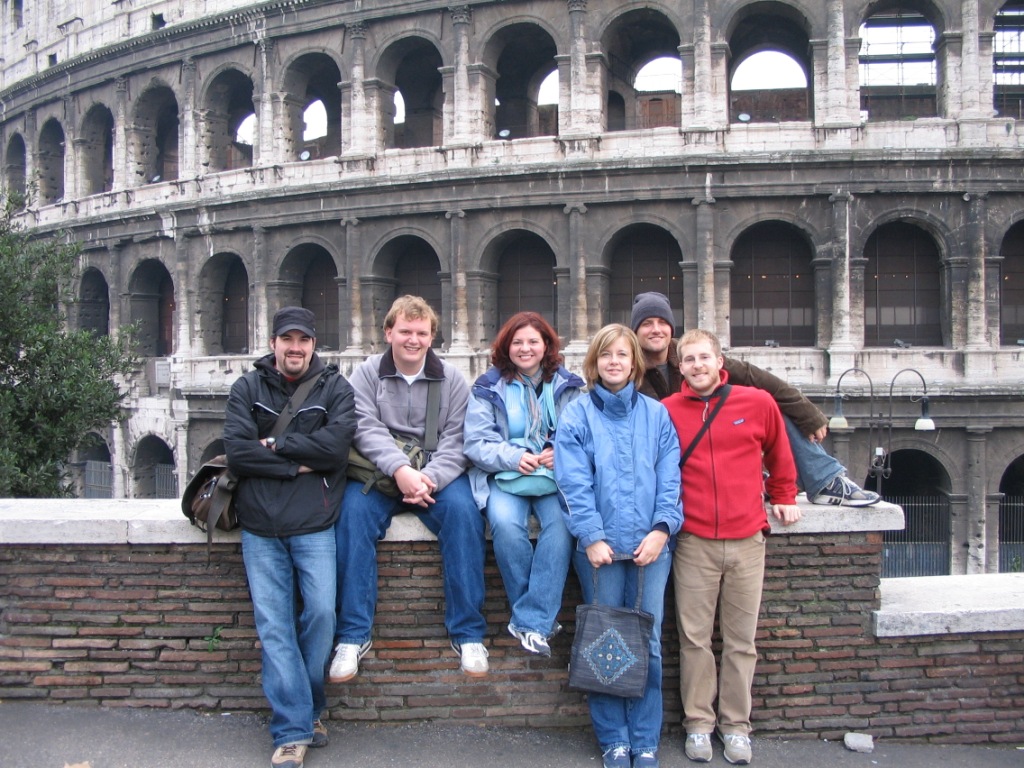 With my teammates at the Colosseum
On the return flight from Rome to Zurich, I sat next to a girl named Natalie, who is studying brass arrangement at the Berklee School of Music. After trading pleasantries and sharing our musical interests, we were both captured by the view of the Apennines, over which we cruised at 500 mph. Winter there had long begun its semi-permanent residence, leaving several thousand feet of mountainside above the treeline decorated for the Advent season in its finest white. Their jagged peaks spread for miles, like so many tents set up by an army of titans, contrastedly sharply by the flat, blue surface of their immediate neighbor, the Tyrrhenian Sea (or perhaps it was the Ligurian Sea at that point).
 The lower cupola atop St. Peter's at dusk
According to the Genesis account, God made man and woman last of all, the pinnacle of his creation. The inner beauty of the human mind and heart aside, even the physical form of us humans ought to be atop the list of physical creation in which to revel, far above the Grand Canyon or autumn in the Catskills. For that moment today on the plane, that truth was clear. I suppose the Romans had it right, after all: for over two millenia, their art has been fixed upon the human form, although sometimes eschewing the graceful slopes of Grecian art for defined musculature. But the attention their artists have paid to the details of even toe and tendon, bellybutton and eyelid speaks a strong word nonetheless.
 Michaelangelo's Pieta. I admire this greatly for how one can see that every last ounce of life has been exhausted from Jesus' body, now lying in his mother's arms. "And a sword shall pierce your own soul, too."
 The clouds over northern Rome at sunset
From the dizzying, buzzing complexities of subatomic particles to the hulking masses of mountains and everything in between--the curves of a woman's back included--beauty is everywhere. May the Lord grant us all inquisitive, perceptive eyes to see it and grateful, wondering hearts to cherish it. Yes, even here in Istanbul. Or Detroit. Or Modesto. But everything we see here is only a dim reflection of what we'll see in God's face in heaven.
______________________
*Annie Dillard, Pilgrim at Tinker Creek (New York: Harper Collins, 1999, 128).
Thursday, November 17, 2005
Zechariah 3, part 2: God will remove guilt in a single day
As we've seen in my last post on Zechariah's 4th vision, God has spoken in favor of Joshua and Jerusalem in spite of his utter wretchedness. He now, the symbol of the priesthood through whom all Jerusalem could enter into God's presence, gains hope through hearing these words. How could his heart help but burn within him upon hearing God speak of his gracious approval (v. 2)? Yet his head still hangs low as he stands before the altar in service to God. When this vision was preached in February 519, Haggai had already delivered a stinging rebuke of the priesthood months before (Hag 2.10-14). Will God accept him and his offerings? He is still dirty and helpless.
But God comes and removes his filthy garments, saying to him, "See, I have taken your iniquity away from you and will clothe you in festal robes." The priesthood has been restored! The hands of God have removed his guilt and clothed him in bright white, in new robes radiant with the splendor reserved for God's own attendants in the heavenly courts. Ah, such grace! We who are equally powerless and defiled have our sins washed away by Christ's blood and are wrapped in pure garments, those of Christ himself, in whom we are hidden before God (Is 1.18; Rev 7.14).
The priesthood has been restored. There is gracious renewal. These are the words of God, the defining characteristics of his actions in history. Is it a wonder that the Bible only contains two chapters on creation, one on the fall, and two on recreation? Everything in between is the story of his redemptive work in history in spite of man's failures.* And here the priesthood is restored: now right sacrifices can be made, paving the way for the God of glory to again dwell with his people (cf. Ex 29.44-46). Hope springs anew for the people of God in light of his incredible mercies.
But sinful, human priests can offer only the blood of goats and calves, which can never fully atone for man's sin (Heb 10.11). If the scope of God's forgiveness and reconciliation are to be in accord with his revealed nature, there must be something better to come. Isaiah spoke of a servant, a tender shoot, who would come and bear Israel's iniquity (52.13 - 53.12). Those words of his were focused on things yet to come. And here God again calls his people toward a blessed future hope: "Now listen, Joshua the high priest, you and your friends who are sitting in front of you [the other priests]--indeed they are men who are a symbol, for behold, I am going to bring My servant the Branch. For behold, the stone that I have set before Joshua; on one stone are seven eyes [or facets]. Behold, I will engrave an inscription on it ... and I will remove the iniquity of that land in one day.
Joshua, the now-"sinless" mediator, points ahead toward God's servant, the Branch. But just who is he? Walter Kaiser points out how all four occurrences of the Branch (Heb. tsemah) correspond with the portraits of Jesus of Nazareth in each of the four Gospels: tsemah as King (Jer 23.5; Matthew); tsemah as Servant (Zech 3.8; Mark); tsemah as fully Man (Zech 6.12; Luke); and tsemah as fully God (Is 4.2; John).** And he is also a stone (cf. Ps 118.22-23; Dan 2.35, 45) with seven facets, which could easily represent either the sevenfold Spirit given to the Messiah (a 'shoot' and a 'branch') in Is 11.1-2, or it could be a poetic representation of the completeness of the coming Messiah in whom is no deficiency. He is wholly competent to save, something Paul is quick to point out in his letter to the Colossian church.
History has revealed that this Branch has been fulfilled in the King of the Jews, the Son of Man and of God, who came to serve and to give his life as a bloody ransom for many. In his death upon barren Golgotha, he bore in his own body the guilt of God's chosen ones, his Jerusalem (Zech 3.2). He now gives us the fulfilled promise of acceptance by God in spite of being lifelong sinners. The removal of guilt and shame in that seems implausible in man's eyes, both to the remnant returning from exile and to us, has taken place and is a true offer to all to be received by faith (Rom 3.25-26). Through Christ, our great and enduring high priest, our sins have been taken away for all time (Heb 10.12).
This gospel leads us to live out our duties to God and to others (and is not the latter inseparable from the former?) "in view of God's mercy" (Rom 12.1, NIV). Christian living in holiness and obedient service to God must always be preached as the result of God's grace toward us, not the other way around. Notice how the charge to Joshua (v. 7) comes after God's forgiveness of him. Anything else is deadly moralism, which benefits us none.
Zechariah's message was for a community and was to result in communal encouragement and peace. What, then, is the communal result of such blessing and comforting grace? "In that day ... every one of you will invite his neighbor to sit under his vine and under his fig tree" (Zech 3.10). The result is a sharing of blessing, an extension of received grace to others in need. And so it goes in the kingdom of God. Oh, for the day when faith shall become sight!
________________________
* This was pointed out by Kevin DeYoung in his sermon "A Survey of Genesis", delivered at University Reformed Church, East Lansing, Mich., on February 6, 2005.
** Walter Kaiser, The Preacher's Commentary: Micah - Malachi. (Nashville: Thomas Nelson, 1992, 334-35).
But God comes and removes his filthy garments, saying to him, "See, I have taken your iniquity away from you and will clothe you in festal robes." The priesthood has been restored! The hands of God have removed his guilt and clothed him in bright white, in new robes radiant with the splendor reserved for God's own attendants in the heavenly courts. Ah, such grace! We who are equally powerless and defiled have our sins washed away by Christ's blood and are wrapped in pure garments, those of Christ himself, in whom we are hidden before God (Is 1.18; Rev 7.14).
The priesthood has been restored. There is gracious renewal. These are the words of God, the defining characteristics of his actions in history. Is it a wonder that the Bible only contains two chapters on creation, one on the fall, and two on recreation? Everything in between is the story of his redemptive work in history in spite of man's failures.* And here the priesthood is restored: now right sacrifices can be made, paving the way for the God of glory to again dwell with his people (cf. Ex 29.44-46). Hope springs anew for the people of God in light of his incredible mercies.
But sinful, human priests can offer only the blood of goats and calves, which can never fully atone for man's sin (Heb 10.11). If the scope of God's forgiveness and reconciliation are to be in accord with his revealed nature, there must be something better to come. Isaiah spoke of a servant, a tender shoot, who would come and bear Israel's iniquity (52.13 - 53.12). Those words of his were focused on things yet to come. And here God again calls his people toward a blessed future hope: "Now listen, Joshua the high priest, you and your friends who are sitting in front of you [the other priests]--indeed they are men who are a symbol, for behold, I am going to bring My servant the Branch. For behold, the stone that I have set before Joshua; on one stone are seven eyes [or facets]. Behold, I will engrave an inscription on it ... and I will remove the iniquity of that land in one day.
Joshua, the now-"sinless" mediator, points ahead toward God's servant, the Branch. But just who is he? Walter Kaiser points out how all four occurrences of the Branch (Heb. tsemah) correspond with the portraits of Jesus of Nazareth in each of the four Gospels: tsemah as King (Jer 23.5; Matthew); tsemah as Servant (Zech 3.8; Mark); tsemah as fully Man (Zech 6.12; Luke); and tsemah as fully God (Is 4.2; John).** And he is also a stone (cf. Ps 118.22-23; Dan 2.35, 45) with seven facets, which could easily represent either the sevenfold Spirit given to the Messiah (a 'shoot' and a 'branch') in Is 11.1-2, or it could be a poetic representation of the completeness of the coming Messiah in whom is no deficiency. He is wholly competent to save, something Paul is quick to point out in his letter to the Colossian church.
History has revealed that this Branch has been fulfilled in the King of the Jews, the Son of Man and of God, who came to serve and to give his life as a bloody ransom for many. In his death upon barren Golgotha, he bore in his own body the guilt of God's chosen ones, his Jerusalem (Zech 3.2). He now gives us the fulfilled promise of acceptance by God in spite of being lifelong sinners. The removal of guilt and shame in that seems implausible in man's eyes, both to the remnant returning from exile and to us, has taken place and is a true offer to all to be received by faith (Rom 3.25-26). Through Christ, our great and enduring high priest, our sins have been taken away for all time (Heb 10.12).
This gospel leads us to live out our duties to God and to others (and is not the latter inseparable from the former?) "in view of God's mercy" (Rom 12.1, NIV). Christian living in holiness and obedient service to God must always be preached as the result of God's grace toward us, not the other way around. Notice how the charge to Joshua (v. 7) comes after God's forgiveness of him. Anything else is deadly moralism, which benefits us none.
Zechariah's message was for a community and was to result in communal encouragement and peace. What, then, is the communal result of such blessing and comforting grace? "In that day ... every one of you will invite his neighbor to sit under his vine and under his fig tree" (Zech 3.10). The result is a sharing of blessing, an extension of received grace to others in need. And so it goes in the kingdom of God. Oh, for the day when faith shall become sight!
________________________
* This was pointed out by Kevin DeYoung in his sermon "A Survey of Genesis", delivered at University Reformed Church, East Lansing, Mich., on February 6, 2005.
** Walter Kaiser, The Preacher's Commentary: Micah - Malachi. (Nashville: Thomas Nelson, 1992, 334-35).
Subscribe to:
Posts (Atom)