1 Now on the same occasion there were some present who reported to Him about the Galileans whose blood Pilate had mixed with their sacrifices [presumably murders that squelched a rebellion at the Temple]. 2 And Jesus said to them, "Do you suppose that these Galileans were greater sinners than all other Galileans because they suffered this fate? 3 I tell you, no, but unless you repent, you will all likewise perish. 4 Or do you suppose that those eighteen on whom the tower in Siloam fell and killed them were worse culprits than all the men who live in Jerusalem? 5 I tell you, no, but unless you repent, you will all likewise perish." (Luke 13:1-5)
I have friends who live in Minneapolis with their families. I don't know if they or any of their family was involved in yesterday's bridge collapse in which so many died or were severely injured. Situations like this beg the question, Where is God in a disaster like this? Isn't he supposedly in control? What manner of king is this Christ, who claims to be extending his rule and reign over all things in the universe? But that's not the question Jesus himself wants us to hear. He wants us to ask ourselves, "Have you repented? Are you going to embrace me, my reign, and my ways, or are you going to keep living your own way in disbelief?" If so, he warns, just as quickly as a tower collapsed or a highway bridge fell into the Mississippi River, so too will we be crushed under the weight of his fury.
All of the death, disorder, and tragedy in this world is the direct result of humanity's fall into sin. We can blame Adam all we want and shirk our own responsibility, but we forget one thing. We forget that we, too, sin every day as active participants of the rebellion that began that infamous day in Eden. Minneapolis is supposed to be a divine wake-up call, a backwards gift of God's patient mercy that says, "Get serious! Get off the path you're on! If you don't, I will kill you with a death far worse than drowning in a river, for I am a consuming fire."
I'm sure that this won't be the popular message in churches across American this Sunday. Most instead will probably preach some sort of heretical message about how this wasn't from God's hand (even insurance companies get it right by calling it an "act of God"); it was a random event incompatible with a loving God, instead of seeing God's love that slaps us in the face with events like this that call us repentance, and who has offered his very own Son to bear every last ounce of the wrath due to sinners, due to you and me.
Thursday, August 2, 2007


Tuesday, July 31, 2007
Lessons from Turkey, part IV
Only Jesus and people really matter.
Being removed from American culture for nineteen months, I no longer knew as well what was going on in the news, what the newest movies and music were, or what fashion trends were in vogue. Worst of all, I didn't get to watch Tigers baseball games! (Let's only hope that if I'm ever on Who Wants To Be A Millionaire?, questions pertaining to 2005-07 are omitted.) While many people—and I am all too often included—fuss and worry about such things, I lived just fine without them. I had other Christians to live with, I had all the yogurt, rice, chicken, and lentil soup I could eat, I had my Bible and some good books, and I had (and have still) a Savior who hears my prayers. And that's really about all we need. Why is contentment such a difficult thing to learn?
Sunday, July 29, 2007
Tag, I'm it!
Well, I've been hit--or tagged, that is, by Halfmom. Now I'm supposed to share eight things about myself that few people know. In the name of chain letters and all things of the devil, here they are.
1. I have an extra patella (kneecap) in my left leg. It's tiny, about the size of a dime, and it was discovered at age 14 during an X-ray after I was hit by a car while riding my bike. The doctor said it's believed that about one percent of the U.S. population actually shares this phenomenon.
2. I desire to adopt a child or have a foster child. I think it's such a beautiful expression of gratitude for what my heavenly Father has done for me, who "in love . . . predestined us to adoption as sons through Jesus Christ to Himself, according to the kind intention of His will, to the praise of the glory of His grace, which He freely bestowed on us in the Beloved" (Ephesians 1:4-6). I think it's such an amazing thing to give up a normal, easier familial life and sacrificially take in an unwanted child, accept her unconditionally, and shower upon her the love she has never felt. Even this afternoon I was deeply moved when reading this in The Lutheran Witness
magazine (July 2007) about a camp for foster children. "Children in foster care struggle with the impact of past abuse and neglect. In entering out-of-home care, they also experience the loss of established relationships. They may be separated, not only from birth parents, but also from siblings and extended family members. They may have to attend a new school or move to a different neighborhood. These losses are compounded for children who spend time in multiple foster homes."
How much more has God, who "sets the lonely in families" (Psalm 68:6 NIV), done in rescuing us from peril and calling us his own children! "As for your birth, on the day you were born your navel cord was not cut, not were you washed with water for cleasing; you were not rubbed with salt or even wrapped in cloths. No eye looked with pity on you to do any of these things for you, to have compassion on you. Rather you were thrown out into the open field, for you were abhorred on the day you were born." And yet, while dead and "squirming in [our] blood," he graciously said to us, "Live!" and took us under his wing to raise and nurture us (Ezekiel 16; cf. Ephesians 2:1-10).
3. I'm afraid of heights. Don't even ask me to get on a roller coaster or climb a tree.
4. I have always envied people who can do backflips off of diving boards--I think it's so cool. Yet I am too scared to attempt a backflip myself, for fear of hitting my head on the diving board a la Greg Louganis.
5. I am getting mildly annoyed (or more) that friends of mine, even those younger than me, are continually getting engaged and married, while I'm not even dating anyone. I think I can count on one hand the number of friends from MSU who are still single. In an age when more and more people are postponing marriage until their late twenties or even thirties, why do I feel this background desire--perhaps even pressure--to find a life partner with whom to share my every moment and serve the Lord alongside? Or is this simply the good ol' sin of coveting, that is, "wanting what is another's, desiring what I don't have rather than appreciating what I do have. To covet is to fantasize a life other than what is given to me."*
6. I used to play the handbells. (Oh, the things that happen when you grow up in a Lutheran gradeschool!)
7. I want to become more literate in "the classics" and in poetry and also become a better writer. Being a verbal processor, I often spout out far more words than are needed to get across my point. This is at its worst when I try to form thought-provoking questions while leading a Bible study or teaching a science lesson in the classroom. As a result, people get lost and wonder what my question actually is. Good writers, especially poets, learn how to use language as pointedly and carefully as possible, loathing even a syllable's waste.
8. Secret or not, I have long possessed underdeveloped artistic skills. (Perhaps this is why I watch Home and Garden Television with my mom.) When I was a child, you couldn't pry pencils out of my hand; I was continually drawing. I even had this funny, rather bulbous callus on my middle finger from where the pencil pressed. My kindergarten teacher has even kept drawings of mine since 1986, thinking I would become a renowned artist some day. Then, since my senior year of high school, I've enjoyed casual photography. One of these days, I really need to take some classes in photography, particularly photojournalism and Adobe Photoshop. "To one he gave five talents. . . ."
. . . and a bonus #9: I've had some super cool costumes in my day. In preschool my dad made me a robot costume consisting of a large cardboard box covered in aluminum foil and bedecked with all manner of flashing lights, gauges, switches, and the like. In kindergarten my mom masterfully made an insulated shark costume for Halloween, complete with a dorsal fin. I looked out of its toothy mouth. Then in my Ninja Turtles phase, I made a Shredder costume and other assorted Samurai gear from cardboard and fabric scraps around the house. Sweet.
_______________________
*Eugene H. Peterson, Christ Plays in Ten Thousand Places: A Conversation in Spiritual Theology (Grand Rapids, Mich.: Wm B. Eerdmans, 2005), 259.
1. I have an extra patella (kneecap) in my left leg. It's tiny, about the size of a dime, and it was discovered at age 14 during an X-ray after I was hit by a car while riding my bike. The doctor said it's believed that about one percent of the U.S. population actually shares this phenomenon.
2. I desire to adopt a child or have a foster child. I think it's such a beautiful expression of gratitude for what my heavenly Father has done for me, who "in love . . . predestined us to adoption as sons through Jesus Christ to Himself, according to the kind intention of His will, to the praise of the glory of His grace, which He freely bestowed on us in the Beloved" (Ephesians 1:4-6). I think it's such an amazing thing to give up a normal, easier familial life and sacrificially take in an unwanted child, accept her unconditionally, and shower upon her the love she has never felt. Even this afternoon I was deeply moved when reading this in The Lutheran Witness
magazine (July 2007) about a camp for foster children. "Children in foster care struggle with the impact of past abuse and neglect. In entering out-of-home care, they also experience the loss of established relationships. They may be separated, not only from birth parents, but also from siblings and extended family members. They may have to attend a new school or move to a different neighborhood. These losses are compounded for children who spend time in multiple foster homes."
How much more has God, who "sets the lonely in families" (Psalm 68:6 NIV), done in rescuing us from peril and calling us his own children! "As for your birth, on the day you were born your navel cord was not cut, not were you washed with water for cleasing; you were not rubbed with salt or even wrapped in cloths. No eye looked with pity on you to do any of these things for you, to have compassion on you. Rather you were thrown out into the open field, for you were abhorred on the day you were born." And yet, while dead and "squirming in [our] blood," he graciously said to us, "Live!" and took us under his wing to raise and nurture us (Ezekiel 16; cf. Ephesians 2:1-10).
3. I'm afraid of heights. Don't even ask me to get on a roller coaster or climb a tree.
4. I have always envied people who can do backflips off of diving boards--I think it's so cool. Yet I am too scared to attempt a backflip myself, for fear of hitting my head on the diving board a la Greg Louganis.
5. I am getting mildly annoyed (or more) that friends of mine, even those younger than me, are continually getting engaged and married, while I'm not even dating anyone. I think I can count on one hand the number of friends from MSU who are still single. In an age when more and more people are postponing marriage until their late twenties or even thirties, why do I feel this background desire--perhaps even pressure--to find a life partner with whom to share my every moment and serve the Lord alongside? Or is this simply the good ol' sin of coveting, that is, "wanting what is another's, desiring what I don't have rather than appreciating what I do have. To covet is to fantasize a life other than what is given to me."*
6. I used to play the handbells. (Oh, the things that happen when you grow up in a Lutheran gradeschool!)
7. I want to become more literate in "the classics" and in poetry and also become a better writer. Being a verbal processor, I often spout out far more words than are needed to get across my point. This is at its worst when I try to form thought-provoking questions while leading a Bible study or teaching a science lesson in the classroom. As a result, people get lost and wonder what my question actually is. Good writers, especially poets, learn how to use language as pointedly and carefully as possible, loathing even a syllable's waste.
8. Secret or not, I have long possessed underdeveloped artistic skills. (Perhaps this is why I watch Home and Garden Television with my mom.) When I was a child, you couldn't pry pencils out of my hand; I was continually drawing. I even had this funny, rather bulbous callus on my middle finger from where the pencil pressed. My kindergarten teacher has even kept drawings of mine since 1986, thinking I would become a renowned artist some day. Then, since my senior year of high school, I've enjoyed casual photography. One of these days, I really need to take some classes in photography, particularly photojournalism and Adobe Photoshop. "To one he gave five talents. . . ."
. . . and a bonus #9: I've had some super cool costumes in my day. In preschool my dad made me a robot costume consisting of a large cardboard box covered in aluminum foil and bedecked with all manner of flashing lights, gauges, switches, and the like. In kindergarten my mom masterfully made an insulated shark costume for Halloween, complete with a dorsal fin. I looked out of its toothy mouth. Then in my Ninja Turtles phase, I made a Shredder costume and other assorted Samurai gear from cardboard and fabric scraps around the house. Sweet.
_______________________
*Eugene H. Peterson, Christ Plays in Ten Thousand Places: A Conversation in Spiritual Theology (Grand Rapids, Mich.: Wm B. Eerdmans, 2005), 259.
Friday, July 27, 2007
Lessons from Turkey, part III
I have no clue what I’m doing—but God does.
In his second letter to Timothy,
In this letter Paul sounds a strong call to “share in suffering for the gospel by the power of God” (1:8), embodying the treasure of the gospel and portraying Christ as crucified. Part of his sufferings led to an earlier and less severe house arrest in Rome, during which he was able to preach the good news “unhindered” (Acts 28:31). Was St. Luke kidding when he wrote that? Unhindered? Really? If the gospel’s impact relied upon the Apostle’s eloquent communication and personal freedom, then the message would’ve stayed chained there with him. But God is the one in control, not
This reality kept Paul going despite all his apparent failures and setbacks. He didn’t labor out of a desperate hope that perhaps he could woo a few of the “lost” over to Christ’s side; nay, he suffered “for the sake of the elect,” those who are chosen and “found” by God. The Father has foreordained them for salvation, the Son has purchased them by his blood on the Cross, and the Holy Spirit creates and sustains their faith. In other words, God actually saves sinners.
For me, too, God’s sovereign freedom in saving people really must be the only hope for the world. Even if I were a Turk and able to speak the language, I think I would have little hope of actually convincing someone that he is a rebellious God-hater in need of forgiveness and an estranged child in need of reconciliation, yet saved apart from anything he has or can do, simply on the basis of a Jewish rabbi who was ignominiously exterminated upon a Roman cross. And on top of that, he would need to deny his familial and cultural values (“To be a Turk is to be a Muslim”), putting himself to open reproach, and daily die to himself as well. Yeah, right!
Every day, I felt like I had absolutely no clue what I was doing. I was some goofy yabancı (foreigner) whose Turkish is pretty feeble, with little real understanding of the cultural mindset, experiences, and values. And yet people did come to faith through us and through the witness of others, both native and foreign, around
Ah, if this great, important, holy matter rested on the fervor of our love, on the abundance of our means, on the training of our missionaries; in short, if it rested on our will and on our faith and strength, then we would have a sad situation. For we are poor miserable sinners, whose love soon disappears; whose strength is only weakness; and whose knowledge is only patchwork. But we should not look at ourselves, but only at the fact that God has commanded this work of missions. He has promised to bless our humble work, and to bless it abundantly.
Accordingly my favorite verse over these past two years has been Romans 15:21 (quoting Isaiah 52:15): “As it is written, ‘Those who have never been told of him will see, and those who have never heard will understand.’” Amen.
Thursday, July 26, 2007
Lessons from Turkey, part II
Our hope and God's goodness depend on his free grace.
Islam is essentially a works-based religion, i.e., being in a right relationship with God both now and forever is essentially a business transaction where we must do certain works, the “five pillars,” and life is lived as a tenuous “test.” I've met a number of students who waver under such an oppressive burden of perfection placed upon them. Many others don't care. None can have true hope in the goodness of God. Why? Because if God gives all good things but makes us earn him, then he withholds the greatest gift of all time—that is, if he is truly more beautiful and wonderful than all else. But I believe the God of the Bible is more awesome than all else. And so he is also the greatest Giver of all, bringing us to himself by unmerited favor apart from our deeds, and holding us near him in his hands for all our days (Isaiah 46:3-4; 55:1-2; Ephesians 2:1-9; Titus 3:3-7; 1 Peter 3:18). Furthermore, if God makes coming to him based upon our meritorious deeds, he is constrained by human will as to who will be saved, making him less than free. And if even God's plans are contingent upon human will, what sure hope can we have that we will overcome this world of chaos, evil, and death?
Wednesday, July 25, 2007
Lessons from Turkey, part I
Prior to ever heading overseas, a large part of my motivation was not only to help spread the Good News of Jesus Christ, but also to see God in new ways and come out of my time a more mature man. When I ask myself, What am I learning from being here? How am I growing? it’s often a depressing exercise in futility. I usually have no ready answers, and I’ve only become aware of even more sin in my life. I don’t pray much, I crave everyone’s approval, I was lazy and easily frustrated about studying and using Turkish, I came up with excuses not to spend time with students, I sought independence more than supportive fellowship with my teammates . . . the list could go on.
But yet I do find that I have been learning and growing. Friends have pointed out my humble teachability and desire for change, my skills in teaching the truth of God’s Word, and that I do in fact care about reaching Turks with the truth. And while I have no idea what lessons I’ll continue to learn now that I've returned to America
The Trinity is essential to the gospel.
Five times each day in the Muslim world the ezan is sung, calling the devout to offer their ritual prayers (namaz) to Allah. Included in the ezan is the essential “pillar” of Muslim theology: that God/Allah is one, and one alone (similar to the Judeo-Christian shema in Deuteronomy 6:4). To ascribe to others the divinity relegated to Allah is an unforgiveable sin.
At first I found the concept of the Trinity (üçlü birlik) to be one of the most common questions or objections to the Christian faith. We Christians are clearly lying polytheists, claiming that Jesus was not only the “Son of God"[1]—a blasphemy in itself, for God does not have sexual relations with humans—but even the Supreme Deity himself. Because there’s no truly satisfactory way to explain the tri-unity of God the Father, God the Son, and God the Holy Spirit (especially in the eyes of a questioning Muslim), I started thinking more about what the Trinity teaches about the One God himself. [2]
Far from being the more distant, borderline deistic being that Allah is, the Trinity shows that God is emphatically personal, whose essential nature is one of relationship. “Trinity is not an attempt to explain or define God by means of abstractions . . . but a witness that God reveals himself as personal and in personal relations,” writes Eugene H. Peterson. “Under the image of the Trinity we discover that we do not know God by defining him but by being loved by him and loving in return." [3]
Because God has forever been in relationship with himself, this allows God to have always been loving without being dependent on the works of his hands. The Father has always and forever had his beloved Son, cementing love and joy at the very core of his being. For Allah to have someone to love, he needed to create humankind, and is therefore in some manner restrained and dependent upon us for his character. Thus love is not part of his truest nature, unlike that of our great and unchanging Yahweh.
On top of all that, the sheer mind-boggling physics of the Trinity itself, completely inexplicable by even man’s most strenuous intellectual gymnastics, upholds to me the validity of the Holy Scriptures themselves; their message is confirmed as “breathed out by God” (2 Timothy 3:16) and truly trustworthy. God is Someone far greater than my mind can ever conceive, making him worthy of worship, obedience, wonder, and fear-of-the-Lord.
_______________________________
[1] I suppose we are half to blame for perpetuating the misunderstanding, given that we continue the notion that “Son of God” refers chiefly to Jesus’ virgin birth. Yes, that’s partly true. But in Jewish understanding, “Son of God” was a common designation for the Messiah, the man who was to be Yahweh’s anointed king in the line of David through whom he would justly reign to fulfill his promises to Abraham and redeem Israel from her enemies (see, e.g., 2 Samuel 7:11-16; Psalms 2:6-7, 12; 72:1; Romans 1:3-4). Jesus as “Son of God” also shows that he is so closely united with God the Father that his actions and sayings are one and the same (Luke 10:21-22; John 5:17-22). This is particularly seen in John’s Gospel, where Jesus is portrayed as God living and acting in the flesh (John 20:31)—something far different from the mere human Messiah the Jews expected.
[1] I suppose we are half to blame for perpetuating the misunderstanding, given that we continue the notion that “Son of God” refers chiefly to Jesus’ virgin birth. Yes, that’s partly true. But in Jewish understanding, “Son of God” was a common designation for the Messiah, the man who was to be Yahweh’s anointed king in the line of David through whom he would justly reign to fulfill his promises to Abraham and redeem Israel from her enemies (see, e.g., 2 Samuel 7:11-16; Psalms 2:6-7, 12; 72:1; Romans 1:3-4). Jesus as “Son of God” also shows that he is so closely united with God the Father that his actions and sayings are one and the same (Luke 10:21-22; John 5:17-22). This is particularly seen in John’s Gospel, where Jesus is portrayed as God living and acting in the flesh (John 20:31)—something far different from the mere human Messiah the Jews expected.
[2] Is it of note that I lived in the district of Kadıköy (on the Asian side of modern-day İstanbul)? It was once known as Khalkedon (or
Tuesday, July 24, 2007
Lessons from a road trip
A few years ago all sorts of situations from my daily life would strike me as some sort of spiritual analogy or illustration; now that doesn't happen so much. But on my drove down to Richmond, Virginia, a few came to me.
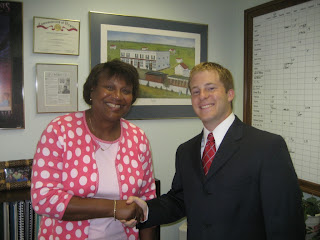 Shaking hands with HCPS HR head Patrese Pruden to "seal the deal."
Thank God for cruise control. As would happen when one spends 800 miles on the road in one stretch, I encountered a variety of speed limits, such as the 70 mph in Michigan, 65 mph in our backwards-minded southeastern neighbor, or 55 mph through all the work-absent "construction" zones along the Pennsylvania Turnpike. Speed limits are rules; they're guidelines that must be followed. Yet even in a 65-mph zone, I found myself drifting along with whatever everyone else did, going with the flow of traffic and not giving much heed to how fast I was going--sixty, seventy, even eighty-plus miles per hour.
Isn't this much like our lives as disciples of Jesus in this world? How easy it is to simply watch what everyone else around me is doing and get sucked into that! Even at the bar on Friday night I had to be continually vigilant. And it's more than just unwittingly meshing with the ambient activity; "going with the flow" is really caving in to my own comfort levels and desires versus giving steadfast, alert attention to the truth of God's Word and the authority of Christ. I'm sure that it's more than just a linguistic coincidence that "disciple" and "discipline" both have the same root of vigilant training of one's mind and will. "So roll up your sleeves, put your mind in gear, be totally ready to receive the gift that's coming when Jesus arrives. Don't lazily slip back into those old grooves of evil, doing just what you feel like doing. You didn't know any better then; you do now. As obedient children, let yourselves be pulled into a way of life shaped by God's life, a life energetic and blazing with holiness. God said, 'I am holy; you be holy' " (1 Peter 1:13-16, The Message).
 Richmond the beautiful: row houses in the Church Hill district
Urinal faith. In case you have two X chromosomes and don't know the Urinal Code of Conduct, there is a universal, unspoken rule that you never use a urinal immediately adjacent to a urinal in use. Period. So when I stopped to use a restroom at a highway rest stop, I thought to myself, "This is stupid; there are four urinal in here, but there might as well only be two, since by The Rule only two could be in use at any point in time. It's as if the urinal next to me weren't even there." But then I had a reality check: No, the urinal really is there, an objective reality, for anyone to use. We've simply excluded its use by our own made-up rules.
How much this is like our reconciliation to God in Christ! In 2 Corinthians 5 St. Paul writes of our reconciliation as an accomplished fact. "God . . . reconciled us to Himself through Christ . . . . God was in Christ reconciling the world to Himself, not counting their trespasses against them" (vv. 18, 19). In a twist of logic that undermines all human reason, the sins of all people have already been dealt with and put away. But we can fail to believe its truth and thus not receive its saving benefits. Christ is there for us, but we do not "have" him (1 John 5:12).
Likewise we can read in the Holy Scriptures that "if anyone is in Christ, he is a new creation" (2 Corinthians 5:17); "we have been buried with [Christ] through baptism into death, so that as Christ was raised from the dead through the glory of the Father, so we too might walk in newness of life. . . . Even so consider yourselves to be dead to sin, but alive to God in Christ Jesus" (Romans 6:4, 11); "This [bread] is My body which is given for you" (Luke 22:19). I do not understand it at all, but it's as if the apostles preached in this way: "Your redemption has taken place. If you repent of your ways and believe it, you receive it, and your salvation is truly effective. But if you don't believe it, you reject the Son of God and the Father's gracious gifts through him, and you judge yourself unworthy of eternal life." If we believe that we are in fact reconciled to Christ, that we have been made anew by his Spirit, and that he is in the Sacraments indeed present with his forgiveness and resurrection-life, then all those things are in fact ours to use. Jesus and his saving benefits are there whether we reckon it or not. We can believe and receive, or we can cast a suspicious eye of unbelief and fail to take hold of all that he promises and offers.
 More well-kept row houses in my district, The Fan
 Shaking hands with HCPS HR head Patrese Pruden to "seal the deal."
Thank God for cruise control. As would happen when one spends 800 miles on the road in one stretch, I encountered a variety of speed limits, such as the 70 mph in Michigan, 65 mph in our backwards-minded southeastern neighbor, or 55 mph through all the work-absent "construction" zones along the Pennsylvania Turnpike. Speed limits are rules; they're guidelines that must be followed. Yet even in a 65-mph zone, I found myself drifting along with whatever everyone else did, going with the flow of traffic and not giving much heed to how fast I was going--sixty, seventy, even eighty-plus miles per hour.
Isn't this much like our lives as disciples of Jesus in this world? How easy it is to simply watch what everyone else around me is doing and get sucked into that! Even at the bar on Friday night I had to be continually vigilant. And it's more than just unwittingly meshing with the ambient activity; "going with the flow" is really caving in to my own comfort levels and desires versus giving steadfast, alert attention to the truth of God's Word and the authority of Christ. I'm sure that it's more than just a linguistic coincidence that "disciple" and "discipline" both have the same root of vigilant training of one's mind and will. "So roll up your sleeves, put your mind in gear, be totally ready to receive the gift that's coming when Jesus arrives. Don't lazily slip back into those old grooves of evil, doing just what you feel like doing. You didn't know any better then; you do now. As obedient children, let yourselves be pulled into a way of life shaped by God's life, a life energetic and blazing with holiness. God said, 'I am holy; you be holy' " (1 Peter 1:13-16, The Message).
 Richmond the beautiful: row houses in the Church Hill district
Urinal faith. In case you have two X chromosomes and don't know the Urinal Code of Conduct, there is a universal, unspoken rule that you never use a urinal immediately adjacent to a urinal in use. Period. So when I stopped to use a restroom at a highway rest stop, I thought to myself, "This is stupid; there are four urinal in here, but there might as well only be two, since by The Rule only two could be in use at any point in time. It's as if the urinal next to me weren't even there." But then I had a reality check: No, the urinal really is there, an objective reality, for anyone to use. We've simply excluded its use by our own made-up rules.
How much this is like our reconciliation to God in Christ! In 2 Corinthians 5 St. Paul writes of our reconciliation as an accomplished fact. "God . . . reconciled us to Himself through Christ . . . . God was in Christ reconciling the world to Himself, not counting their trespasses against them" (vv. 18, 19). In a twist of logic that undermines all human reason, the sins of all people have already been dealt with and put away. But we can fail to believe its truth and thus not receive its saving benefits. Christ is there for us, but we do not "have" him (1 John 5:12).
Likewise we can read in the Holy Scriptures that "if anyone is in Christ, he is a new creation" (2 Corinthians 5:17); "we have been buried with [Christ] through baptism into death, so that as Christ was raised from the dead through the glory of the Father, so we too might walk in newness of life. . . . Even so consider yourselves to be dead to sin, but alive to God in Christ Jesus" (Romans 6:4, 11); "This [bread] is My body which is given for you" (Luke 22:19). I do not understand it at all, but it's as if the apostles preached in this way: "Your redemption has taken place. If you repent of your ways and believe it, you receive it, and your salvation is truly effective. But if you don't believe it, you reject the Son of God and the Father's gracious gifts through him, and you judge yourself unworthy of eternal life." If we believe that we are in fact reconciled to Christ, that we have been made anew by his Spirit, and that he is in the Sacraments indeed present with his forgiveness and resurrection-life, then all those things are in fact ours to use. Jesus and his saving benefits are there whether we reckon it or not. We can believe and receive, or we can cast a suspicious eye of unbelief and fail to take hold of all that he promises and offers.
 More well-kept row houses in my district, The Fan
Saturday, July 21, 2007
Richmond or bust!
Okay, so this is yet another divergence from my normal "theological" posts, but I've got to pass along the news: I got my first "real" job! The thirteen-hour drive down to Richmond, VA, on Tuesday did not end up in vain; I am the new chemistry (and perhaps biology) teacher at Hermitage High School, Henrico County Public Schools. (To keep this going, though, I promise that I'll write about some of my lessons from Turkey. It's just that I've been so busy since I got back to the States that I haven't had any time.)
Their human resources science specialist, Libbey Kitten, told me before that of the four candidates, I was her choice as the best fit for the job. I interviewed with the principal, assistant principal, and the two science department chairpersons. Our one-and-a-half-hour interview felt less like a formal interview than a conversation, and I felt remarkably poised and comfortable compared to other interviews I've had. The HHS faculty were very warm, enthusiastic about students and their school, and I noticed a unity and teamwork among them that was different from other schools.
After the interview I got lunch at Panera Bread with Libbey Kitten. One of the funny things she told me was that a major factor in her confidence in me was that I had spent the past two years in Turkey. She knew I could easily handle relocating to a new part of the U.S. and starting life out on my own with little difficulty, having already done so on a much greater scale overseas.
As we were driving back to HHS, Libbey got a call notifying her that I was chosen to fill the position as the new chemistry teacher. Almost simultaneoulsy I got a call from HR head Patrese Pruden with the congratulations. I was so excited and relieved to have a job--and at a good school with supportive faculty and administration, too! I think it's an environment where I can grow as a professional while continually facing new challenges from the racially and socioeconomically diverse student body. I'm a little bummed that I won't have my own classroom, but even one of the young department chairpersons had to do likewise her first few years. As the rookie on staff, I'm willing to pay my dues.
On top of that, Richmond is a pretty darn cool city. The district that I hope to soon call home, "The Fan," is really cool, with neat little indie shops, cafes, and clubs; the real highlight, however, is the non-stop blocks of refinished brick row houses. There is certainly a lot of history here, too. Not only was Richmond the capital city of the Confederacy, but even the site of Patrick Henry's famous "Give me liberty, or give me death" speech still stands (St. John Episcopal Church).
Now only two big decisions stand before me. (1) I don't have housing locked up yet, but I'm really hoping to land a really nice one-bedroom apartment that I looked at today on Grove in the Fan. It's a beautiful and safe neighborhood of some rental units mixed among families and young professionals. (2) It's my choice whether I want to teach full-time chemistry or split chemistry/biology, which mostly hinges upon whether or not I can get a cross country and track coaching position within the district. But compared with the pressure and uncertainty of not yet having a solid job, this is a huge load off.
Thank you so much, heavenly Father, for this job and for everyone who has aided me along the way. I feel your hands of blessing open toward me; my cup overflows. Surely your goodness and steadfast love shall pursue me all the days of my life. In Jesus' name, Amen.
Their human resources science specialist, Libbey Kitten, told me before that of the four candidates, I was her choice as the best fit for the job. I interviewed with the principal, assistant principal, and the two science department chairpersons. Our one-and-a-half-hour interview felt less like a formal interview than a conversation, and I felt remarkably poised and comfortable compared to other interviews I've had. The HHS faculty were very warm, enthusiastic about students and their school, and I noticed a unity and teamwork among them that was different from other schools.
After the interview I got lunch at Panera Bread with Libbey Kitten. One of the funny things she told me was that a major factor in her confidence in me was that I had spent the past two years in Turkey. She knew I could easily handle relocating to a new part of the U.S. and starting life out on my own with little difficulty, having already done so on a much greater scale overseas.
As we were driving back to HHS, Libbey got a call notifying her that I was chosen to fill the position as the new chemistry teacher. Almost simultaneoulsy I got a call from HR head Patrese Pruden with the congratulations. I was so excited and relieved to have a job--and at a good school with supportive faculty and administration, too! I think it's an environment where I can grow as a professional while continually facing new challenges from the racially and socioeconomically diverse student body. I'm a little bummed that I won't have my own classroom, but even one of the young department chairpersons had to do likewise her first few years. As the rookie on staff, I'm willing to pay my dues.
On top of that, Richmond is a pretty darn cool city. The district that I hope to soon call home, "The Fan," is really cool, with neat little indie shops, cafes, and clubs; the real highlight, however, is the non-stop blocks of refinished brick row houses. There is certainly a lot of history here, too. Not only was Richmond the capital city of the Confederacy, but even the site of Patrick Henry's famous "Give me liberty, or give me death" speech still stands (St. John Episcopal Church).
Now only two big decisions stand before me. (1) I don't have housing locked up yet, but I'm really hoping to land a really nice one-bedroom apartment that I looked at today on Grove in the Fan. It's a beautiful and safe neighborhood of some rental units mixed among families and young professionals. (2) It's my choice whether I want to teach full-time chemistry or split chemistry/biology, which mostly hinges upon whether or not I can get a cross country and track coaching position within the district. But compared with the pressure and uncertainty of not yet having a solid job, this is a huge load off.
Thank you so much, heavenly Father, for this job and for everyone who has aided me along the way. I feel your hands of blessing open toward me; my cup overflows. Surely your goodness and steadfast love shall pursue me all the days of my life. In Jesus' name, Amen.
Thursday, July 12, 2007
California knows how to party!
Just a few updates for y'all . . . 'cause the past week has been crazy.
Congratulations, Anne and Ryan! Almost as soon as I got into the States I hopped back on a plane and flew to Sacramento for my friend Ryan's wedding in Lodi, CA. I was able to spend a few days with some friends from my days at MSU, which was a real blessing. Sure, I had some friends before I began to follow Jesus as Lord, but if you were to ask me about them now, I'd surely put "friends" in quotation marks--or anything else that shows the reality to me of how different these guys are. Friends aren't drinking buddies or people you try to imitate and suck up to to garner their attention. They're people who accept you for who you are and use their words carefully to build you up, avoiding sarcastic I-was-only-kidding jabs that mince and wound no matter how lightly-intended they were.

Granted, I felt some distance, not having talked to some of these guys, let alone seen them, in months or even a few years. But it's good to find that we can still laugh, hug, dance like robots, support each other in the Lord, and--of course--play ultimate frisbee like always.


Then on Sunday we rolled out at 4:15 A.M. to drive down to Los Angeles, from which I caught the Amtrak Surfliner to San Juan Capistrano. I was greeted there by my uncle Chris and his daughter Lizzie, my one and only cousin. It was a treat to spend a few days with them in and around their home in San Clemente. Beach sand, brilliant sunsets, frozen bananas, and the Transformers movie--all good stuff.

Keep your fingers crossed. As if all that travel weren't enough action for a week's time, there's more. Today I had a telephone job interview with Henrico County Public Schools (Richmond, VA) that went pretty well, or at least well enough for them to say, "We want you, " and schedule a follow-up interview in person next week. This would be for a full-time high school chemistry position at a relatively good, racially diverse school on the outskirts of the city.
I also have another job interview at Haslett High School (near Lansing, MI) tomorrow morning.
I promise that I'll make good soon on posting some of my lessons from my time in Turkey.
Congratulations, Anne and Ryan! Almost as soon as I got into the States I hopped back on a plane and flew to Sacramento for my friend Ryan's wedding in Lodi, CA. I was able to spend a few days with some friends from my days at MSU, which was a real blessing. Sure, I had some friends before I began to follow Jesus as Lord, but if you were to ask me about them now, I'd surely put "friends" in quotation marks--or anything else that shows the reality to me of how different these guys are. Friends aren't drinking buddies or people you try to imitate and suck up to to garner their attention. They're people who accept you for who you are and use their words carefully to build you up, avoiding sarcastic I-was-only-kidding jabs that mince and wound no matter how lightly-intended they were.

Granted, I felt some distance, not having talked to some of these guys, let alone seen them, in months or even a few years. But it's good to find that we can still laugh, hug, dance like robots, support each other in the Lord, and--of course--play ultimate frisbee like always.


Then on Sunday we rolled out at 4:15 A.M. to drive down to Los Angeles, from which I caught the Amtrak Surfliner to San Juan Capistrano. I was greeted there by my uncle Chris and his daughter Lizzie, my one and only cousin. It was a treat to spend a few days with them in and around their home in San Clemente. Beach sand, brilliant sunsets, frozen bananas, and the Transformers movie--all good stuff.

Keep your fingers crossed. As if all that travel weren't enough action for a week's time, there's more. Today I had a telephone job interview with Henrico County Public Schools (Richmond, VA) that went pretty well, or at least well enough for them to say, "We want you, " and schedule a follow-up interview in person next week. This would be for a full-time high school chemistry position at a relatively good, racially diverse school on the outskirts of the city.
I also have another job interview at Haslett High School (near Lansing, MI) tomorrow morning.
I promise that I'll make good soon on posting some of my lessons from my time in Turkey.
Monday, July 2, 2007
Amerika'ya geldim!
As of 12:50 P.M. EDT today, I am back on American soil! It was nice to be home and eat tacos with my mom tonight; I don't think the weight of what just happened has sunken in yet.
My final few days in Istanbul were, well . . . heavy. Sure, I had a lot of people to see, errands to run, gifts to buy, and food to eat (!), but it was just the weight of knowing that I may be seeing him/her/it for the final time. Every step down the street, every bite of food, every minute with students or teammates left me winded, almost stripped of breath, trembling with bittersweet. I'd love to go back--and soon!--having given some two years of mine for the life of the city. When stuff like that happens, you just can't part so easily.
I'll miss you, all my fellow servants from this year.
I'll miss you, all you Turkish people, students or otherwise, who have touched my life and, hopefully, whose lives I've also touched in some way.
I'll miss you, Bosphorus, with your enchanting blue waters.
I'll miss you, Istanbul, as your windows flicker among the hills at nighttime.
I'll miss you, UCI, and the taste of heaven you've been (Revelation 7:9-10).
I'll miss you, brothers and sisters in the Lord, as you continue faithfully clinging to the gospel and mercifully offering its light with open hands to those around you. "Hold fast what you have, so that no one may seize your crown."
My final few days in Istanbul were, well . . . heavy. Sure, I had a lot of people to see, errands to run, gifts to buy, and food to eat (!), but it was just the weight of knowing that I may be seeing him/her/it for the final time. Every step down the street, every bite of food, every minute with students or teammates left me winded, almost stripped of breath, trembling with bittersweet. I'd love to go back--and soon!--having given some two years of mine for the life of the city. When stuff like that happens, you just can't part so easily.
I'll miss you, all my fellow servants from this year.
I'll miss you, all you Turkish people, students or otherwise, who have touched my life and, hopefully, whose lives I've also touched in some way.
I'll miss you, Bosphorus, with your enchanting blue waters.
I'll miss you, Istanbul, as your windows flicker among the hills at nighttime.
I'll miss you, UCI, and the taste of heaven you've been (Revelation 7:9-10).
I'll miss you, brothers and sisters in the Lord, as you continue faithfully clinging to the gospel and mercifully offering its light with open hands to those around you. "Hold fast what you have, so that no one may seize your crown."
Wednesday, June 20, 2007
Only twelve days to go
It's settled (I just now got my flight itinerary!): I'm coming home July 2, which means I have but twelve days left here in Turkey! Every day I'm hit with the reality that my time here is all but over, and the memories and my enjoyment of my time here leaves me with a nearly overwhelming feeling of bittersweet. I've been trying to see as many friends and say goodbyes, shoot as many photos, eat as much Turkish food, do as much shopping, and wander around the streets as much as I can. Forget sleep.
In the meantime, I'm continuing with little success to find a Stateside teaching job. A few possibilities lie in Stafford and Henrico Counties (Virginia), charter schools in Charlotte and Chicago, and a smattering of high schools around Michigan. I have tons of applications out, but I never hear back from any schools. We'll see. I'm not necessarily worried at all about not finding a job, but I just don't want it to be a last-minute thing where I have only two weeks to move to a new city (or even a new state), adjust to life in a new area, prepare my classroom, and plan at least two subjects' worth of lessons.
Two questions keep popping up in all this decision making: (1) Which is more important: the school where I'm teaching, or the city where I'll live? I want to teach high school biology in a mixed-race school if at all possible, but usually one of the two isn't an option (usually the former). A few interesting openings have popped up, but in less than desirable locations, chiefly in the boonies somewhere with few good churches or social activities. I really want to live somewhere I can meet people my age who share my faith in Christ.
(2) Should I aim for teaching in an urban area? Normally I would want to have easy access to open country roads for cycling and forests for hiking and mountain biking. Without nature, I go nuts. Yet urban schools often get the short end of the stick when it comes to dedicated, talented teachers, and I think it could be a unique way to trust God with the next few years of my life to live in a lower-income area and continue learning to work "cross-culturally"--after all, I'm about as Suburbian White Boy as you can get.
In the meantime, I'm continuing with little success to find a Stateside teaching job. A few possibilities lie in Stafford and Henrico Counties (Virginia), charter schools in Charlotte and Chicago, and a smattering of high schools around Michigan. I have tons of applications out, but I never hear back from any schools. We'll see. I'm not necessarily worried at all about not finding a job, but I just don't want it to be a last-minute thing where I have only two weeks to move to a new city (or even a new state), adjust to life in a new area, prepare my classroom, and plan at least two subjects' worth of lessons.
Two questions keep popping up in all this decision making: (1) Which is more important: the school where I'm teaching, or the city where I'll live? I want to teach high school biology in a mixed-race school if at all possible, but usually one of the two isn't an option (usually the former). A few interesting openings have popped up, but in less than desirable locations, chiefly in the boonies somewhere with few good churches or social activities. I really want to live somewhere I can meet people my age who share my faith in Christ.
(2) Should I aim for teaching in an urban area? Normally I would want to have easy access to open country roads for cycling and forests for hiking and mountain biking. Without nature, I go nuts. Yet urban schools often get the short end of the stick when it comes to dedicated, talented teachers, and I think it could be a unique way to trust God with the next few years of my life to live in a lower-income area and continue learning to work "cross-culturally"--after all, I'm about as Suburbian White Boy as you can get.
Thursday, June 14, 2007
Walking in newness of life
1What shall we say then? Are we to continue in sin that grace may abound? 2By no means! How can we who died to sin still live in it? 3Do you not know that all of us who have been baptized into Christ Jesus were baptized into his death? 4We were buried therefore with him by baptism into death, in order that, just as Christ was raised from the dead by the glory of the Father, we too might walk in newness of life.
Of course, the problem is that "nothing good dwells in me, that is, in my flesh" (Romans 7:18), and I will continually sin. Life is a battle of continually putting to death my sin through confessing it not only to God (the easy part), but also to brothers (the hard part), and through repenting of my old ways, stepping out of them and onto new paths, "that we might walk in newness of life."
____________________
*Props to Peter Leithart for these insightful words regarding Romans 6.
5For if we have been united with him in a death like his, we shall certainly be united with him in a resurrection like his. 6We know that our old self was crucified with him in order that the body of sin might be brought to nothing, so that we would no longer be enslaved to sin. 7For one who has died has been set free from sin. 8Now if we have died with Christ, we believe that we will also live with him. 9We know that Christ being raised from the dead will never die again; death no longer has dominion over him. 10For the death he died he died to sin, once for all, but the life he lives he lives to God. 11So you also must consider yourselves dead to sin and alive to God in Christ Jesus. (Romans 6:1-11)
On Easter, of all days, I was thinking about baptism (and not because it was apparently a practice within some ancient churches to culminate a lengthy period of catechesis [Christian teaching] with Easter baptisms), chiefly because this remarkable passage loomed in my mind.*
Finding myself falling into--nay, willfully stepping into--into old patterns of sin in my life that have come back with a vengeance (Is this a Die Hard movie?), it suddenly clicked: The life of Jesus that is manifest in each one of us is his resurrection life, a life that is now lived after death. We are initiated into the eschatological glory of the risen Jesus through the death and rising of our baptism that joins us to him (Romans 6:4, 8-9). But the process of our transformation into his glory also involves earthly sanctification, what the apostle Paul calls "Christ . . . formed in you" (Galatians 4:19). This process of sharing in his glory (2 Corinthians 3:18) is not separate from the glory of the risen Lord. Rather, it is precisely his resurrection that makes all the difference--for resurrection can only happen when there has been a death.
The raw reality is that if I want the life of Christ to be formed in me at any given point of my life--hospitality, sexuality, stewardship of my finances and gifts, relationships with family and friends, whatever--it is going to be the life of his resurrection. And therefore there must be putting to death of my old ways. Like a Norse funeral, they need to be bound to a ship, set aflame, and sailed off into the distance, ne'er to return.Of course, the problem is that "nothing good dwells in me, that is, in my flesh" (Romans 7:18), and I will continually sin. Life is a battle of continually putting to death my sin through confessing it not only to God (the easy part), but also to brothers (the hard part), and through repenting of my old ways, stepping out of them and onto new paths, "that we might walk in newness of life."
____________________
*Props to Peter Leithart for these insightful words regarding Romans 6.
Wednesday, June 13, 2007
Grrrrrreat!

Justin Verlander of my beloved Tigers threw a no-hitter against the Brewers in Motown on Tuesday! "Poise beyond his age," wrote ESPN's Jerry Crasnick. The 2006 American League Rookie of the Year's fastball still clocked 101 mph in the ninth inning, and his sick curveball and hit-the-brakes changeup eluded batters all night. You can watch all 27 outs here.
The final line: 9 innings pitched, 112 pitches, 0 hits, 0 earned runs, 12 strikeouts, 4 walks. Now if that's not a reason to enjoy a cold one with your buddies, I don't know what is.
Friday, June 8, 2007
And through this happy grave, to rise . . .
I wanted to pass along this latest and final baptismal poem of John Piper's, written for his daughter Talitha. Though it marginally reflects Piper's credobaptist theology, to which I do not subscribe, like much of his other poetry I find it of such beauty, eloquence, and God-exalting grace that it's well worth passing along.
For Talitha at Her Baptism
May 16, 2007
For Talitha at Her Baptism
May 16, 2007
The Lord himself once stood
With John the Baptist in the river, just
The way you stand with me
Tonight, the Son of Man with perfect trust,
Fulfilling everything
Required of us, as if a spotless Lamb
Should there repent, as if,
Immersed and hushed, the great I AM
Could choose to sink in death
And bury there alone in the abyss
Our sin, a parable
Of love and hope and suffering—and this.
And now you stand with me
Tonight in these strange waters, full of death,
And put your hand in mine
To lay you down, as if in sleep, one breath
Away from heaven’s gate,
As I have done three thousand times, since you
Were eight weeks old. But now
To signify not sleep but death, and through
This happy grave, to rise
Not this time into one more fading day,
But everlasting life.
And so tonight, dear Talitha, I pray:
God grant that you would live
Forever in the faith that makes you one
With Jesus Christ, and takes
You into death with him, and life, where none
Can pluck you from his hand
Or undo what the risen Lord has done.
And when the time should come
That I, though he has called me precious son,
Must once more be immersed
In death, fear not, this is no final threat
To me or you, but take
My hand in hope, as you do now, and let
Me draw my final breath,
And enter heaven’s gate assured of this:
That you will follow me
Someday and greet me with a holy kiss.
Sunday, June 3, 2007
Droppin' the update situa-tas*
So . . . I have Internet access (for a few minutes, at least)! Just like a good sermon from Pastor Kevin at URC, I have three points of interest:
1. The job hunt is, well, slower than traffic on the Lodge (M-10) in Detroit right now. A school in NC canceled my interview the day of--and didn't bother to tell me, and a school in Chicago asked to set up an interview for May 31 but never returned any of my calls or e-mails to confirm it. Needless to say, May 31 has come and gone without any news--except some news I didn't want to hear: I was not offered either of the two positions near Lansing I interviewed for that I really wanted. I now have some eight pages, single-spaced, of schools I've sought out as far as jobs, with little luck so far. Whee.
2. On Thursday night while groovin' to some hits from the '90s at what became a post-Coffee House dance party, someone mentioned, "Isn't it funny how we never forget song lyrics? I can't believe I still know the words to [some song by Third Eye Blind]!" The thought popped in my head about how, while newer worship songs do emphasize the facet of the Psalms involving personal response, they fail pretty miserably as teaching tools. What I mean is that for centuries people didn't have ready access to the Scriptures, but they did have the sung liturgies and hymns of their church worship. Singing or chanting of God's character and saving acts in words given rhythm, melody, and rhyme give us truth that sticks in our heads and hearts. (Is it any surprise that much of the Old Testament, especially the Prophets, is in "rhyming" poetry?) Even the best of us cannot memorize scriptural prose as well as we know song lyrics. Three cheers for hymns old and new richer in words of God's saving grace than in words of lying and failing promises to love God alone and surrender myself to him.

3. I'm really going to miss Istanbul. The more I open my eyes, the more in awe I am at how this really is the best city in the world. My favorite thing is to see the Bosphorus at night, especially while crossing the southernmost bridge. Unlike the daily chaos, everything seems so calm as countless warm dots of light glimmer unto the horizons among the hills. I could probably talk and write for hours or days about how darn sweet this place is. I've been all over--Rome, Prague, Sevilla, Berlin, Munich, Fez--and Istanbul smokes 'em all, hands-down. Four more weeks.
*Props to my boy Jose for that one
1. The job hunt is, well, slower than traffic on the Lodge (M-10) in Detroit right now. A school in NC canceled my interview the day of--and didn't bother to tell me, and a school in Chicago asked to set up an interview for May 31 but never returned any of my calls or e-mails to confirm it. Needless to say, May 31 has come and gone without any news--except some news I didn't want to hear: I was not offered either of the two positions near Lansing I interviewed for that I really wanted. I now have some eight pages, single-spaced, of schools I've sought out as far as jobs, with little luck so far. Whee.
2. On Thursday night while groovin' to some hits from the '90s at what became a post-Coffee House dance party, someone mentioned, "Isn't it funny how we never forget song lyrics? I can't believe I still know the words to [some song by Third Eye Blind]!" The thought popped in my head about how, while newer worship songs do emphasize the facet of the Psalms involving personal response, they fail pretty miserably as teaching tools. What I mean is that for centuries people didn't have ready access to the Scriptures, but they did have the sung liturgies and hymns of their church worship. Singing or chanting of God's character and saving acts in words given rhythm, melody, and rhyme give us truth that sticks in our heads and hearts. (Is it any surprise that much of the Old Testament, especially the Prophets, is in "rhyming" poetry?) Even the best of us cannot memorize scriptural prose as well as we know song lyrics. Three cheers for hymns old and new richer in words of God's saving grace than in words of lying and failing promises to love God alone and surrender myself to him.

3. I'm really going to miss Istanbul. The more I open my eyes, the more in awe I am at how this really is the best city in the world. My favorite thing is to see the Bosphorus at night, especially while crossing the southernmost bridge. Unlike the daily chaos, everything seems so calm as countless warm dots of light glimmer unto the horizons among the hills. I could probably talk and write for hours or days about how darn sweet this place is. I've been all over--Rome, Prague, Sevilla, Berlin, Munich, Fez--and Istanbul smokes 'em all, hands-down. Four more weeks.
*Props to my boy Jose for that one
Saturday, May 26, 2007
Information Superhighway . . . in Michigan
We Michiganders (or Michiganians, if you please) say that there are only two seasons in the Pleasant Peninsula: winter and road work. Trying to travel on I-75 during the summertime can often be a slow, stop-and-go nightmare. Little gets done.
Well, that looks like what my updating and blogging activity is going to look like for the next six weeks, due to the fact that my new apartment doesn't even have telephone service, let alone Internet.
Please check back and keep in touch.
Well, that looks like what my updating and blogging activity is going to look like for the next six weeks, due to the fact that my new apartment doesn't even have telephone service, let alone Internet.
Please check back and keep in touch.
Sunday, May 20, 2007
Assorted updates
On the front of other personal sundries . . .
1. I finally have a job interview! After no small effort scouting out secondary science teaching positions, I have an interview on Wednesday--of all places--at Grand Ledge High School (Grand Ledge, MI), where I did my internship in 2004-05. Out of a pool of some sixty applicants, nine were selected to interview for two positions. The science department, including my mentor teacher, all said they were rooting for me.
If I get offered the job, I see no reason not to take it. I'm familiar with the school, the people, the administration, and the teaching resources; there might be an open cross country coaching position; I could live in Lansing, which would offer both urban diversity and easy access to some great country roads for cycling; and I'd already have a great church home, University Reformed Church.

2. Please pray for my friends Jon and Bethany. They are the proud parents of little Mitchell McAvoy, who, after his birth on May 1st, had to undergo open-heart surgery for t-DGA, a serious congenital heart condition. He's actually being treated at the University of Michigan hospital, where I was also delivered and lived in an incubator for two months. The neonatal unit there is awesome. Fortunately, the surgery seems to have gone well, and Mitchell is on the road to recovery, but please keep them in your prayers.
3. If only I were able to be in St. Louis this October for . . . German Days! That's right, leave it up to those crazy, beer-drinking Lutherans at Concordia Seminary to host something this darn cool. I still sometimes think about schemes for moving to der Vaterland.
1. I finally have a job interview! After no small effort scouting out secondary science teaching positions, I have an interview on Wednesday--of all places--at Grand Ledge High School (Grand Ledge, MI), where I did my internship in 2004-05. Out of a pool of some sixty applicants, nine were selected to interview for two positions. The science department, including my mentor teacher, all said they were rooting for me.
If I get offered the job, I see no reason not to take it. I'm familiar with the school, the people, the administration, and the teaching resources; there might be an open cross country coaching position; I could live in Lansing, which would offer both urban diversity and easy access to some great country roads for cycling; and I'd already have a great church home, University Reformed Church.

2. Please pray for my friends Jon and Bethany. They are the proud parents of little Mitchell McAvoy, who, after his birth on May 1st, had to undergo open-heart surgery for t-DGA, a serious congenital heart condition. He's actually being treated at the University of Michigan hospital, where I was also delivered and lived in an incubator for two months. The neonatal unit there is awesome. Fortunately, the surgery seems to have gone well, and Mitchell is on the road to recovery, but please keep them in your prayers.
3. If only I were able to be in St. Louis this October for . . . German Days! That's right, leave it up to those crazy, beer-drinking Lutherans at Concordia Seminary to host something this darn cool. I still sometimes think about schemes for moving to der Vaterland.
Saturday, May 19, 2007
Jesus our hero
For my final six weeks in Turkey (how sad!), I'll be helping to lead a group of U.S. university students who've come to learn the culture and share with others about Jesus Christ. Here is the text of a short talk I'll be giving to them on Wednesday morning:
Jesus Our Hero
This summer, and especially during longer-term service in church planting and evangelism, you might come up against times during which you'll ponder the question, "Is all of this really worth it? No one is responding, no one is embracing Jesus, and I'm getting sick and tired of this." The stark truth is that for as much as we can pray for others, preach the full force of God's law, and share the news of God's grace, we cannot make anyone repent and follow the Lord Jesus. What, then, must we ask ourselves in such times? It's this: "Even if no one responds, is Jesus Christ worthy of being preached and proclaimed?" I hope that both now, and especially at the summer's end, your answer will be a resounding "Yes!"
Everywhere you go in Turkey, you'll see Mustafa Kemal Atatürk--statues in parks, photographs in public businesses, and even in family homes. People are crazy about this guy. He's a true hero to the Turkish people. But why? What's so great about him? We don't, after all, go nuts about George Washington.
Here's a brief Turkish history lesson, a story of salvation and leadership: In 1915 Mustafa Kemal became known as Gazi Paşa Mustafa Kemal--"war hero general"--for his foresight and strategy that allowed the Ottoman army to defeat the ANZAC (Australia and New Zealand Army Corps) soldiers at Gallipoli, not far from here. Then, after the Ottoman Empire lost World War I and Turkey became occupied by the British, French, Greeks, Italians, and Russians, life became somewhat oppressive. The country was cut up into zones of foreign occupation, and even mighty Istanbul itself was set up into different zones requring a passport for travel. (Think like East and West Germany and the divided city of Berlin after World War II.) The economy was unstable, many people were radically poor, and hope for the future was uncertain. What would become of Turkey and its people?

But Mustafa Kemal and the Turkish people wouldn't stand for this. Beginning in 1919, Kemal led the three-year War of Independence (Turkish Kurtuluş Savaşı, "salvation/liberation war") and defeated the foreign occupants, forcing their retreat. In the following years as the newly independent country's leader, he ushered in a new era for the Turkish people in which a democratic constitution was drawn up for the new Republic of Turkey. Public schools were funded, the alphabet was switched from awkward Arabic characters to the more functional Latin ones, thus increasing literacy, and Western, secular ideals were embraced. In his eyes, Turkey was moving forward into a new age. The parliament gave him the surname Atatürk, meaning "father of the Turks." In other words, the Turks wanted to say, "He has delivered us and made our new life possible; we find our identity in this hero; we are his people."
There's a word we find used in ancient Greek that fits Atatürk pretty well: archegos. This word generally has a threefold connocation: (a) a trailblazer or pioneer who opens the way for others, (b) a source or founder, and (c) a leader-ruler. According to J. Julius Scott, it refers to "an individual who opened the way for others to follow, founded the city in which they dwelt, gave his name to the community, fought its battles and secured the victory, and then remained as leader-ruler-hero of the people." [1]
Four times in the New Testament we see this unique word archegos used in reference to Jesus Christ:
Acts 3:15 "You killed the Author of life, whom God raised from the dead. To this we all are witnesses."
Acts 5:31 "God exalted him at his right hand as Leader [NIV Prince] and Savior, to give repentance to Israel and forgiveness of sins."
Hebrews 2:10 "For it was fitting that he, for whom and by whom all things exist, in bringing many sons to glory, should make the founder [NRSV pioneer] of their salvation perfect through suffering."
Hebrews 12:2 ". . . fixing our eyes on Jesus, the founder [NRSV pioneer] and perfecter of our faith, who for the joy that was set before him endured the cross, despising the shame, and is seated at the right hand of the throne of God."
Elsewhere in Hebrews are two closely related words, "source" and "forerunner":
Hebrews 5:8-10 "Although he was a son, he learned obedience through what he suffered. And being made perfect, he became the source [aitios] of eternal salvation to all who obey him, being designated by God a high priest after the order of Melchizedek."
Hebrews 6:19-20 "We have this [hope] as a sure and steadfast anchor of the soul, a hope that enters into the inner place behind the curtain, where Jesus has gone as a forerunner [prodromos] on our behalf, having become a high priest forever after the order of Melchizedek."
In a country that so readily embraces as its hero, I offer that we have a far more worthy hero to proclaim and worship: Jesus the Messiah, who, through his sufferings upon the Cross and his bodily resurrection from the dead unto the Father's seat of honor, has paved the way to God's presence, brought us to glory as God's favored children, and secured our citizenship in God's kingdom. Here are but a few of the reasons from the Epistle to the Hebrews why the crucified and risen Christ is worthy of praise and proclamation as a hero far above anything any earthly leader can accomplish:
1. Through his sufferings and death, he has tasted death for everyone as their substitute, sparing us from the wrath of God as a sacrifice of propitiation (2:9-10, 17).
2. By fulfilling his Father's will and dying to bring God's chosen people back to him, Jesus was crowned with greatness of glory and honor (2:7-10; also 1:13; 3:3-6).
3. Through him we are made his brothers and therefore God's beloved sons, who will share in the glory to come (2:10-13).
4. Jesus is a faithful leader over us and a servant for us, God's house (3:1-6).
5. His death has destroyed the one who has the power of death, the devil, and has freed us from the slavery to fear of death (2:14-15). Satan's ability to accuse us with the Law has been broken, because in his perfect obedience Jesus fulfilled the Law for us (5:8; also Matthew 5:17; Romans 10:4; Colossians 2:14-15).
6. He has rendered completely obsolete all forms of fearfully making insufficient sacrifices to God as a way of covering our sins and extending our hopes of receiving his blessing (7:18--10:18). Rather, he has pioneered a new way to God and secured the way there, washing us perfectly clean (9:13-14) and giving us good hope (6:19-20), so that with confidence and full assurance we can approach the holy God as our Father (4:16; 10:19-23).
7. The salvation he has wrought and brought us into is an eternal salvation, never to be done away with, weakened, discarded by God, or broken by other powers (5:9; 7:25).
8. He will return again at the end of this age to save those who are eagerly waiting for him (9:28) and bring them to into glory.
9. He has secured for us all that we need for entrance into the new age of God's rest (4:8-10) and has given us all the promises of life and blessing that he himself inherited through his own obedient sonship (9:15-17). Now through him we have citizenship in the homeland of God (11:14-16), the heavenly Jerusalem (12:22-24). We have been given a permanent city with foundations (11:10) and a kingdom that cannot be shaken (12:28).
10. He has set an example for us to imitate and has shown us the way to salvation: a way that must pass through the shame and pains of rejection, death to self, and the cross, but breaks through to the joy set before us. He shows us it's a possible race, since he himself ran the race with endurance, both beginning and finishing it (12:1-2; also 6:12); and even now he is interceding for us, that we might finish the race (7:25).
11. He is not a haughty or prideful ruler, but rather he is a compassionate Savior who is able to help us when we are tempted by sin and rocked by doubt (2:18; 4:15).
This is the Jesus we are to proclaim, who is worthy of being told no matter what anyone else thinks! This is our Hero-King! Throughout your summer here, whenever you see a picture or statue of Atatürk, think about Jesus and his liberation far greater than the Kurtuluş Savaşı, the "so great a salvation" he has achieved for us upon the Cross.
Jesus Our Hero
This summer, and especially during longer-term service in church planting and evangelism, you might come up against times during which you'll ponder the question, "Is all of this really worth it? No one is responding, no one is embracing Jesus, and I'm getting sick and tired of this." The stark truth is that for as much as we can pray for others, preach the full force of God's law, and share the news of God's grace, we cannot make anyone repent and follow the Lord Jesus. What, then, must we ask ourselves in such times? It's this: "Even if no one responds, is Jesus Christ worthy of being preached and proclaimed?" I hope that both now, and especially at the summer's end, your answer will be a resounding "Yes!"
Everywhere you go in Turkey, you'll see Mustafa Kemal Atatürk--statues in parks, photographs in public businesses, and even in family homes. People are crazy about this guy. He's a true hero to the Turkish people. But why? What's so great about him? We don't, after all, go nuts about George Washington.
Here's a brief Turkish history lesson, a story of salvation and leadership: In 1915 Mustafa Kemal became known as Gazi Paşa Mustafa Kemal--"war hero general"--for his foresight and strategy that allowed the Ottoman army to defeat the ANZAC (Australia and New Zealand Army Corps) soldiers at Gallipoli, not far from here. Then, after the Ottoman Empire lost World War I and Turkey became occupied by the British, French, Greeks, Italians, and Russians, life became somewhat oppressive. The country was cut up into zones of foreign occupation, and even mighty Istanbul itself was set up into different zones requring a passport for travel. (Think like East and West Germany and the divided city of Berlin after World War II.) The economy was unstable, many people were radically poor, and hope for the future was uncertain. What would become of Turkey and its people?

But Mustafa Kemal and the Turkish people wouldn't stand for this. Beginning in 1919, Kemal led the three-year War of Independence (Turkish Kurtuluş Savaşı, "salvation/liberation war") and defeated the foreign occupants, forcing their retreat. In the following years as the newly independent country's leader, he ushered in a new era for the Turkish people in which a democratic constitution was drawn up for the new Republic of Turkey. Public schools were funded, the alphabet was switched from awkward Arabic characters to the more functional Latin ones, thus increasing literacy, and Western, secular ideals were embraced. In his eyes, Turkey was moving forward into a new age. The parliament gave him the surname Atatürk, meaning "father of the Turks." In other words, the Turks wanted to say, "He has delivered us and made our new life possible; we find our identity in this hero; we are his people."
There's a word we find used in ancient Greek that fits Atatürk pretty well: archegos. This word generally has a threefold connocation: (a) a trailblazer or pioneer who opens the way for others, (b) a source or founder, and (c) a leader-ruler. According to J. Julius Scott, it refers to "an individual who opened the way for others to follow, founded the city in which they dwelt, gave his name to the community, fought its battles and secured the victory, and then remained as leader-ruler-hero of the people." [1]
Four times in the New Testament we see this unique word archegos used in reference to Jesus Christ:
Acts 3:15 "You killed the Author of life, whom God raised from the dead. To this we all are witnesses."
Acts 5:31 "God exalted him at his right hand as Leader [NIV Prince] and Savior, to give repentance to Israel and forgiveness of sins."
Hebrews 2:10 "For it was fitting that he, for whom and by whom all things exist, in bringing many sons to glory, should make the founder [NRSV pioneer] of their salvation perfect through suffering."
Hebrews 12:2 ". . . fixing our eyes on Jesus, the founder [NRSV pioneer] and perfecter of our faith, who for the joy that was set before him endured the cross, despising the shame, and is seated at the right hand of the throne of God."
Elsewhere in Hebrews are two closely related words, "source" and "forerunner":
Hebrews 5:8-10 "Although he was a son, he learned obedience through what he suffered. And being made perfect, he became the source [aitios] of eternal salvation to all who obey him, being designated by God a high priest after the order of Melchizedek."
Hebrews 6:19-20 "We have this [hope] as a sure and steadfast anchor of the soul, a hope that enters into the inner place behind the curtain, where Jesus has gone as a forerunner [prodromos] on our behalf, having become a high priest forever after the order of Melchizedek."
In a country that so readily embraces as its hero, I offer that we have a far more worthy hero to proclaim and worship: Jesus the Messiah, who, through his sufferings upon the Cross and his bodily resurrection from the dead unto the Father's seat of honor, has paved the way to God's presence, brought us to glory as God's favored children, and secured our citizenship in God's kingdom. Here are but a few of the reasons from the Epistle to the Hebrews why the crucified and risen Christ is worthy of praise and proclamation as a hero far above anything any earthly leader can accomplish:
1. Through his sufferings and death, he has tasted death for everyone as their substitute, sparing us from the wrath of God as a sacrifice of propitiation (2:9-10, 17).
2. By fulfilling his Father's will and dying to bring God's chosen people back to him, Jesus was crowned with greatness of glory and honor (2:7-10; also 1:13; 3:3-6).
3. Through him we are made his brothers and therefore God's beloved sons, who will share in the glory to come (2:10-13).
4. Jesus is a faithful leader over us and a servant for us, God's house (3:1-6).
5. His death has destroyed the one who has the power of death, the devil, and has freed us from the slavery to fear of death (2:14-15). Satan's ability to accuse us with the Law has been broken, because in his perfect obedience Jesus fulfilled the Law for us (5:8; also Matthew 5:17; Romans 10:4; Colossians 2:14-15).
6. He has rendered completely obsolete all forms of fearfully making insufficient sacrifices to God as a way of covering our sins and extending our hopes of receiving his blessing (7:18--10:18). Rather, he has pioneered a new way to God and secured the way there, washing us perfectly clean (9:13-14) and giving us good hope (6:19-20), so that with confidence and full assurance we can approach the holy God as our Father (4:16; 10:19-23).
7. The salvation he has wrought and brought us into is an eternal salvation, never to be done away with, weakened, discarded by God, or broken by other powers (5:9; 7:25).
8. He will return again at the end of this age to save those who are eagerly waiting for him (9:28) and bring them to into glory.
9. He has secured for us all that we need for entrance into the new age of God's rest (4:8-10) and has given us all the promises of life and blessing that he himself inherited through his own obedient sonship (9:15-17). Now through him we have citizenship in the homeland of God (11:14-16), the heavenly Jerusalem (12:22-24). We have been given a permanent city with foundations (11:10) and a kingdom that cannot be shaken (12:28).
10. He has set an example for us to imitate and has shown us the way to salvation: a way that must pass through the shame and pains of rejection, death to self, and the cross, but breaks through to the joy set before us. He shows us it's a possible race, since he himself ran the race with endurance, both beginning and finishing it (12:1-2; also 6:12); and even now he is interceding for us, that we might finish the race (7:25).
11. He is not a haughty or prideful ruler, but rather he is a compassionate Savior who is able to help us when we are tempted by sin and rocked by doubt (2:18; 4:15).
This is the Jesus we are to proclaim, who is worthy of being told no matter what anyone else thinks! This is our Hero-King! Throughout your summer here, whenever you see a picture or statue of Atatürk, think about Jesus and his liberation far greater than the Kurtuluş Savaşı, the "so great a salvation" he has achieved for us upon the Cross.
[1] J. Julius Scott, Jr., Archegos in the Salvation History of the Epistle to the Hebrews; http://www.wheaton.edu/DistanceLearning/Arch-heb.htm#(1); last accessed 18 May, 2007.
Thursday, May 10, 2007
Injustice and idiocy
Yesterday I read this article on CNN and was deeply saddened by it. I don't know how accurate it is, but if it's true, then this really disgusts me that innocent women (and men, I'm sure) are being executed for crimes they have not committed. Injustice--whether such an egregious offense as this or simply getting ripped off by a taxi driver who claims to have no change--is one of those things that infuriates me. Please pray for these injustices to be crushed and for truth to reign, especially that the church in Iraq would be a light for justice (Isaiah 59).
"You shall do no injustice in judgment; you shall not be partial to the poor nor defer to the great, but you are to judge your neighbor fairly. You shall not go about as a slanderer among your people, and you are not to act against the life of your neighbor; I am the LORD" (Leviticus 19:15-16).
But you know what the scary thing is? I looked at the woman's photograph and for some reason felt that it was a worse crime to corruptly try and hang her simply because she is reasonably attractive. As if it were a lesser crime to kill someone with less-pretty physical features! Who's the wicked one now, huh?
On top of that, CNN also posted this wonderful story about a law firm with a billboard saying, "Life's short. Get a divorce." It looks like they forgot that the duration for which one can maintain his pectoral muscles and abnormally hairless body or her artificial 36"-24"-36" figure is even shorter. Any takers for "till death do us part"?

"You shall do no injustice in judgment; you shall not be partial to the poor nor defer to the great, but you are to judge your neighbor fairly. You shall not go about as a slanderer among your people, and you are not to act against the life of your neighbor; I am the LORD" (Leviticus 19:15-16).
But you know what the scary thing is? I looked at the woman's photograph and for some reason felt that it was a worse crime to corruptly try and hang her simply because she is reasonably attractive. As if it were a lesser crime to kill someone with less-pretty physical features! Who's the wicked one now, huh?
* * *
On top of that, CNN also posted this wonderful story about a law firm with a billboard saying, "Life's short. Get a divorce." It looks like they forgot that the duration for which one can maintain his pectoral muscles and abnormally hairless body or her artificial 36"-24"-36" figure is even shorter. Any takers for "till death do us part"?

Saturday, April 28, 2007
Bonhoeffer on the Psalms, part III: the Enemies
I still vividly recall the time I began to learn Jesus' command to "love your enemies and pray for those who persecute you." I was fifteen, and my brother Jordan thirteen. We were riding our bikes on the "wrong side of the river" in Saginaw, and Jordan was pushed off his bike and strangled by two teens. His bike ended up getting stolen. The bruising on his throat was hideous--and what can one say about any emotional scars the event left until this day? And yet my mother, aside from giving me one hell of a stern scolding for letting it happen, taught me a much stronger lesson: "Drew, we must pray for these boys. They obviously have neither a loving home nor nice bikes. Their lives cannot be right, or else they wouldn't have done such a thing." What? I thought.
Having our friends and brothers in Christ Necati, Uğur, and Tilmann coldly tortured and slaughtered last week in Malatya, forgiving our enemies becomes the challenge directly in our faces. How can their wives, children, fiancee, and family of these men forgive and live outside of fear? How can we as the church in Turkey, all eyes upon us, point in all things to the living hope into which we've been born (1 Peter 1:3)? Again I find it instructive to turn to the words of pastor Bonhoeffer, a man who knew not only the great evils of the National Socialist (Nazi) regime, but eventually was hanged by them as an enemy of the state.
No section of the Psalter causes us greater difficulty today than the so-called imprecatory psalms. . . . Every attempt to pray these psalms seems doomed to failure. They seem to be an example of what people think of as the religious first stage toward the New Testament. Christ on the cross prays for his enemies and teaches us to do the same. How can we still, with these Psalms, call for the wrath of God against our enemies? . . .
The enemies referred to here are the enemies of the cause of God. It is therefore nowhere a matter of personal conflict. Nowhere does the one who prays these psalms want to take revenge into his own hands. He calls for the wrath of God alone (cf. Romans 12:19). Therefore he must dismiss from his own mind all thought of personal revenge; he must be free from his own thirst for revenge. Otherwise, the vengeance would not be seriously commanded from [that is, prayed for from] God. . . .
God's vengeance did not strike the sinners, but the one sinless man who stood in the sinners' place, namely God's own Son. Jesus Christ bore the wrath of God, for the execution of which the psalm prays. He stilled God's wrath toward sin and prayed in the hour of the execution of the divine judgment: "Father, forgive them, for they do not know what they do!" No other than he, who himself bore the wrath of God, could pray in this way. That was the end of all phony thoughts about the love of God which do not take sin seriously. God hates and redirects his enemies to the only righteous one, and this one asks forgiveness for them. Only in the cross of Jesus Christ is the love of God to be found.
Thus the imprecatory psalm leads to the cross of Jesus and to the love of God which forgives enemies. I cannot forgive the enemies of God out of my own resources. Only the crucified Christ can do that, and I through him. Thus the carrying out of vengeance becomes grace for all men in Jesus Christ. . . .
Even today I can believe the love of God and forgive my enemies only by going back to the cross of Christ, to the carrying out of the wrath of God. The cross of Jesus is valid for all men. Whoever opposes him, whoever corrupts the word of the cross of Jesus on which God's wrath must be executed, must bear the curse of God some time or another. . . .*
It is in the knowledge that God's judgment is faithful and just that we can pray for his avenging of our enemies' sin. For their evils will either be mercifully transferred upon the sacrificial Lamb of God and punished there in him upon Golgotha, or they will be brought to nothing in the eternal torments of the hereafter. But it is in light of the former that we must pray, for God does not wish "for any to perish but all to come to repentance" (2 Peter 3:9)--and as recipients of his undeserved favor must likewise have the same desire. Perhaps it was also in this light that the wives of both Necati and Tilmann chose to forgive their husbands' murderers. I am especially proud of Necati's wife Şemsa, who declared that she is staying put in Malatya. After all, her daughter recently planted some flowers there, and she wishes to stay to see them grow--bringing the life and beauty of God's grace with them.
______________________________
*Dietrich Bonhoeffer, Psalms: The Prayer Book of the Bible (Minneapolis: Augsburg Fortress, 1970), pp. 56-60.
Having our friends and brothers in Christ Necati, Uğur, and Tilmann coldly tortured and slaughtered last week in Malatya, forgiving our enemies becomes the challenge directly in our faces. How can their wives, children, fiancee, and family of these men forgive and live outside of fear? How can we as the church in Turkey, all eyes upon us, point in all things to the living hope into which we've been born (1 Peter 1:3)? Again I find it instructive to turn to the words of pastor Bonhoeffer, a man who knew not only the great evils of the National Socialist (Nazi) regime, but eventually was hanged by them as an enemy of the state.
No section of the Psalter causes us greater difficulty today than the so-called imprecatory psalms. . . . Every attempt to pray these psalms seems doomed to failure. They seem to be an example of what people think of as the religious first stage toward the New Testament. Christ on the cross prays for his enemies and teaches us to do the same. How can we still, with these Psalms, call for the wrath of God against our enemies? . . .
The enemies referred to here are the enemies of the cause of God. It is therefore nowhere a matter of personal conflict. Nowhere does the one who prays these psalms want to take revenge into his own hands. He calls for the wrath of God alone (cf. Romans 12:19). Therefore he must dismiss from his own mind all thought of personal revenge; he must be free from his own thirst for revenge. Otherwise, the vengeance would not be seriously commanded from [that is, prayed for from] God. . . .
God's vengeance did not strike the sinners, but the one sinless man who stood in the sinners' place, namely God's own Son. Jesus Christ bore the wrath of God, for the execution of which the psalm prays. He stilled God's wrath toward sin and prayed in the hour of the execution of the divine judgment: "Father, forgive them, for they do not know what they do!" No other than he, who himself bore the wrath of God, could pray in this way. That was the end of all phony thoughts about the love of God which do not take sin seriously. God hates and redirects his enemies to the only righteous one, and this one asks forgiveness for them. Only in the cross of Jesus Christ is the love of God to be found.
Thus the imprecatory psalm leads to the cross of Jesus and to the love of God which forgives enemies. I cannot forgive the enemies of God out of my own resources. Only the crucified Christ can do that, and I through him. Thus the carrying out of vengeance becomes grace for all men in Jesus Christ. . . .
Even today I can believe the love of God and forgive my enemies only by going back to the cross of Christ, to the carrying out of the wrath of God. The cross of Jesus is valid for all men. Whoever opposes him, whoever corrupts the word of the cross of Jesus on which God's wrath must be executed, must bear the curse of God some time or another. . . .*
It is in the knowledge that God's judgment is faithful and just that we can pray for his avenging of our enemies' sin. For their evils will either be mercifully transferred upon the sacrificial Lamb of God and punished there in him upon Golgotha, or they will be brought to nothing in the eternal torments of the hereafter. But it is in light of the former that we must pray, for God does not wish "for any to perish but all to come to repentance" (2 Peter 3:9)--and as recipients of his undeserved favor must likewise have the same desire. Perhaps it was also in this light that the wives of both Necati and Tilmann chose to forgive their husbands' murderers. I am especially proud of Necati's wife Şemsa, who declared that she is staying put in Malatya. After all, her daughter recently planted some flowers there, and she wishes to stay to see them grow--bringing the life and beauty of God's grace with them.
______________________________
*Dietrich Bonhoeffer, Psalms: The Prayer Book of the Bible (Minneapolis: Augsburg Fortress, 1970), pp. 56-60.
Subscribe to:
Posts (Atom)